ACE created one continuous cue, but diction and dialogue delivery failed
No Qwen voice is inserted. Six local XL Turbo seeds were generated with LM planning disabled; A and B are the two highest-ASR candidates.
A - Preferred ACE-only seed 4106564636, 20.04sHighest automatic character similarity: 0.7727. The male opening was recovered exactly; the hook and female ending still carry diction warnings.
B - Alternate ACE-only seed 572150918, 20.04sSecond-highest automatic character similarity: 0.7619. Use it to compare speech delivery, cast separation and transition quality.
ACE-only route verified
Dialogue-like recitation, singing and the continuing score are all produced inside one 20-second ACE render; no separately generated TTS is present.
Previous omission reduced
The old 24-second A recovered only its first sentence. New A recovers the full spoken-sung-spoken structure after removing LM planning and reducing lyric load.
Exact diction still fails automatically
A transcribes as “오늘 끝나고 저랑 / 저녁 영화 생활 생견례 / 입 닫아 효도 되길”. It is not release-approved.
Human review failed
The user confirmed that both candidates have poor pronunciation and neither sounds like dialogue.
Next route
Test every line as music and align the video as a musical libretto, but require exact Korean diction before expanding beyond a short probe.
Natural adult-male reference for emergency repair only
E1 was generated separately with Qwen3-TTS and inserted into the ACE soundtrack. It is retained as a male-timbre reference and fallback patch, not as the primary release route.
B0 - Original control, 27sThe unchanged preferred soundtrack. It contains the isolated unstable 하나.
E1 - Qwen3 fallback/reference patch, 27sA new cast-locked 하나, 둘, 셋 phrase generated from the dry male anchor and inserted without speed change.
Pronunciation passed
Faster-Whisper recovered exactly 하나, 둘, 셋 from the raw E1 output.
Cast and timing passed
Male-anchor similarity is 0.610. The 2.377-second phrase fits the 2.770-second window with no stretching.
Outside audio is exact
PCM hashes before and after the patch match B0 exactly; final duration is 90.000000 seconds.
Human naturalness pass
The user confirmed that E1 sounds more natural than the rejected VC candidates.
Adult male confirmed
The user confirmed that the inserted voice reads as male.
Not primary release audio
This is a separately generated Qwen voice inserted into ACE music. The primary route remains a single ACE generation containing dialogue, singing and transitions.
C1 and C2 used the wrong speaker reference and an invalid source word
The user rejected both candidates as female-like, electronic and unstable. Automatic QC now rejects them before review; they remain here only as failure evidence.
B0 - Unchanged preferred control, 23sThe currently preferred B audio. The odd male timbre occurs on 하나 near review second 20.5.
C1 - MeanVC2, wider normal-male reference, 23sRejected. The soundtrack-derived reference was mislabeled as male and the output did not match the approved dry male anchor.
C2 - MeanVC2, tighter normal-male reference, 23sRejected. The shorter soundtrack-derived reference increased instability and produced the lowest voice confidence.
Wrong reference passed unchecked
The references labeled male had median F0 values of 291/310 Hz and speaker similarity of -0.025/-0.036 to the approved dry male anchor. They were extracted from a mixed soundtrack and are now forbidden as cast references.
The source word was already broken
The original 하나 scored 0.0 stable voiced-frame ratio and 0.019 voice confidence. A timbre converter can preserve content, but it cannot reconstruct missing natural articulation and prosody.
Electronic, short and nondeterministic
C1/C2 voice confidence was 0.060/0.010 and raw duration was only 86% of the source. The unseeded upstream runner also changed C1 from 164 Hz to 50 Hz on an identical rerun.
Model fault isolated and seed fixed
Clean male self-conversion retained 0.83 voiced stability. The seeded runner produced identical SHA-256 outputs, but direct short-word splicing remains blocked until duration handling is redesigned.
The location was correct, but the generated patch was nearly silent
The candidate is retained only as failure evidence. It is not awaiting approval and must not be used as the next production base.
B0 - Current preferred control, 23.04sThe exact B previously preferred. Use this as the unchanged listening baseline.
B WORD ONLY - Rejected failed repair, 23.04sThe target location is correct, but ACE produced near-silence instead of a replacement male word. The edge blend left a weak, distorted remnant of the original voice.
Direct failure measured
B0 target RMS is -22.91 dBFS; the raw ACE target is -57.05 dBFS with no voiced pitch. This was silence/noise replacement, not voice repair.
Invalid request interaction
The 1.7-second mask was below the documented 3-second Repaint range and the full timeline lyrics were replaced by one local word. Either correction alone restored audible output in controlled tests.
Reference was not a speaker lock
The 4.5-second reference is the full B0 mix from source seconds 6.0-10.5, not isolated male speech. ACE Repaint uses it as audio context and does not guarantee speaker identity.
Can one ACE soundtrack carry dialogue, singing and the transition?
Local ACE-Step 1.5 XL Turbo + 1.7B LM. API cost: 0. Listen in A, B, C order.
A - One-pass spoken / sung / spoken, 24.02sOne continuous ACE generation. Judge whether the marked dialogue is actually spoken, whether male and female roles separate, and whether the score remains continuous.
B - Approved seed localized Repaint, 23.04sReview window 4.0-27.0s; requested repaint window 5.8-25.2s. Judge dialogue delivery and boundary damage.
C - Approved seed source control, same 23.04sUnmodified seed 20260821 window for direct comparison with B.
Runtime passes the two-hour budget
A took 76.56s including XL model load; B took 19.48s with the model loaded.
Automatic diction warning
Whisper recovered only “오늘 끝나고 저랑” from A and “마카트 만나고 저런” from B. This is not a release pass.
Repaint locality failed
B changed audio outside the requested window; the post-window PCM control did not match. Compare B directly with C.
Superseded by the ACE-only v2 probe
A omitted most words and B failed repaint locality. Retain these files as failure evidence only.
Rejected one-session dialogue cast and edited music transition
The user rejected this assembly route. It remains below only as comparison history.
A2 - Cohesive two-speaker dialogue, 7.80sMale and female references perform together in one Qwen3 Base two-speaker task. Configured turn pause: 0.45s.
B2 - Music continues under dialogue, 10.52sThe song crossfades into the separated instrumental for 0.60s; normal protagonist speech enters over the ducked bed.
Production route rejected
Separate TTS and music editing did not solve cast and song-to-dialogue continuity.
Replacement under review
Use the ACE unified dialogue and music comparison above.
Earlier voice directions and rejected 108.74-second timing structure
Qwen3-TTS VoiceDesign candidates generated locally on studio. The full preview keeps the approved vocal and BGM at 1.0x; dialogue is natural-speed timing audio.
A - Warm femaleNatural Korean conversation, calm and gently witty.
B - Friendly maleNatural Korean conversation, dependable with light comedy.
C - Fortune hostCrisp Korean host voice with restrained theatricality.
Timing and stem QC passed
108.741167 seconds. Dialogue, vocal, BGM, SFX, and master durations match. The locked musical source is not stretched.
Listen for voice direction
Judge natural Korean pronunciation, speaking pace, character fit, and whether A/B/C should anchor the final cast.
Not release audio yet
The full preview still uses timing-only dialogue and a silent SFX stem. Final dialogue generation and human mix approval remain required.
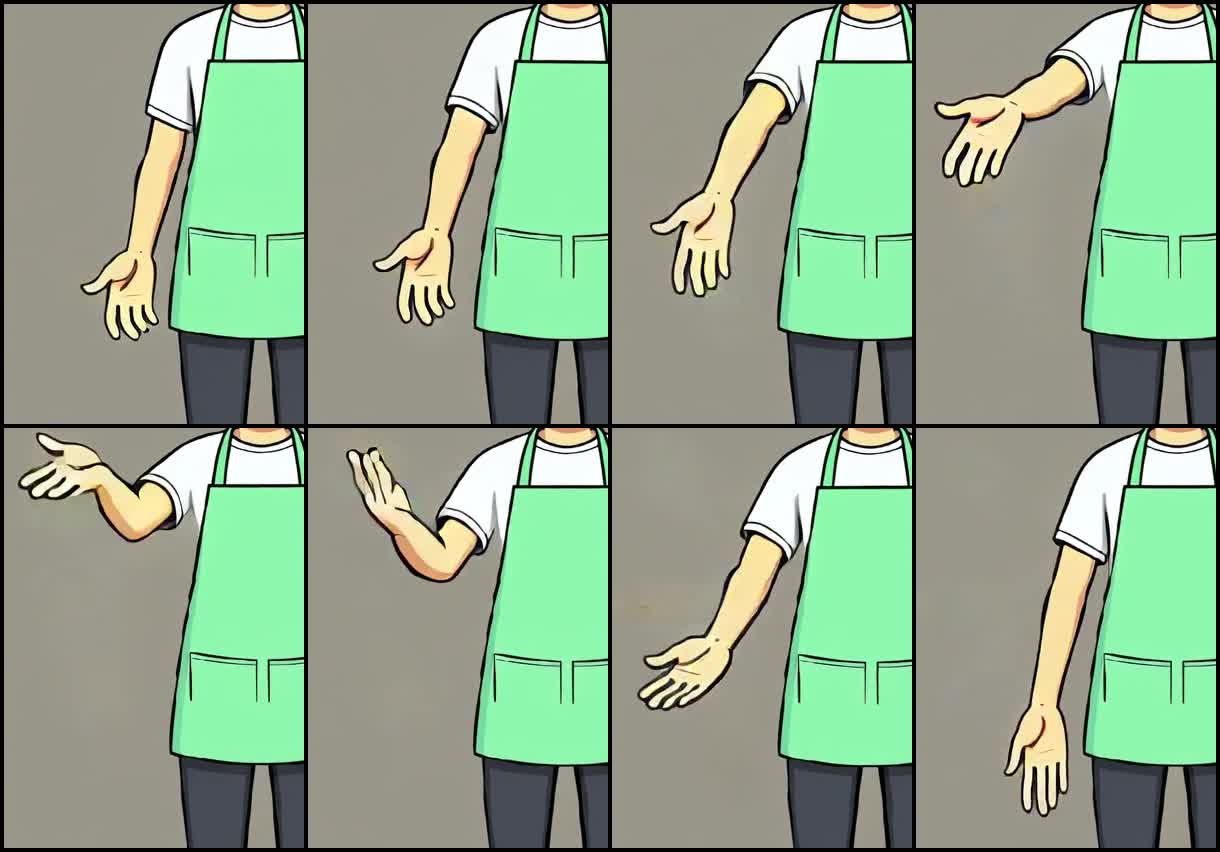
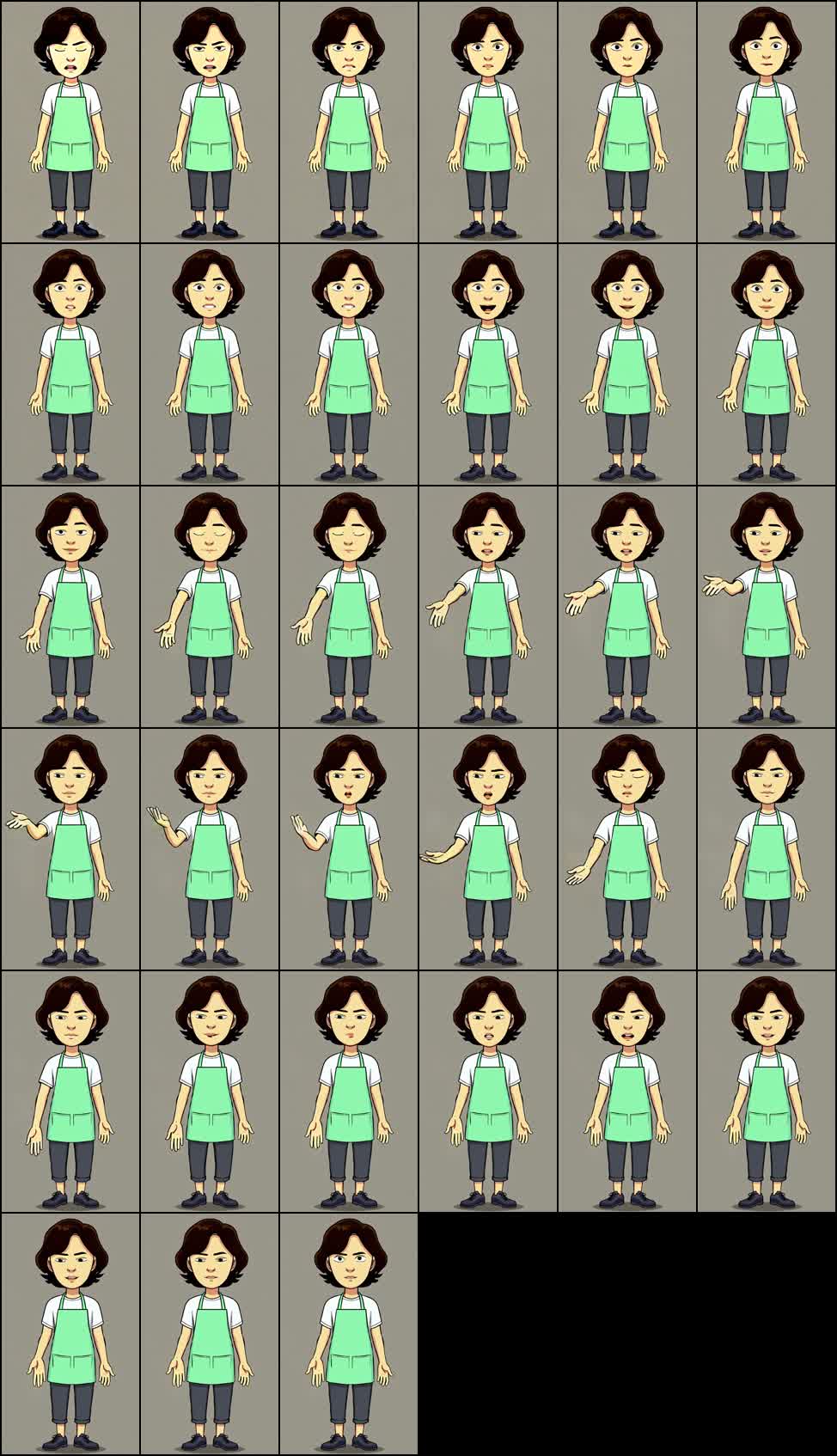
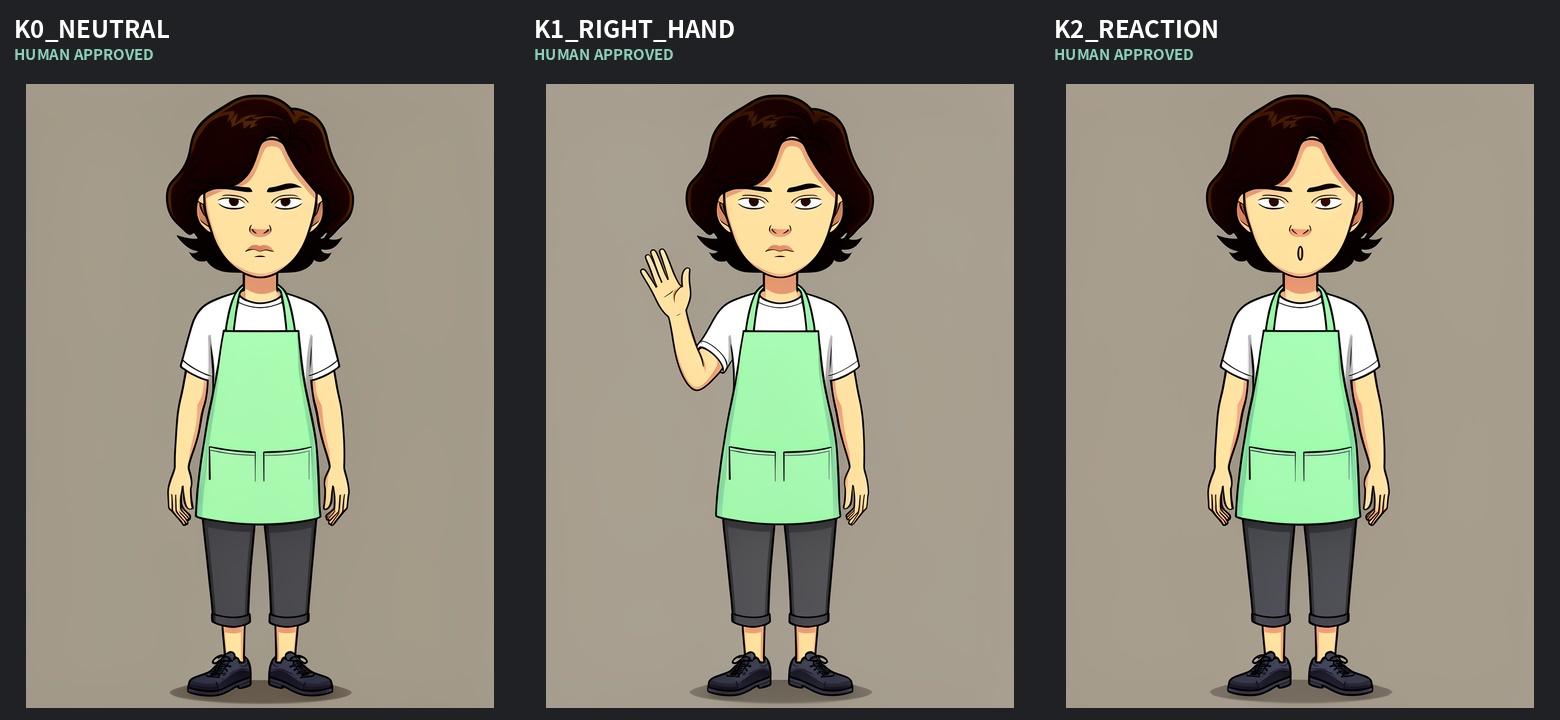
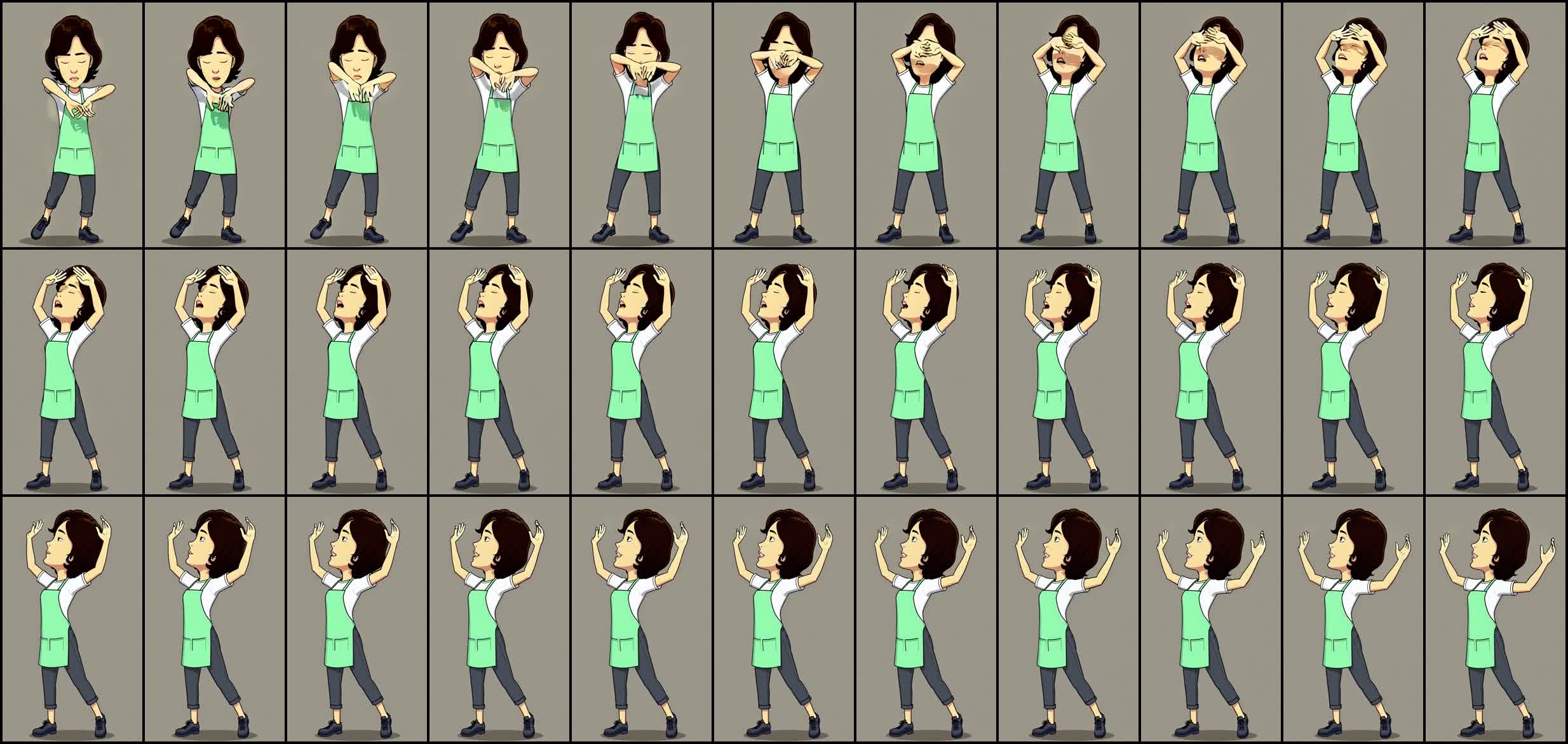
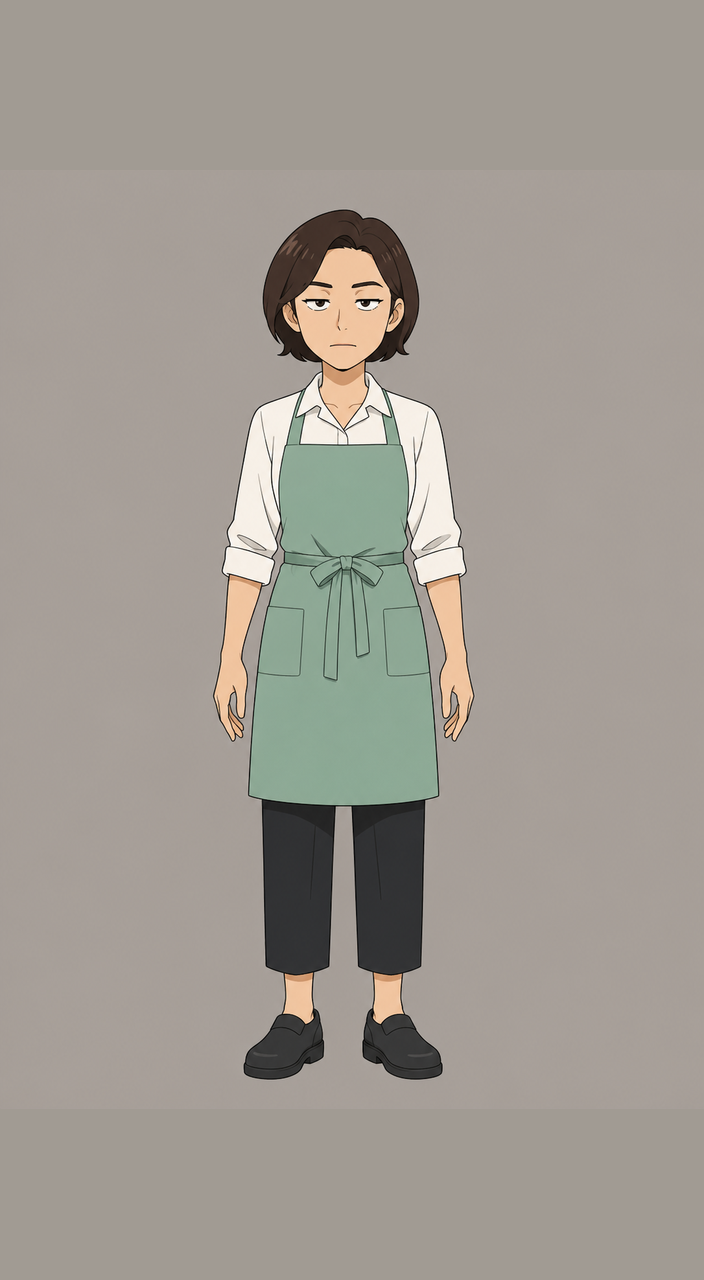
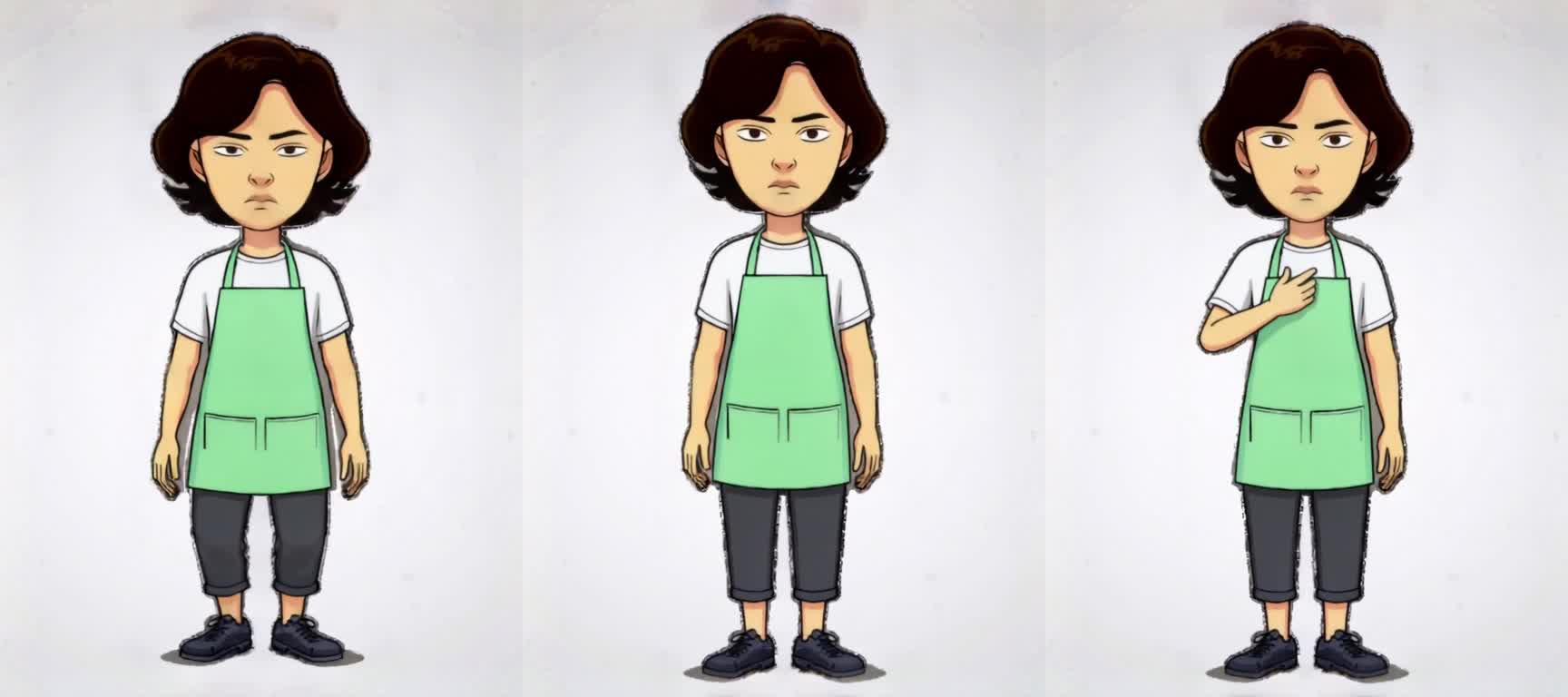
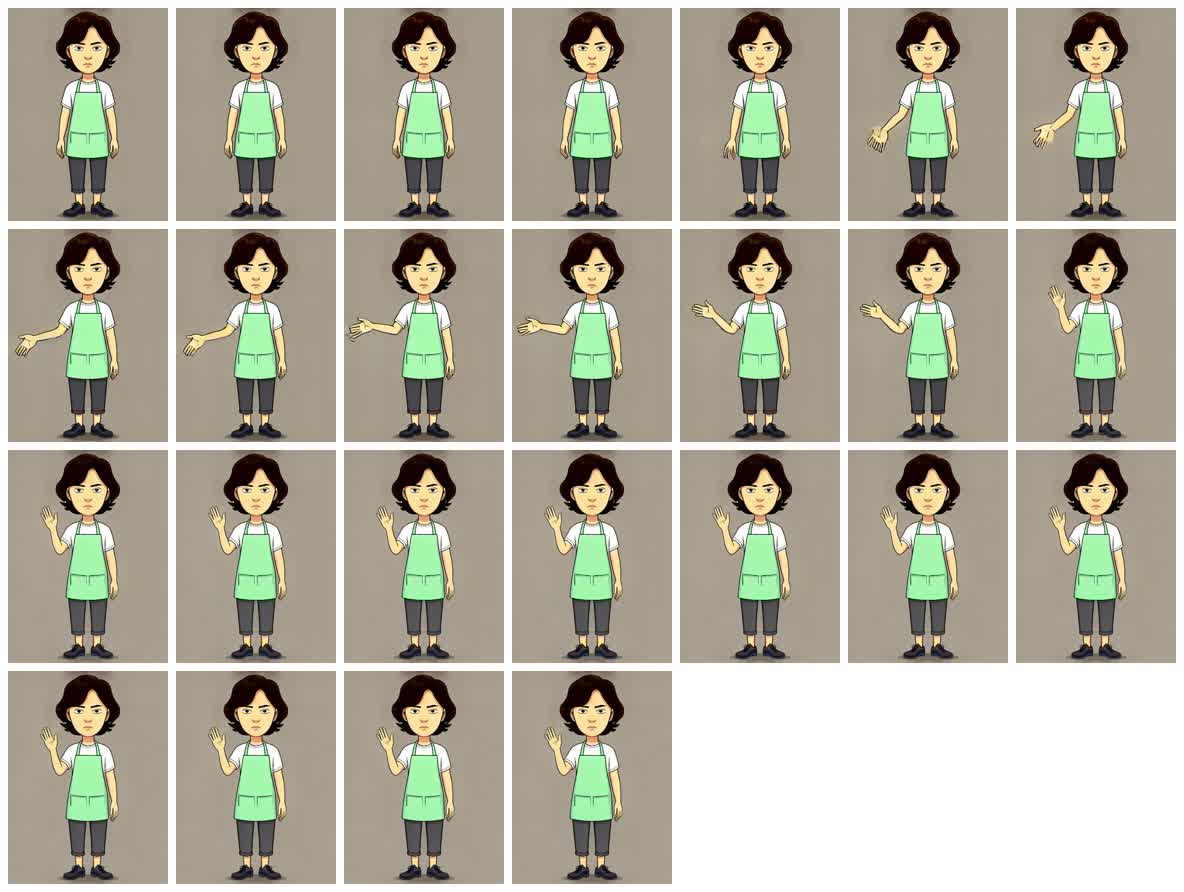
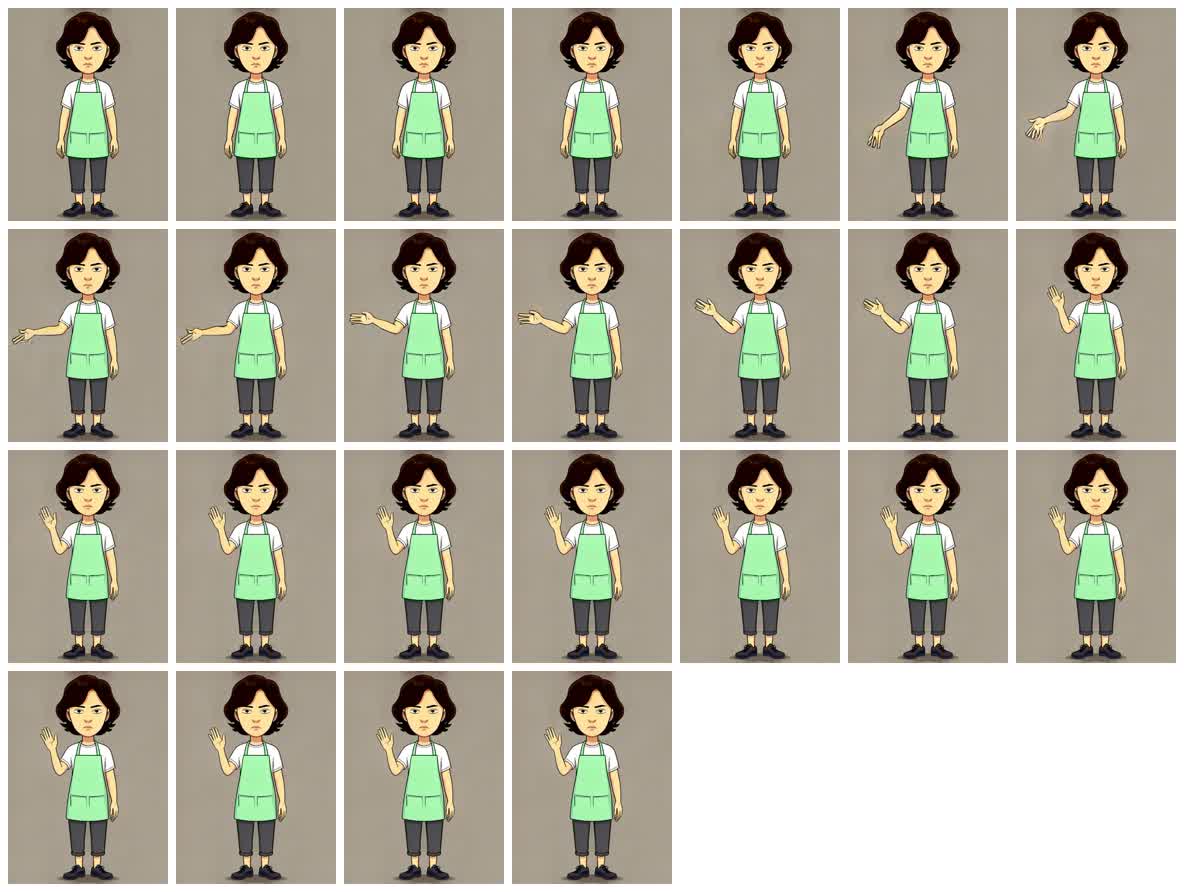
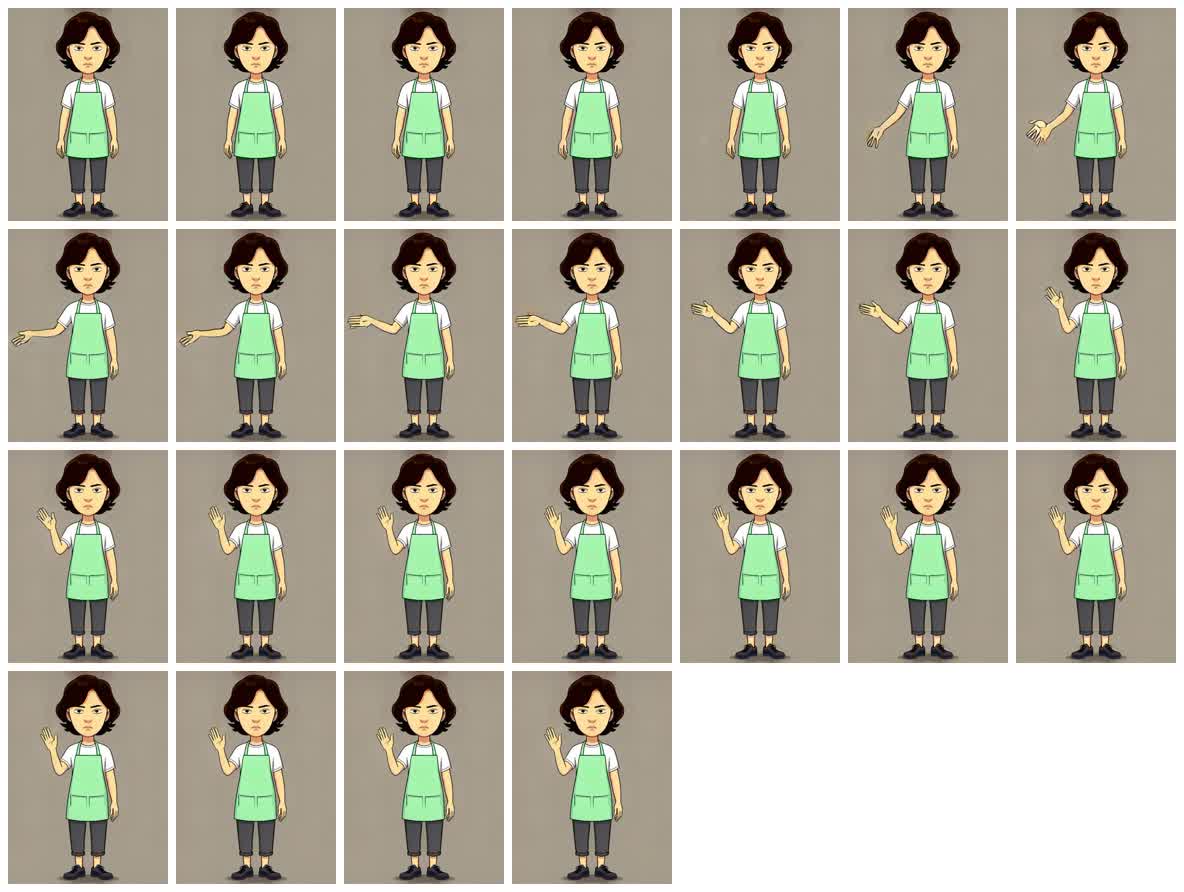
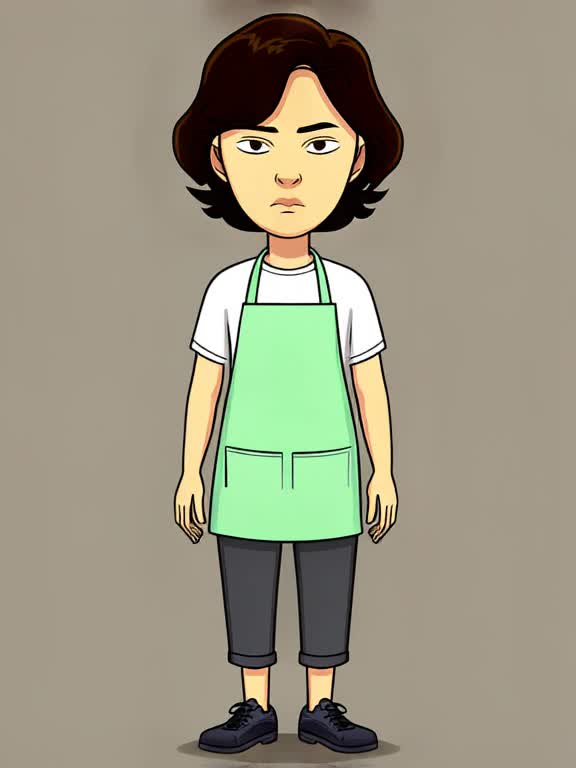
Human approved on 2026-08-05. The 768x1024 references use aspect-preserving center crop for the 512x896 canvas. Production restriction: one separated moderate-speed action per clip; crossed or overlapping hands remain blocked. 33 frames, 16 fps, 8 steps, DPO, seed 42, runtime 8m 36s.
A - Approved Yaco K0 referenceCompare the face shape, eyes, nose, hand proportions, apron, and outline style against the generated clip.
B - One-hand separated driverExactly the same right-hand rise and forward extension used by the approved realistic diagnostic.
C - Ratio-corrected Yaco outputMotion, limb attachment, and hand readability remain stable. Face, shoulders, apron, and legs recover the original width-to-height ratio.
HUMAN APPROVED - REALISTIC C RESTRICTED MOTION
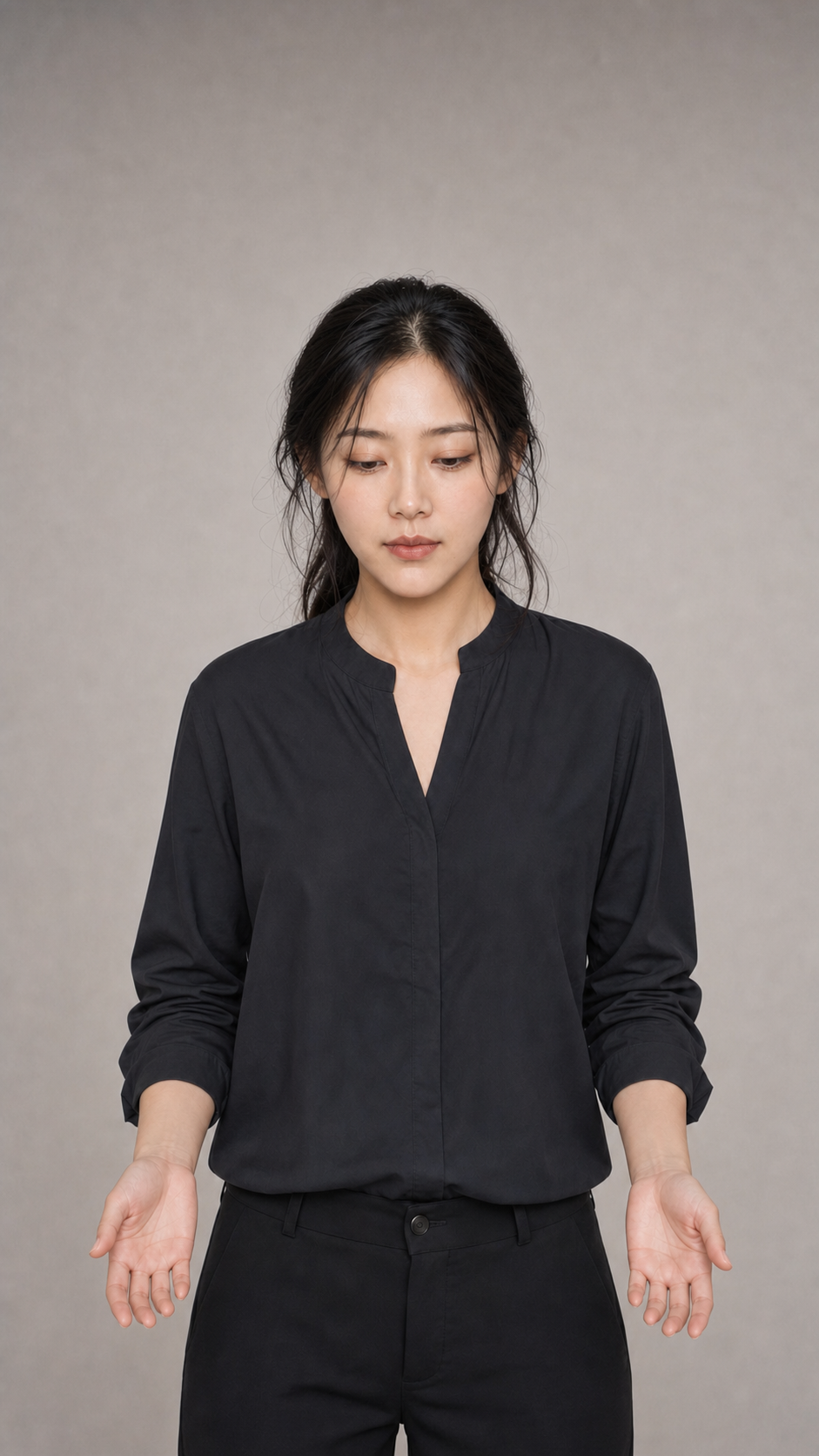
SCAIL-2 Q4 Realistic C one-hand - PASS
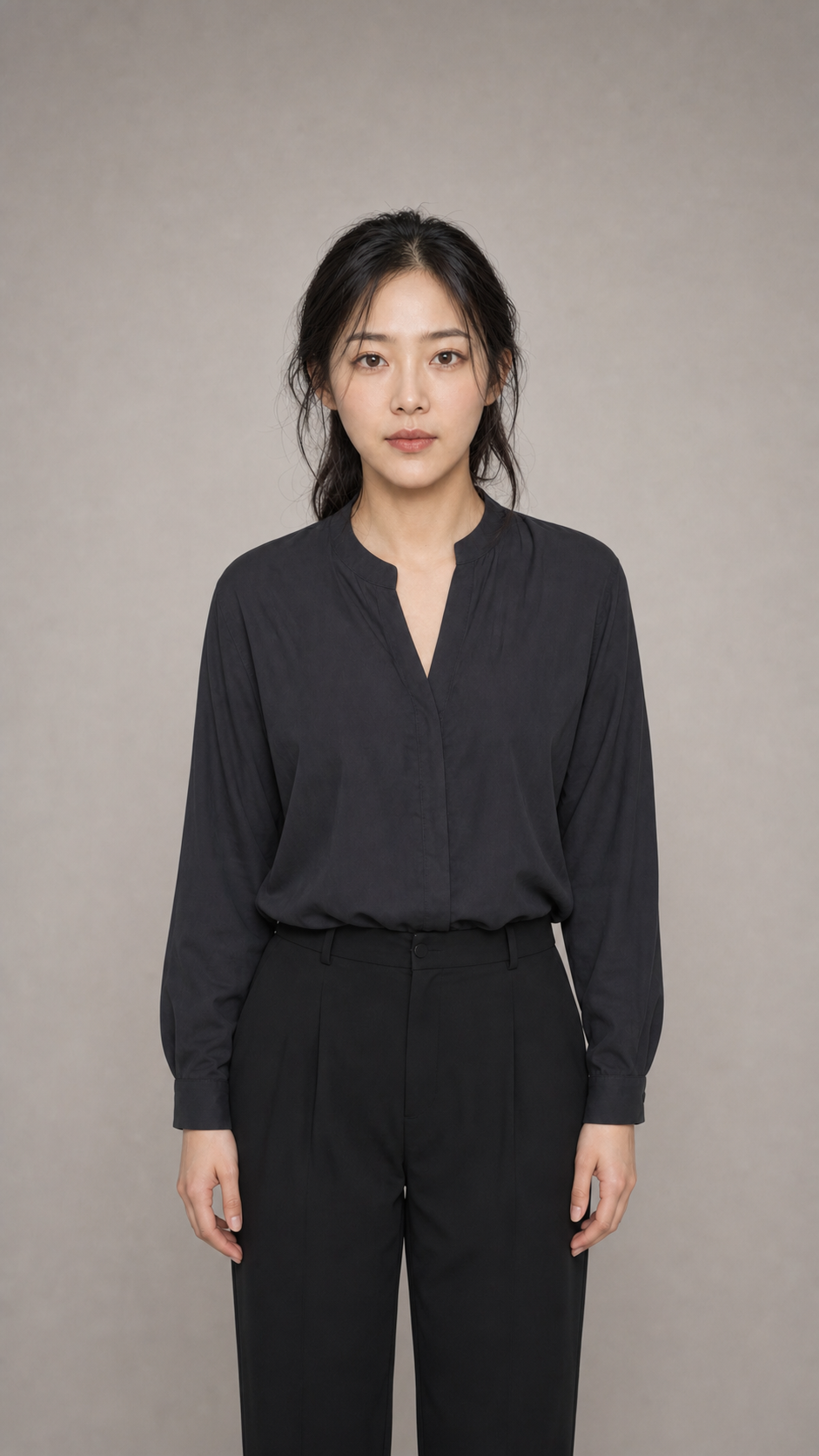
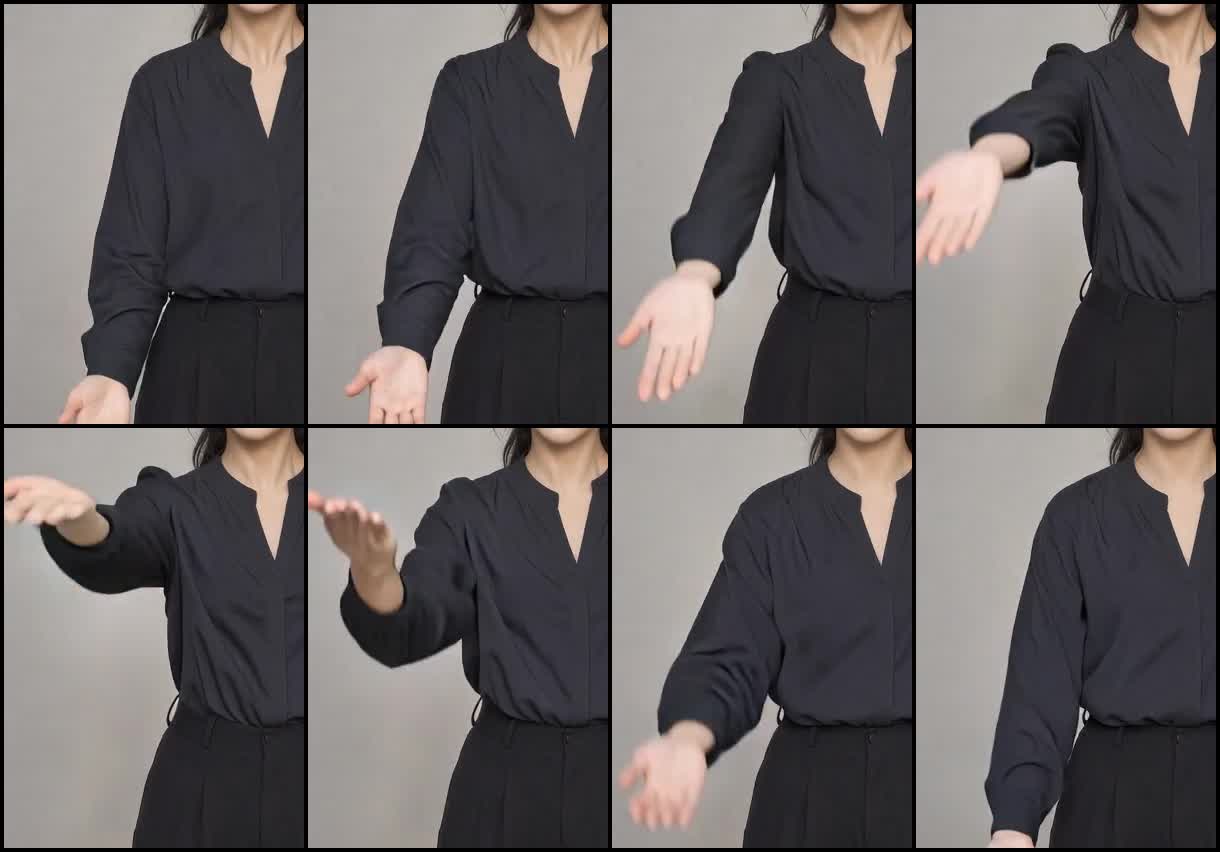
Human approved on 2026-08-05. Production restriction: one separated moderate-speed hand gesture per clip; crossed hands, overlapping hands, and fast palm rotation remain blocked. 512x896, 33 frames, 16 fps, 8 steps, DPO, seed 42, runtime 8m 47s.
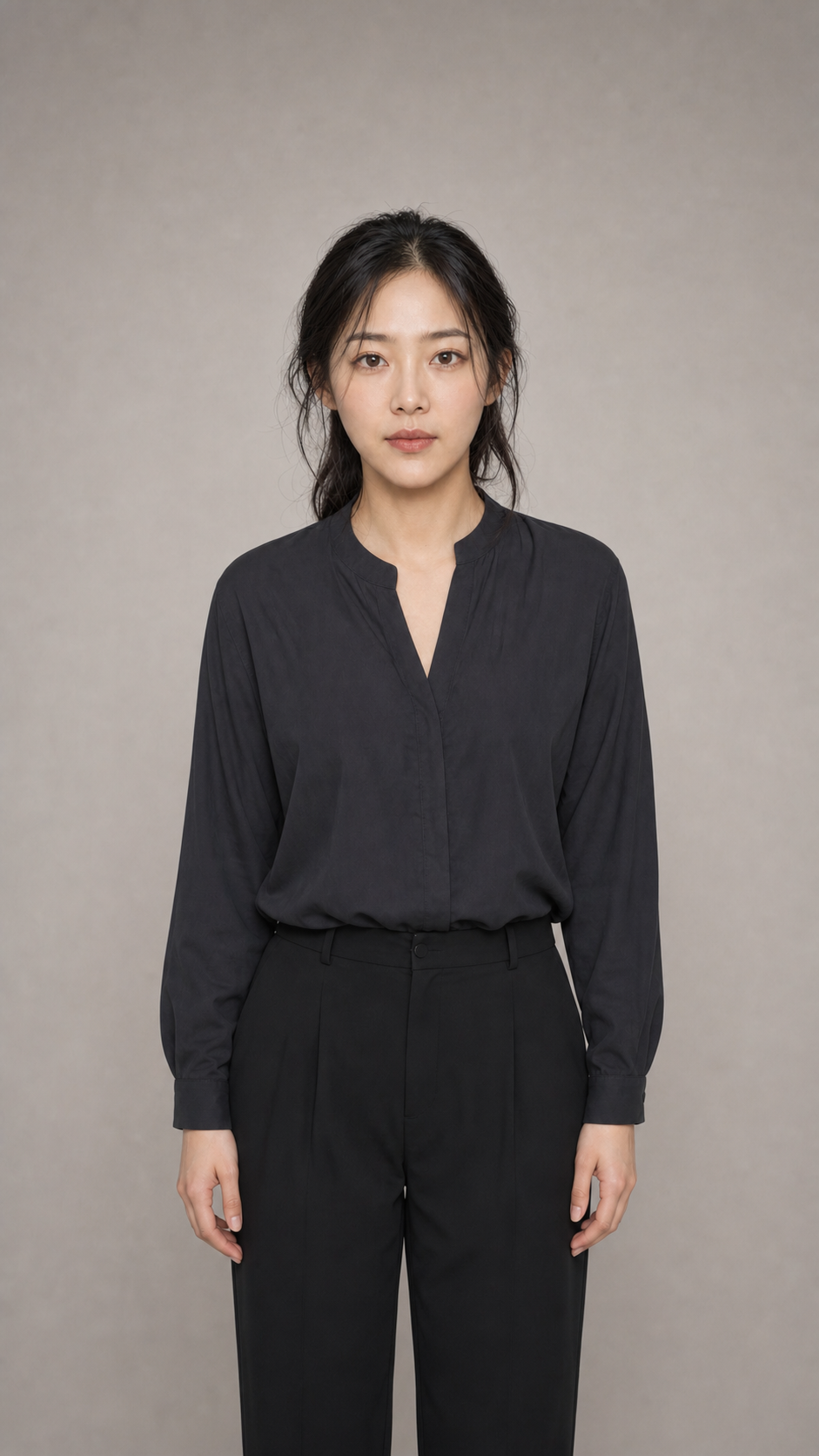
A - Candidate C referenceUnchanged identity, face, clothing, and body references from the previous realistic test.
B - One-hand separated driverOnly the right hand rises and extends. The hands do not cross or overlap.
C - SCAIL-2 diagnostic outputArm and wrist continuity improve substantially. No extra fingers are visible; fast forward motion still softens finger boundaries.
CURRENT VISUAL REVIEW - REALISTIC C HARD MOTION
SCAIL-2 Q4 Realistic C hard-motion - motion/identity pass, hand anatomy fail
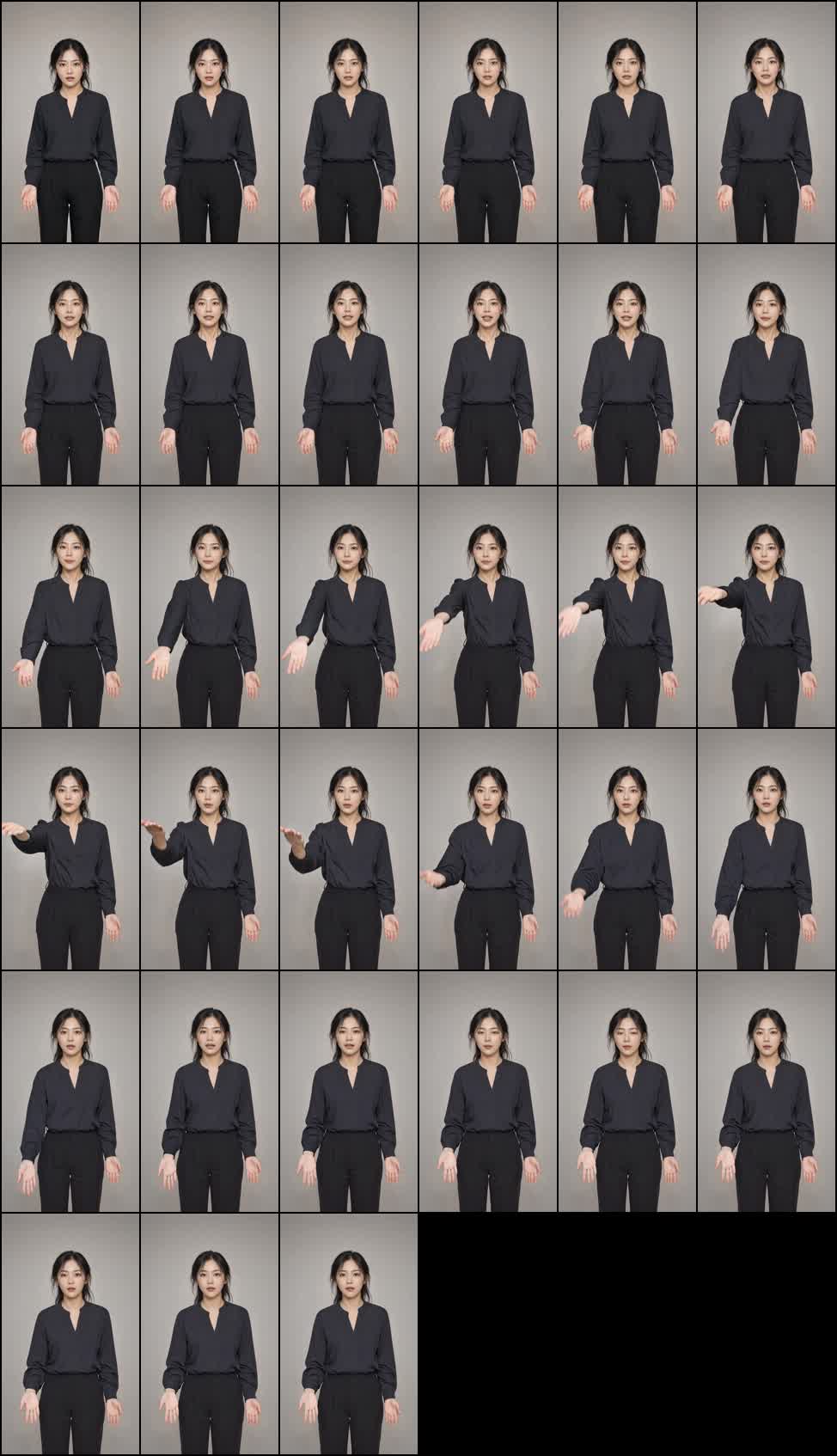
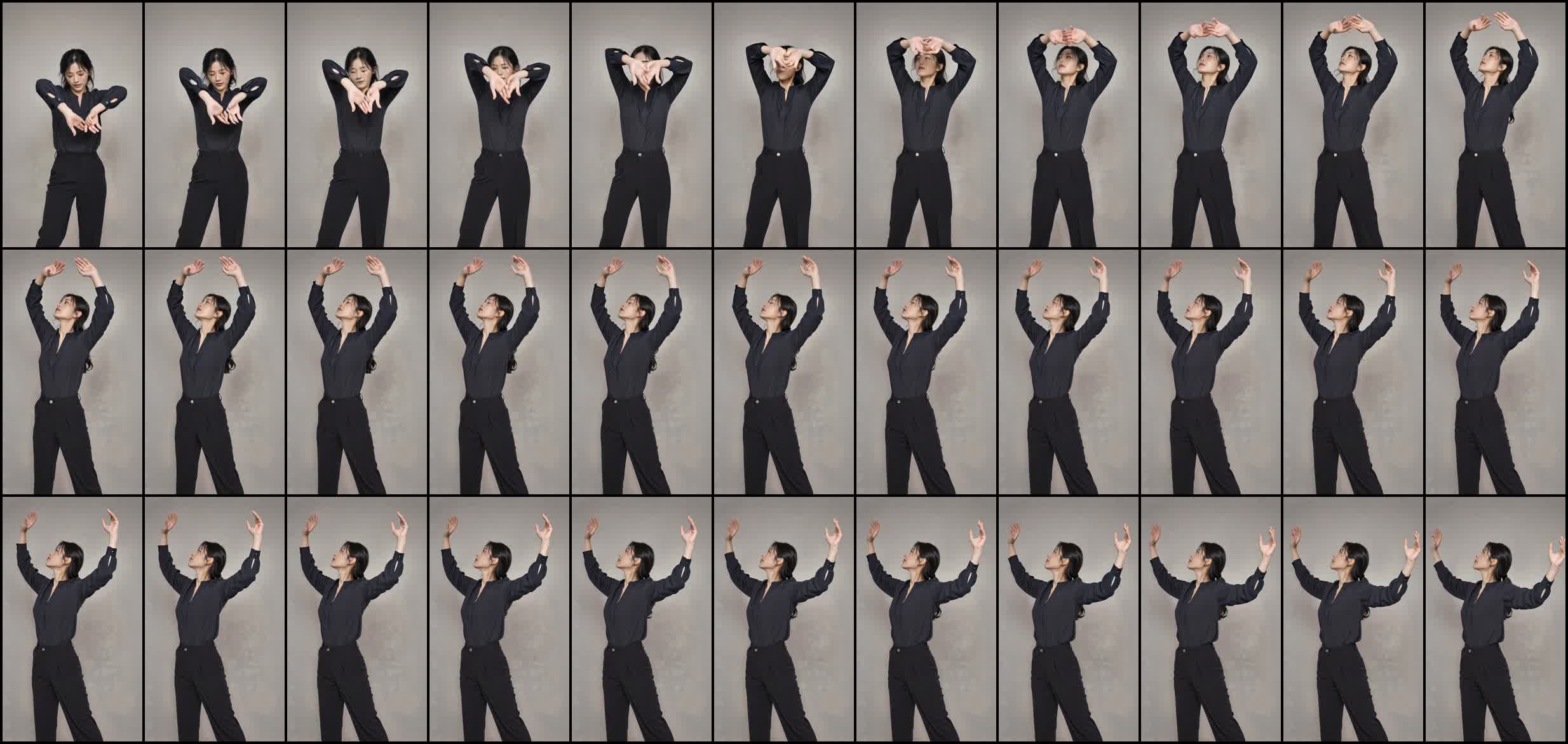
Human review: the source C2 hands have five normal fingers, but fingers deform when the generated hands cross, overlap, and rotate. 512x896, 33 frames, 16 fps, 8 steps, DPO, seed 42, runtime 12m 43s.
A - Candidate C wide-body referencePrimary reference. Existing C1 face close-up and C2 upper-body/hands were also conditioned. The source crops below the thighs, so feet are outside this test.
B - Unchanged hard driving segmentSame 33-frame arm-cross, overhead raise, separation, and torso-turn control used for official and Yaco tests.
C - Realistic C SCAIL-2 outputFace identity, tied hair, shoulders, clothing, body scale, and motion continuity pass. Finger anatomy fails during crossing and overhead rotation.
CURRENT VISUAL REVIEW - YACO HARD MOTION
SCAIL-2 Q4 Yaco multi-reference hard-motion test - pass candidate
H3 is ignored for this build. Character performance stays in LivePortrait frontal dialogue/singing and SING-LOCK-2 subtle sway; background, props, effects, captions, camera crop, and final timing are editor-owned layers.
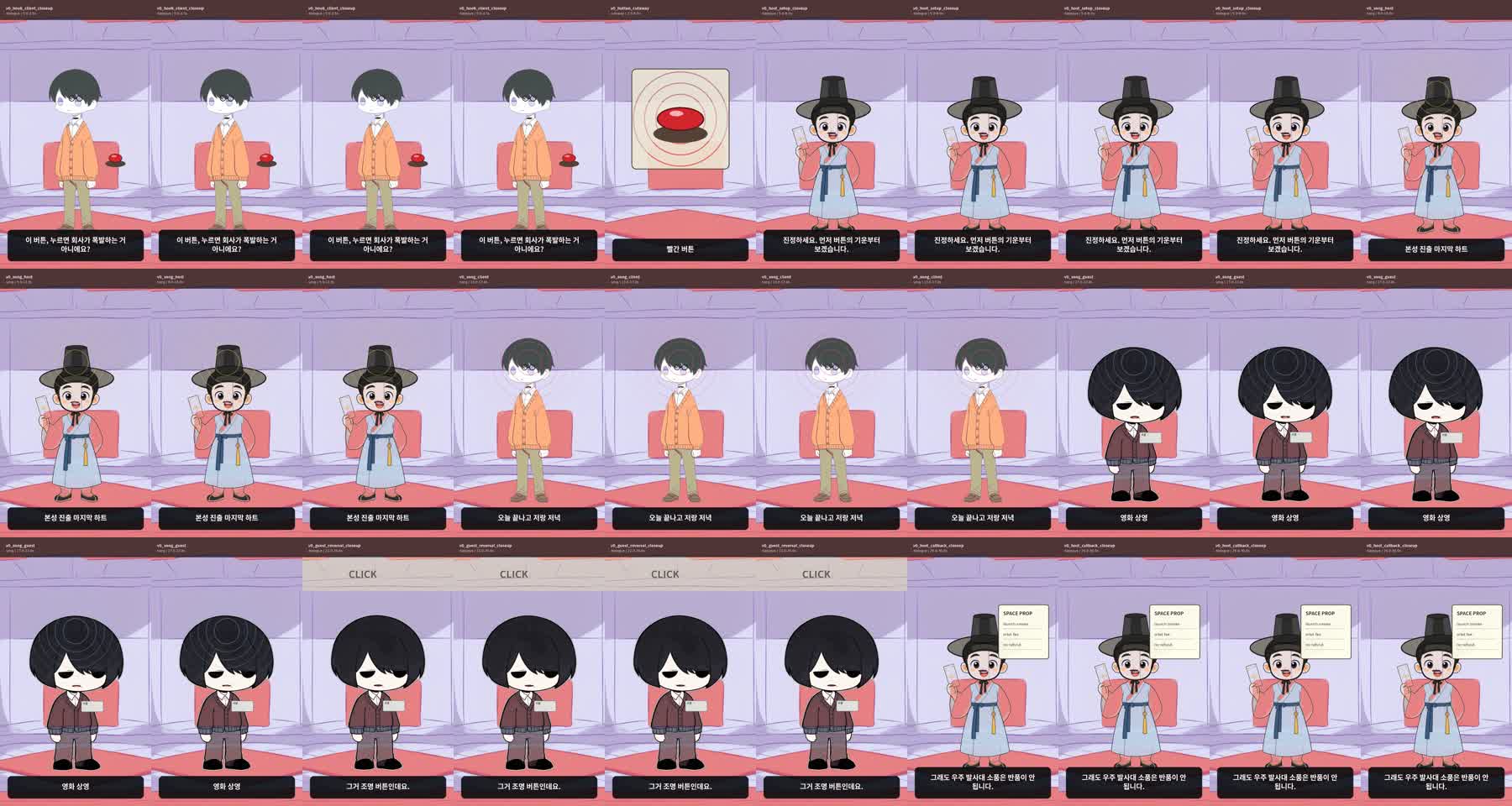
A - actual final v1 MP430.0s actual final pass with script-mapped host/client/guest characters, generated background plate, editor effects, Korean captions, and locked d090_s20260821 song excerpt aligned to the song section.
B - actual final contact sheetOne-second samples across the actual final file. Check character replacement, background, effects, captions, and song section placement.
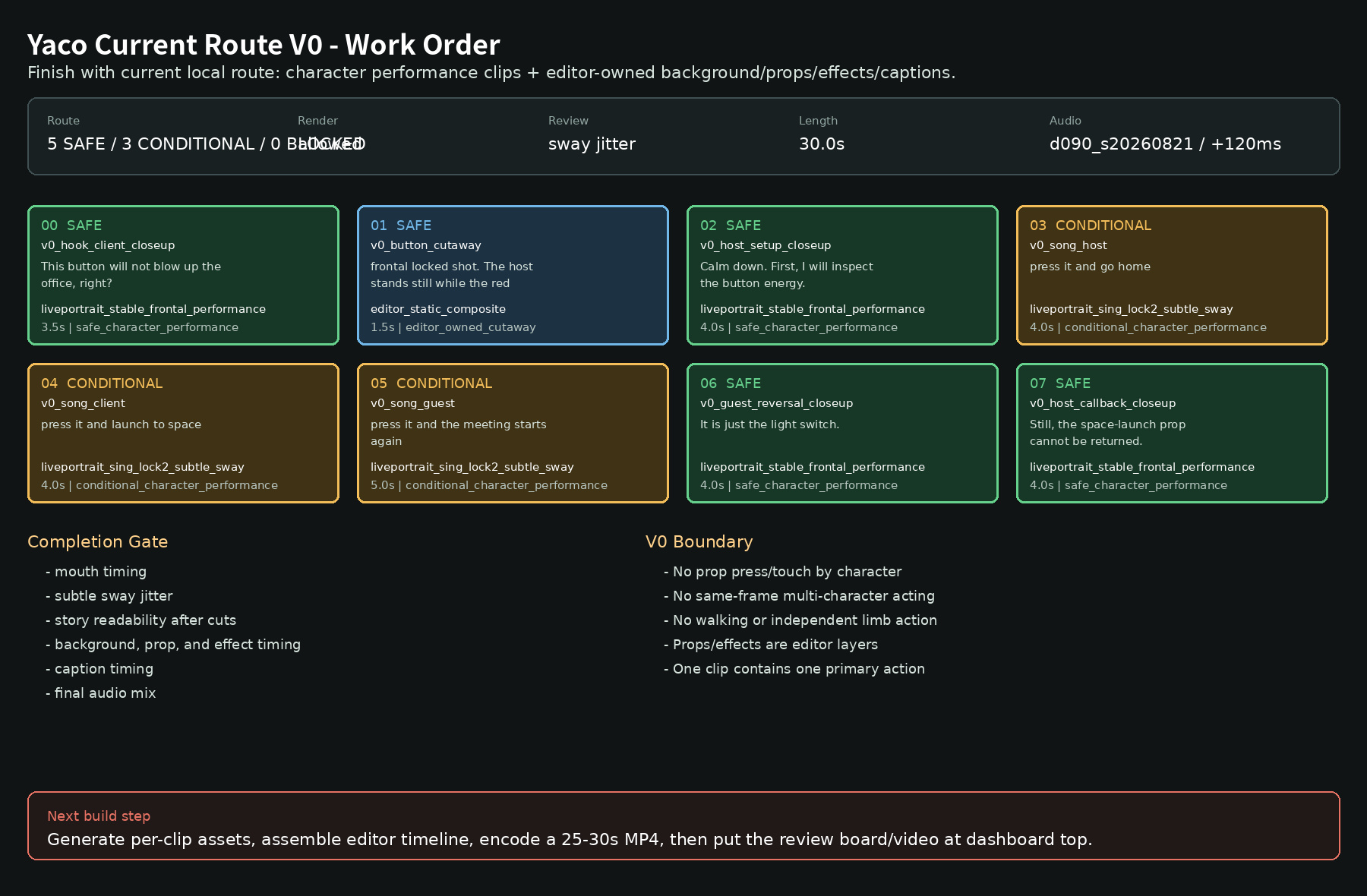
C - work order boardShows the 8 render jobs and which parts belong to LivePortrait versus the editor timeline.
ACTUAL FINAL V1
The current finished file is 30.0s, 1080x1920, 30fps, with script characters, generated background, effects, Korean captions, and locked song excerpt.
LOCAL FIX ONLY
Do not open another quality stage. Fix only visible local issues in this completion file if they are cheap and bounded.
BOUNDARY
No character prop pressing, same-frame multi-character acting, walking, or independent limb gestures in V0. Those beats are cutaways or editor overlays.
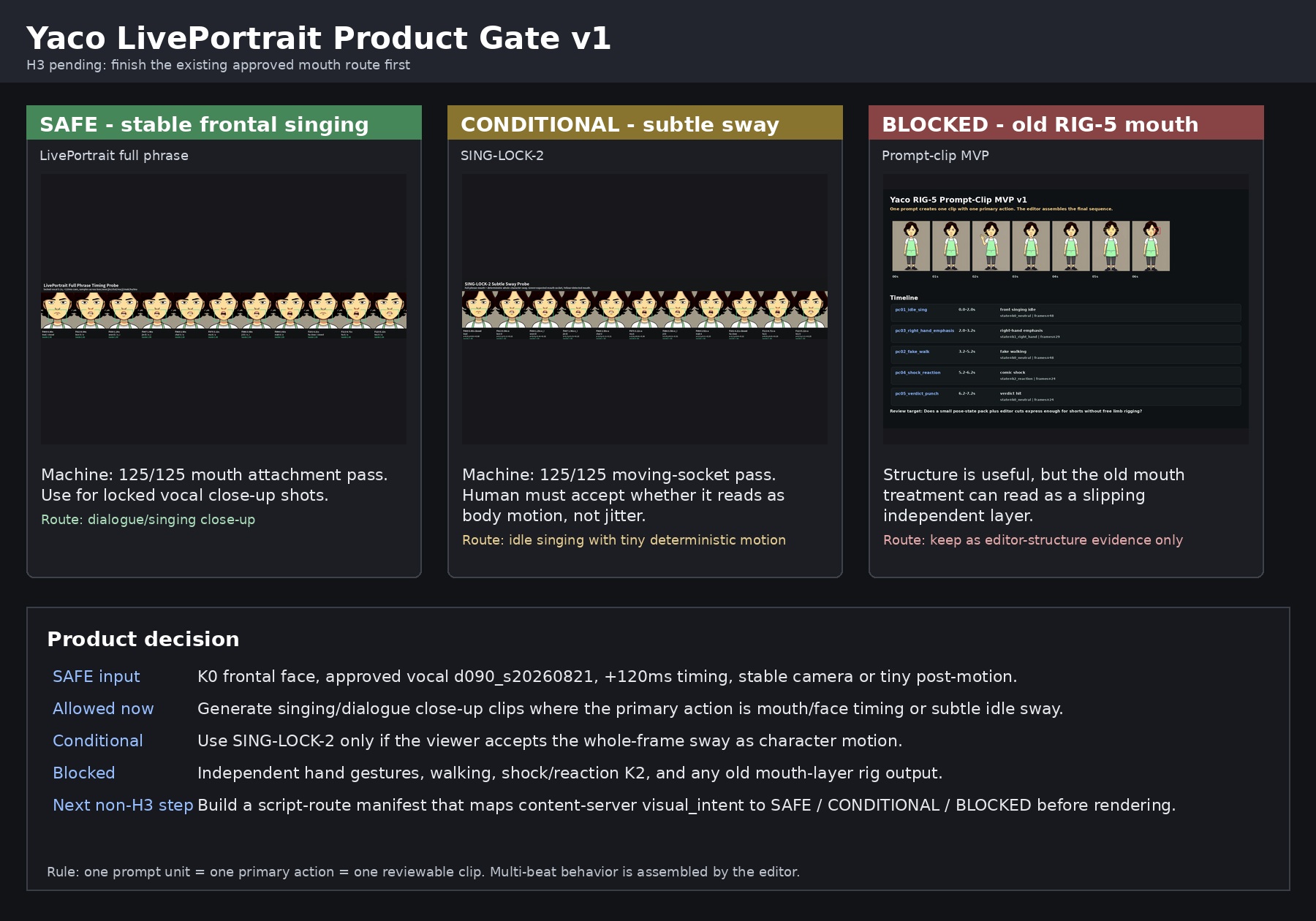
H3 authorization is pending. This board freezes what the existing local route can safely do now: stable frontal singing is safe, subtle sway is conditional, old RIG-5 mouth clips remain blocked.
SAFE
Stable frontal singing/dialogue close-ups using the approved LivePortrait full phrase path. Machine gate: 125/125 mouth attachment pass.
CONDITIONAL
SING-LOCK-2 subtle whole-character sway can proceed only if human review accepts that it reads as body motion rather than jitter.
BLOCKED
Old RIG-5 mouth-layer output, K2 reaction, walking, and independent hand/body gestures are not approved by this route.
This verifies that the approved 5.2s LivePortrait singing mouth remains attached when the whole character is moved slightly. It is deterministic post-motion, not generative body acting.
A - 5.2s audio sway probePrimary review item. Peak motion: x 3px, y 1.4px, rotation 0.32deg.
B - attachment review sheetGreen is expected moving mouth socket; yellow is detected mouth. Samples cover the full phrase.
C - silent sway onlySame frames without audio, for checking whether the sway itself feels acceptable.
Machine gate
PASS_SING_LOCK2_SUBTLE_SWAY_REVIEW_READY. 125/125 frames passed mouth attachment against the moving expected socket.
Human check
Judge whether the subtle movement improves the locked singing shot without looking like camera jitter.
Boundary
This does not approve independent hand gestures or model-generated body motion. Those remain separate one-action clip gates.
Expanded from the short syllable probe to the full 5.2s locked vocal phrase. Uses +120ms viseme delay and stable K0/O/E-I/U/A Yaco heads through native LivePortrait mouth motion.
A - 5.2s audio phrase probe24fps / 125 frames / locked vocal d090_s20260821. This is the primary item to judge now.
B - full phrase review sheetSamples across bon, seon, jin, chul, ma, ji, mak, ha, teu. Green is approved socket; yellow is detected mouth.
C - silent motion onlySame 5.2s frames without audio, useful for judging whether mouth motion itself feels stuck to the face.
CURRENT REVIEW - LIVEPORTRAIT SYLLABLE TIMING PROBE
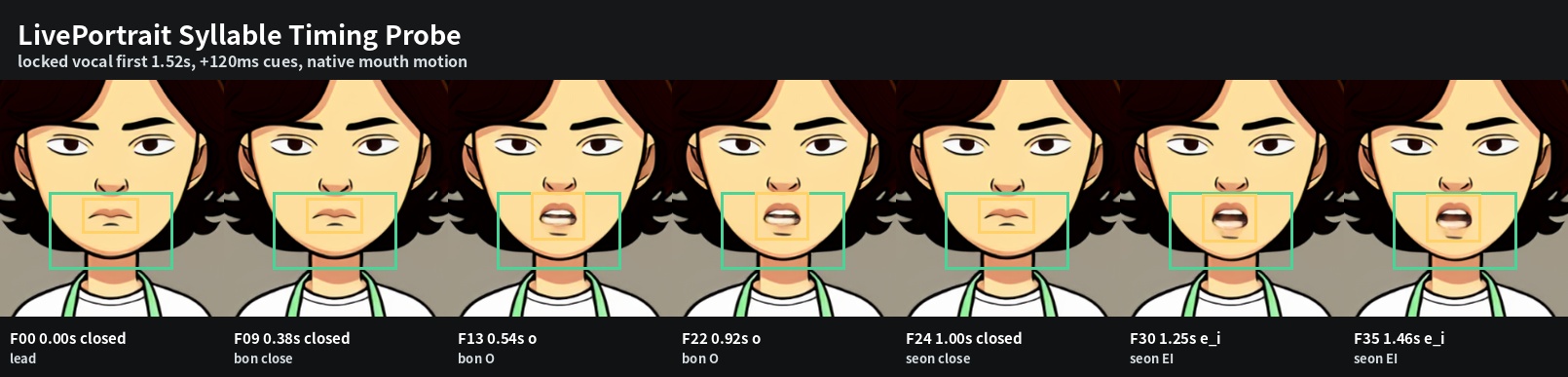
Locked vocal first 1.52s with native mouth motion
This uses the locked vocal d090_s20260821, the approved +120ms viseme delay, and stable K0/O/E-I Yaco heads. Review whether the mouth remains attached while following the sung syllable timing.
A - 1.52s audio timing probe24fps / 36 frames / first locked vocal phrase. This is the primary item to judge.
B - mouth detail sheetSampled frames: lead closed, bon O, seon E-I. Green is approved socket; yellow is detected mouth.
C - silent motion onlySame frames without audio, useful for judging whether the mouth floats or sticks.
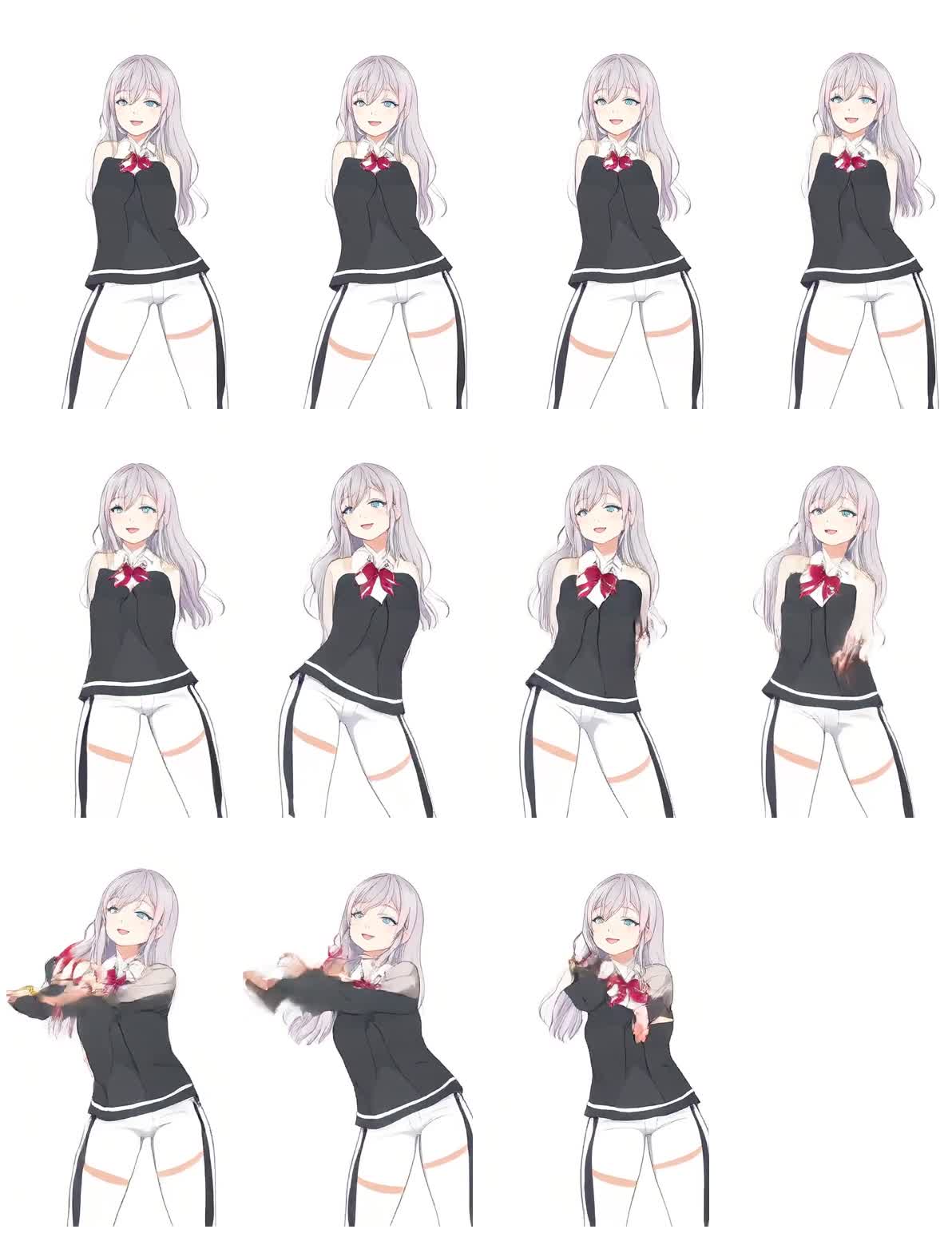
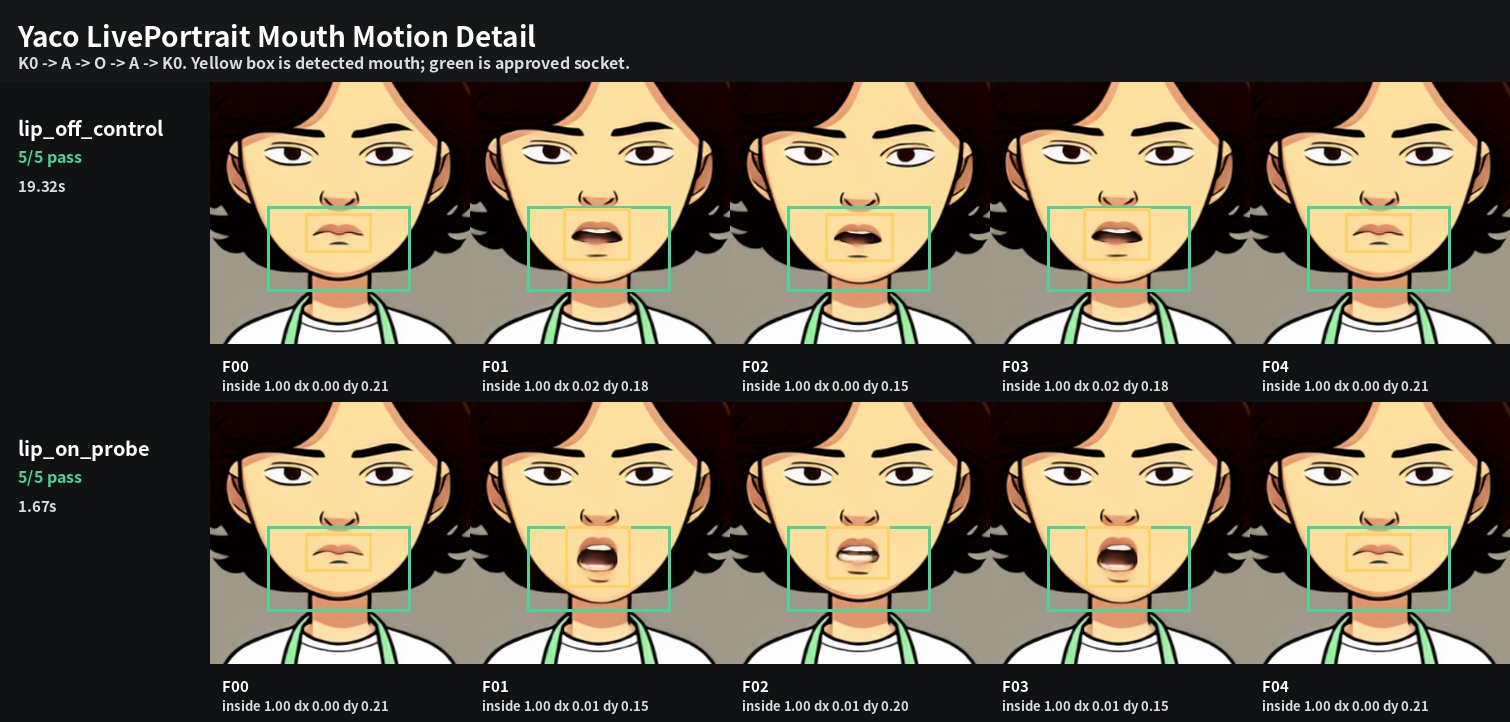
K0/A/O mouth motion stays attached in a 5-frame native probe
Stable K0, A, O, A, K0 heads were run through ComfyUI-LivePortraitKJ directly, without restarting the current ComfyUI service. This is a short recognition and integration probe, not final production approval.
A - lip_on native motion5 frames / 8 fps / K0 -> A -> O -> A -> K0. Use this first for visual mouth attachment.
B - mouth detail comparisonTop row is lip_off control, bottom row is lip_on. Green is approved socket; yellow is detected mouth.
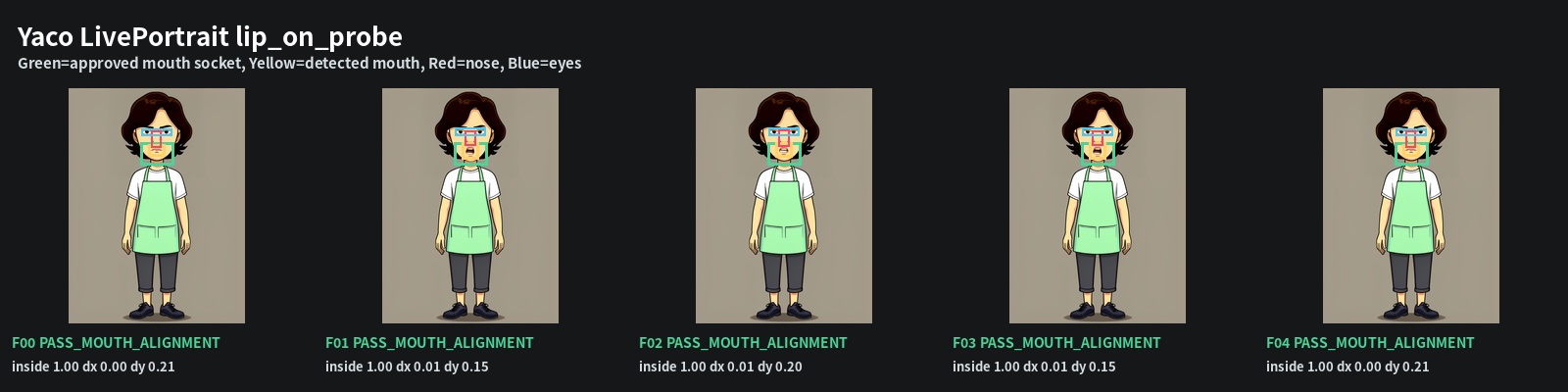
C - full-body contact sheetConfirms the detector remains on the face/mouth region across the whole character frame.
Please judge whether the open-mouth frames read as attached to the face rather than a floating layer. If accepted, expand to a short syllable-timed clip.
Boundary
K2 remains rejected for native mouth probing. This route is allowed only for stable K0/A/O-style shots until wider pose states pass recognition.
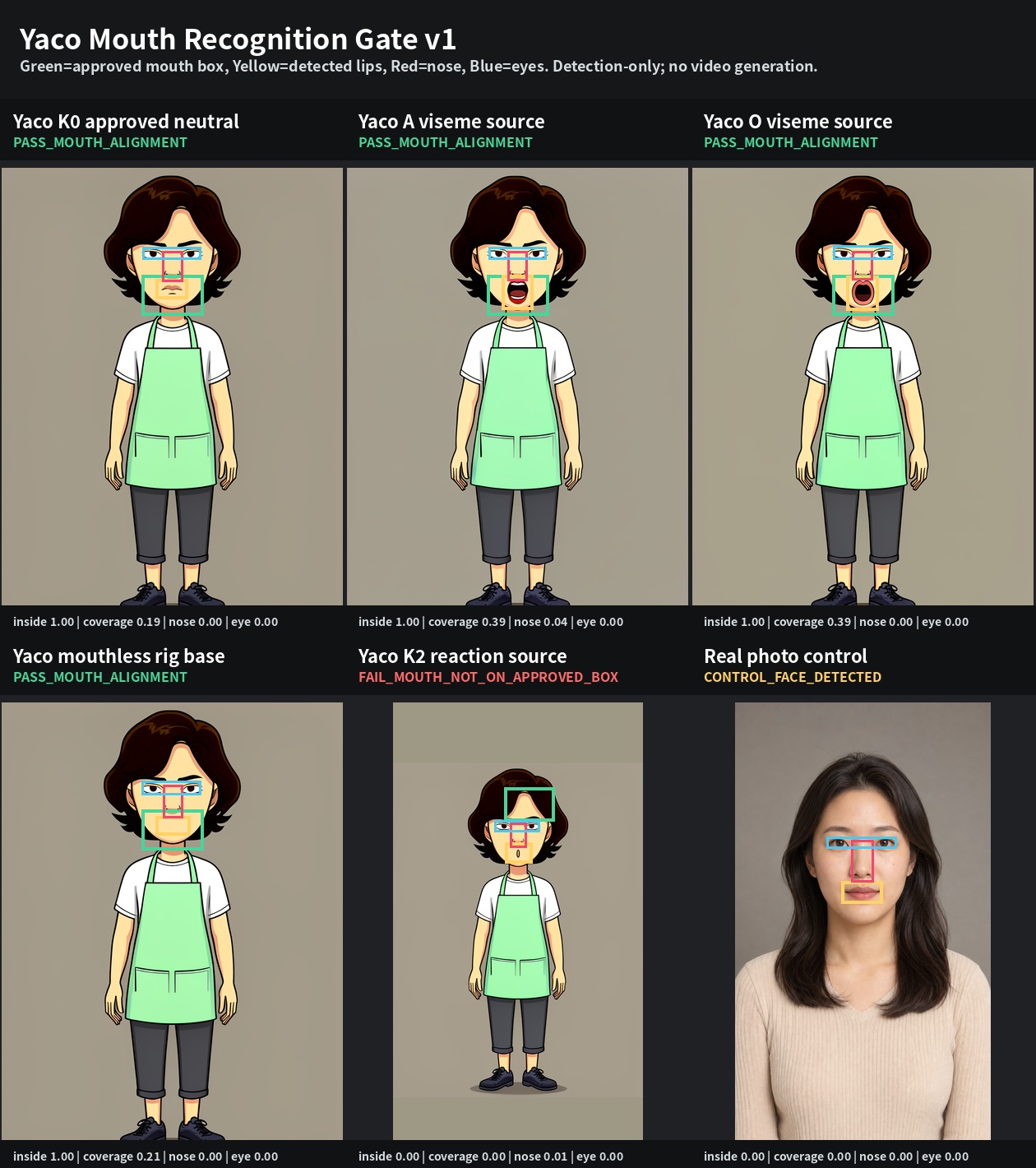
Stable Yaco K0/A/O mouth alignment passes; K2 reaction still fails
Detection-only probe using ComfyUI-LivePortraitKJ FaceAlignment + BlazeFace back camera. Green is the approved mouth socket, yellow is detected lips, red is nose, blue is eyes. This checks alignment before any video generation.
Decision
ALLOW_STABLE_K0_AO_PROBE_REJECT_K2. Native mouth probing is allowed only for stable K0/A/O-style close shots, not K2 reaction shots.
Observed
K0, A, O, and mouthless base place detected lips inside the approved socket. K2 detects an incorrect lower region as the mouth.
Boundary
This explains why the last attached-mouth clip could work: attachment can pass on stable head states while detector recognition still fails on some pose/expression states.
This clip remains useful as workflow evidence, but it is not a visual approval candidate. The mouth patch appears independent/slipping, so mouth recognition and integration must be gated first.
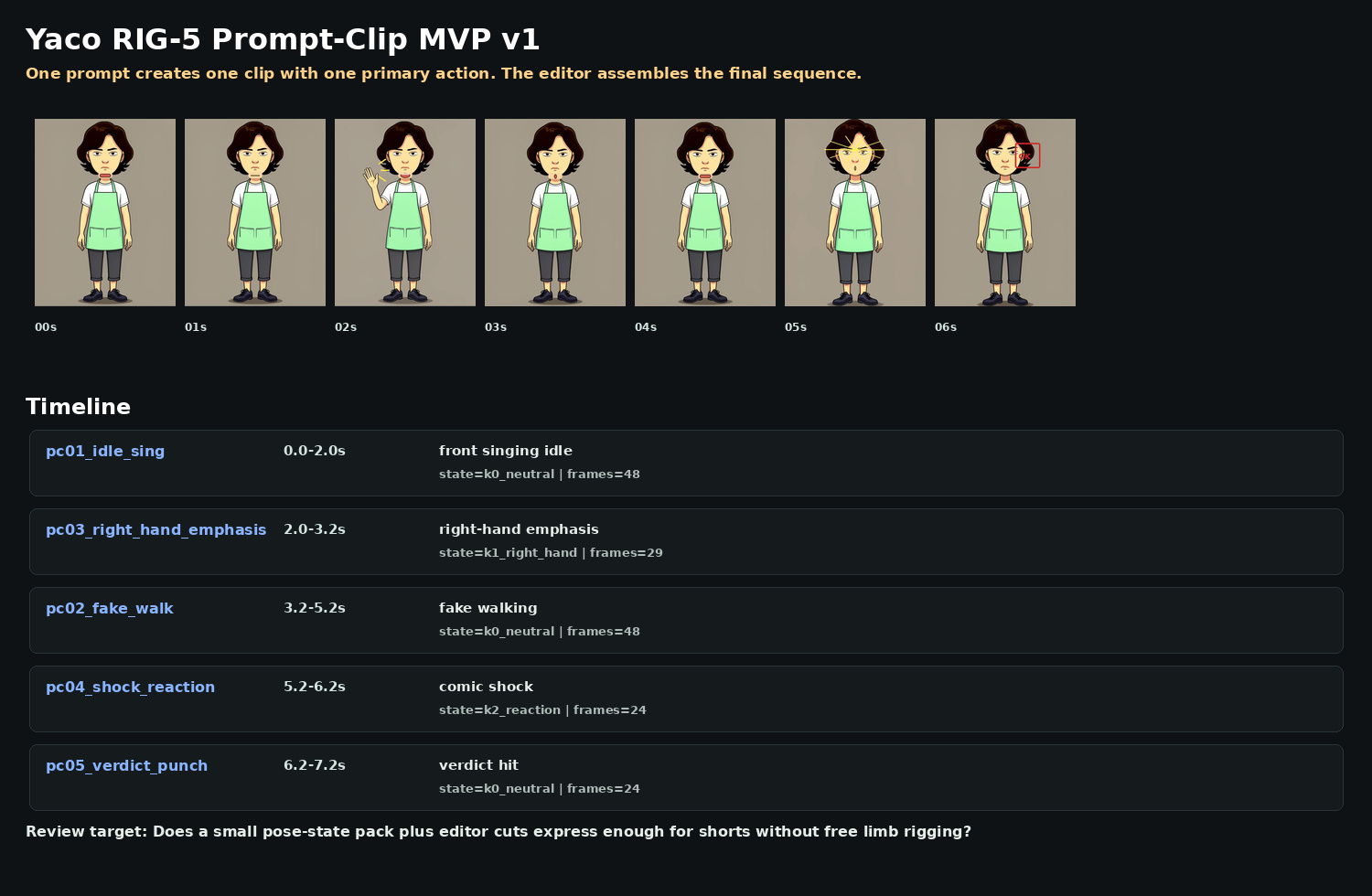
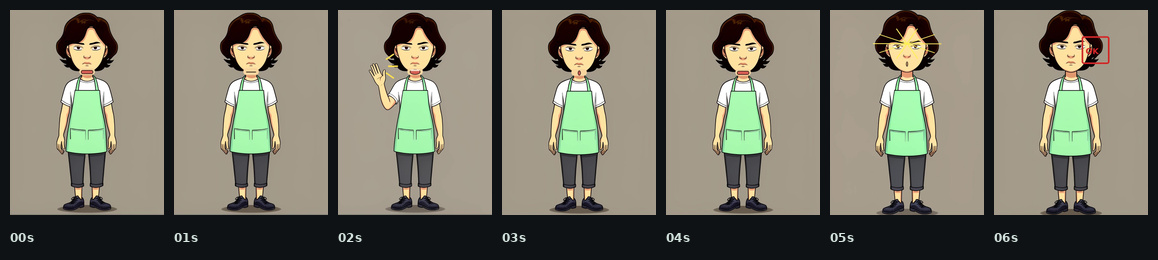
A - Assembled MVP with locked audio7.208s / 768x1024 / pc01 -> pc03 -> pc02 -> pc04 -> pc05. Review whether pose-state clips express enough for shorts.
B - MVP boardShows one-second samples and the editor timeline for each one-action clip.
C - Contact sheetUse this to judge state switches, fake walk, reaction, and verdict readability.
Hold reason
Do not advance to cleaner final state art until the mouth recognition gate is passed or deterministic head-state integration is explicitly selected.
Structure
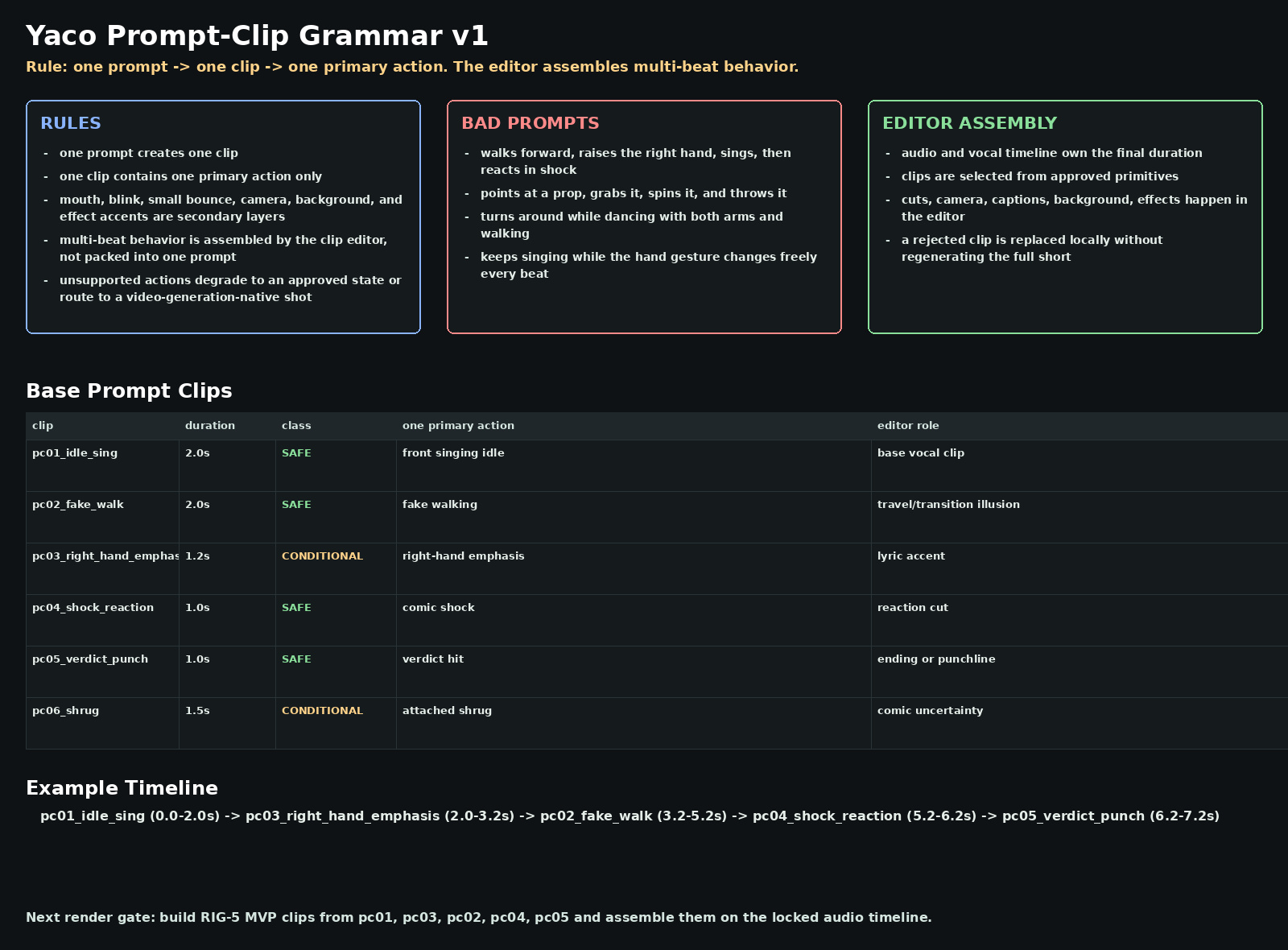
One prompt creates one clip with one primary action; the editor assembles the full sequence on locked audio.
Rejected symptom
The current mouth treatment can read as a separate layer. Treat this as a failed mouth-integration sample.
RIG-5 and video-generation-native shots both follow the same rule: a prompt unit may contain exactly one primary action. Multi-beat behavior is assembled by the editor timeline.
A - Prompt-clip grammar boardDefines allowed prompt units, rejected multi-action prompts, base clip primitives, and an example editor timeline.
Clip unit
One prompt, one clip, one primary action. Mouth, blink, small bounce, background, camera, and effects are secondary layers.
Editor role
The editor assembles idle singing, hand emphasis, fake walk, shock reaction, and verdict punch into the final beat sequence.
Blocked
Prompts that combine walking, singing, hand raise, prop action, and reaction in one generation unit are rejected.
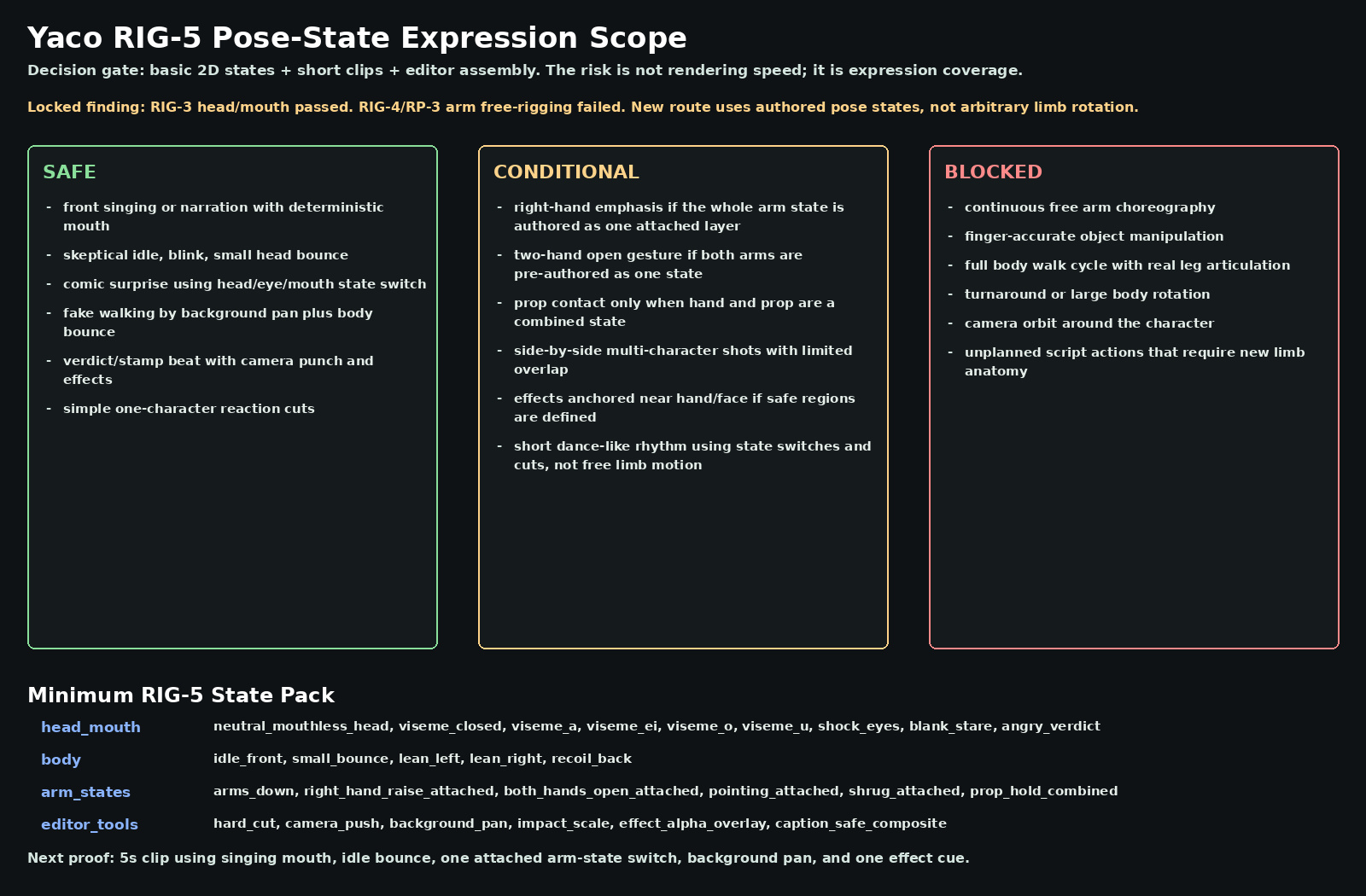
RIG-3 proved head and mouth control. RIG-4/RP-3 failed on free arm/body rigging. The next product route is a small approved pose-state pack, short deterministic clips, and editor assembly.
A - Expression scope boardSafe, conditional, and blocked action classes for mapping script-server requests to approved 2D states.
Safe default
Front singing, narration, reaction cuts, fake walking, verdict beats, camera punch, background pan, and deterministic mouth.
Conditional
Hand gestures only if the whole arm/prop is authored as one attached state. No loose limb rotation.
Blocked
Continuous arm choreography, finger-accurate props, real walk cycles, turnarounds, camera orbit, and arbitrary new limb anatomy.
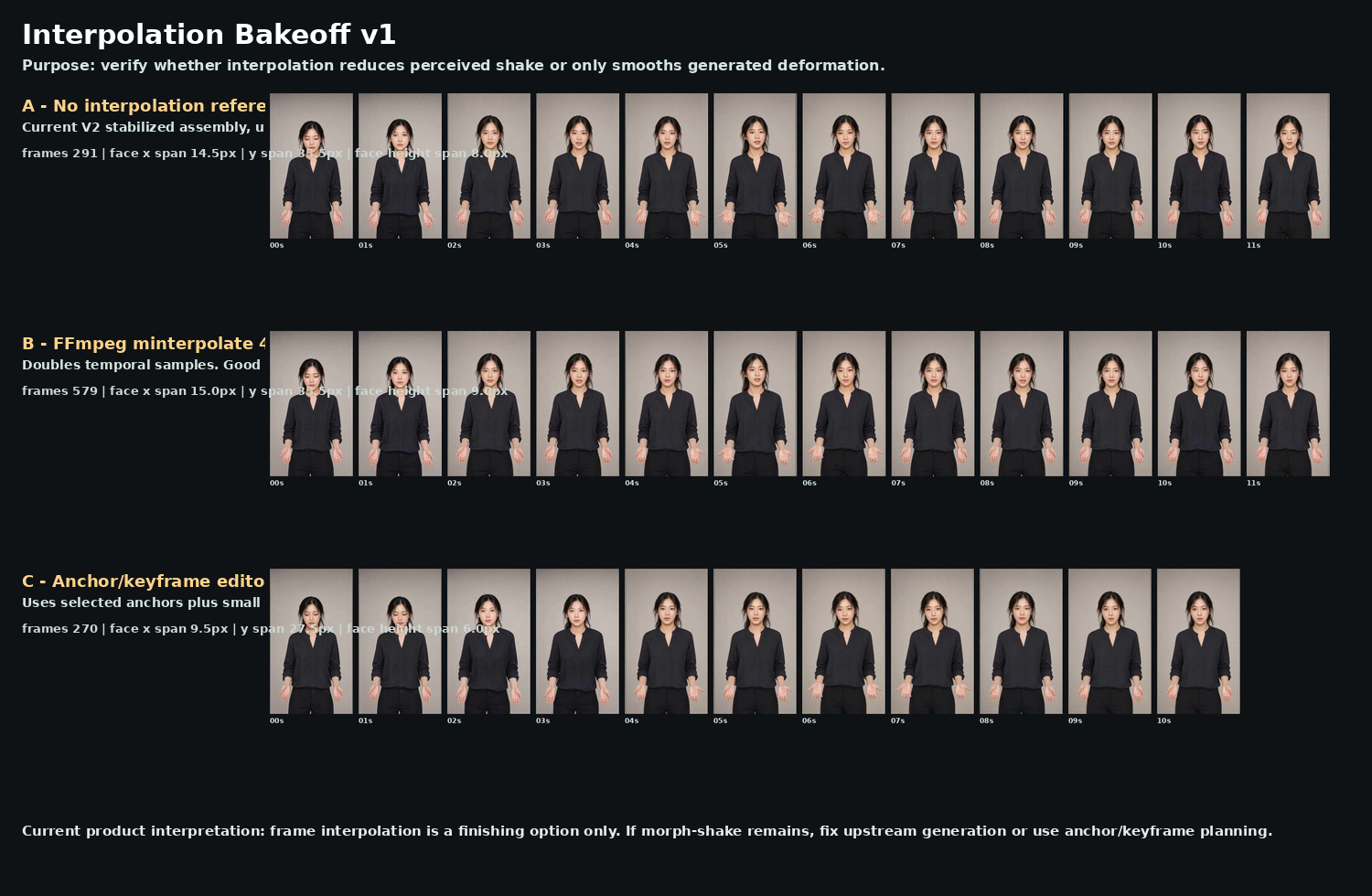
A is the current stabilized assembly. B applies FFmpeg minterpolate at 48fps. C is an editor-only anchor/keyframe baseline. This checks whether interpolation actually fixes shake or only smooths generated deformation.
A - No interpolation referenceCurrent V2 stabilized assembly. Use as baseline for perceived body and hand shake.
B - 48fps interpolationTemporal interpolation only. If morph-shake looks smoother but still present, this cannot be the primary fix.
C - Anchor/keyframe editor baselineStable anchors with editor-only holds. This shows the stability ceiling, but motion may be too limited.
D - Bakeoff boardContact sheets and face-box metrics. B did not reduce face span versus A; C is more stable but less animated.
Current read
Interpolation should not be treated as the main shake fix. It changes temporal smoothness, not generated body/hand deformation.
Use later
Keep interpolation as final polish only after the source clip is already stable.
Next research
Move upstream: shorter generated motions, cleaner first frame, and anchor/keyframe clip planning.
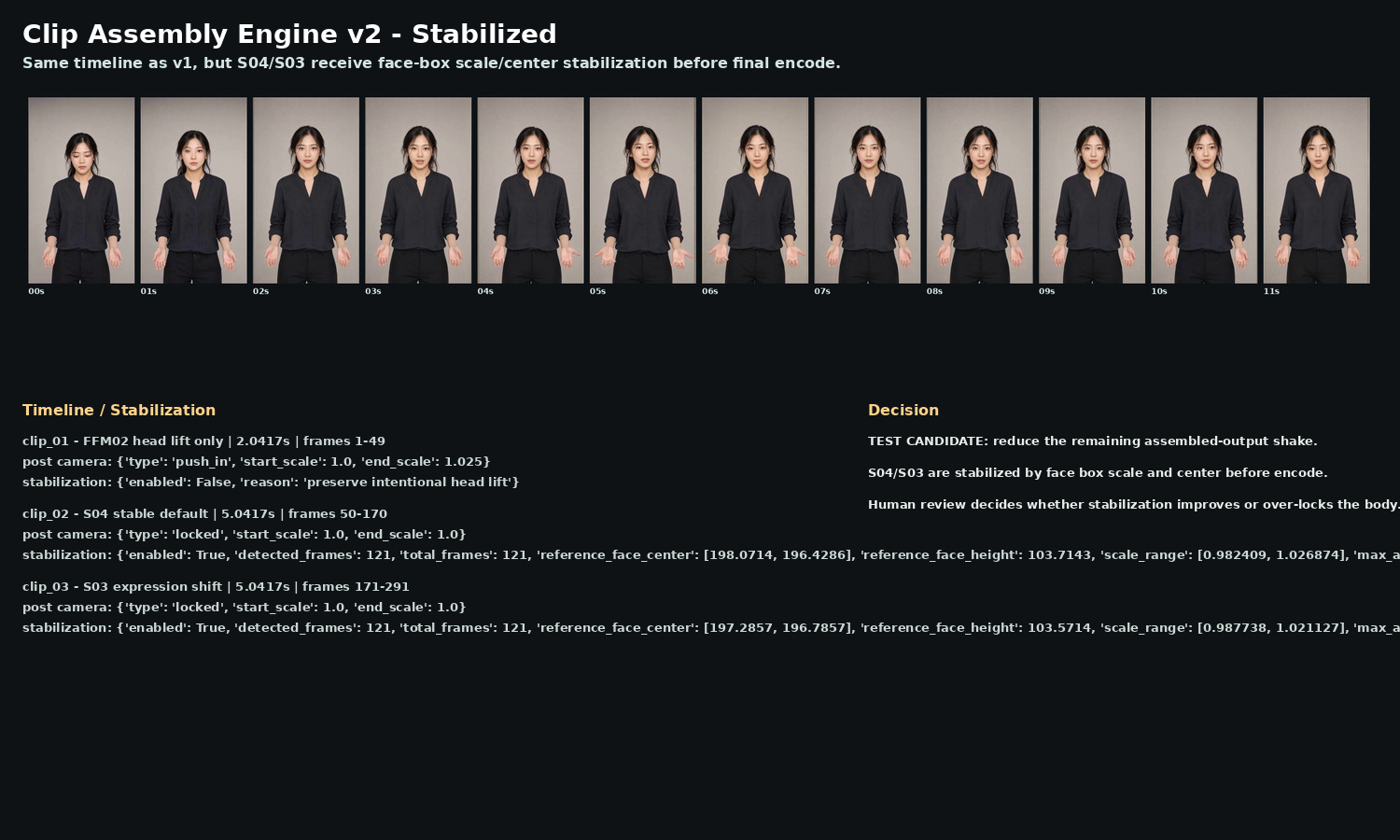
Same timeline as V1, but S04/S03 receive face-box scale and center stabilization before final encode. FFM02 keeps the intentional head lift. This is a review candidate, not a locked pass.
A - Stabilized assembly video12.125s / 384x672 / 291 frames. Use this to judge whether the remaining shake is reduced or whether the body feels over-locked.
B - Stabilization boardShows per-second samples and the stabilization decision. S04/S03 were stabilized by detected face scale and center.
C - Contact sheetOne frame per second across the stabilized output. Compare against V1 for scale drift and pose continuity.
Review required
If V2 reduces the scale jitter without locking the body unnaturally, stabilization becomes part of the assembly engine.
Still not enough
If shake remains visible, the fix must move upstream: first-frame framing, shorter motion, or different source clip selection.
Product rule
Wan remains the clip generator. Timeline, crop, camera feel, and stabilization belong to the separate editor layer.
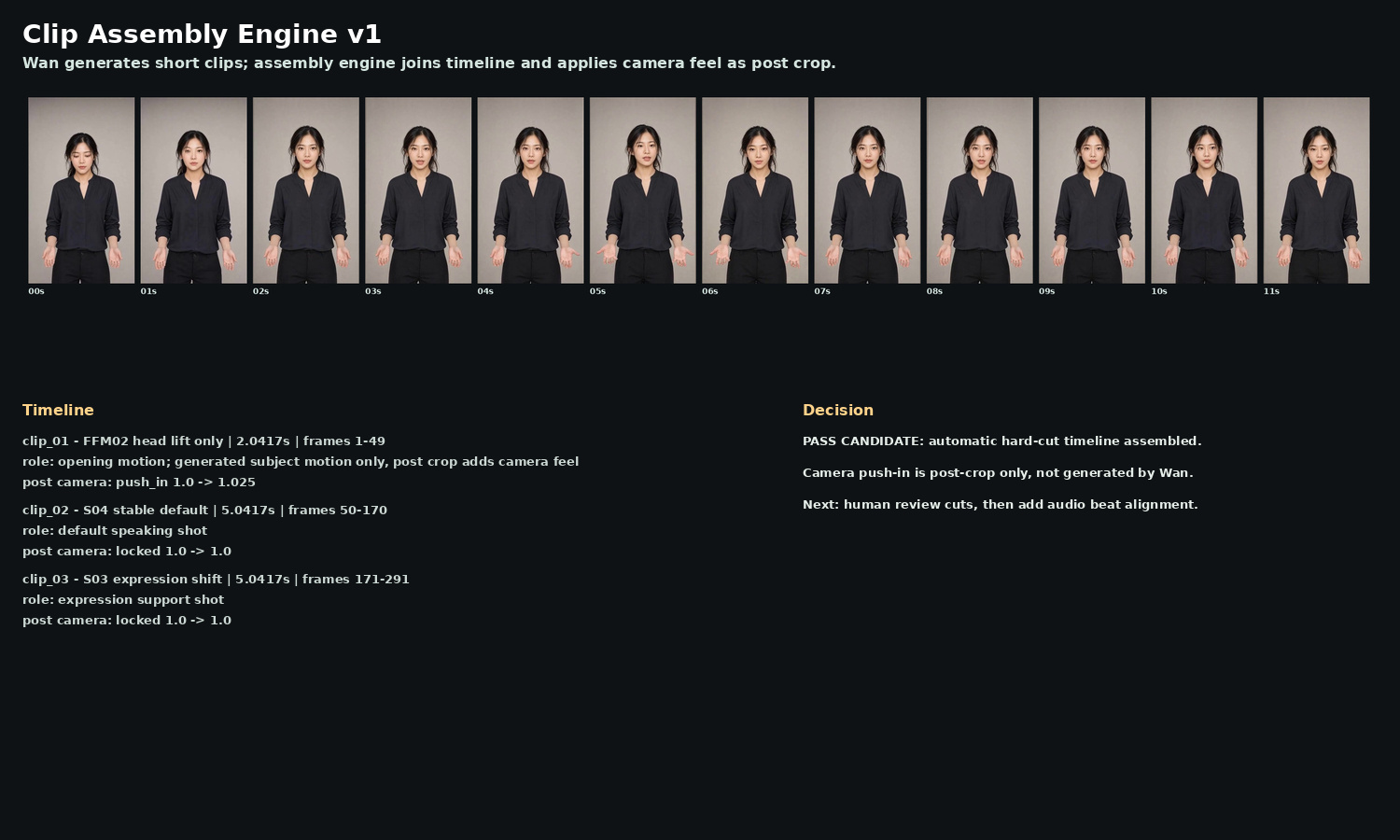
This validates the product structure: Wan generates short approved clips; the assembly engine handles timeline order, hard cuts, and post-crop camera feel. Camera push-in is applied after generation, not inside the Wan prompt.
A - Assembled timeline video12.125s / 384x672 / 291 frames. Timeline: FFM02 head lift with post push-in, S04 default speaking, S03 expression support.
B - Assembly boardShows frame samples, clip order, durations, and post camera settings.
C - Contact sheetOne frame per second across the assembled output. Use this to check hard cuts and continuity.
Structure validated
Wan can stay as a short-clip generator while a separate editor assembles clips and applies camera feel.
Next
Add audio beat alignment and optional clip-level stabilization/crop rules before final production template lock.
Constraint
Current version uses hard cuts only. Crossfades are avoided until face morph risk is tested.
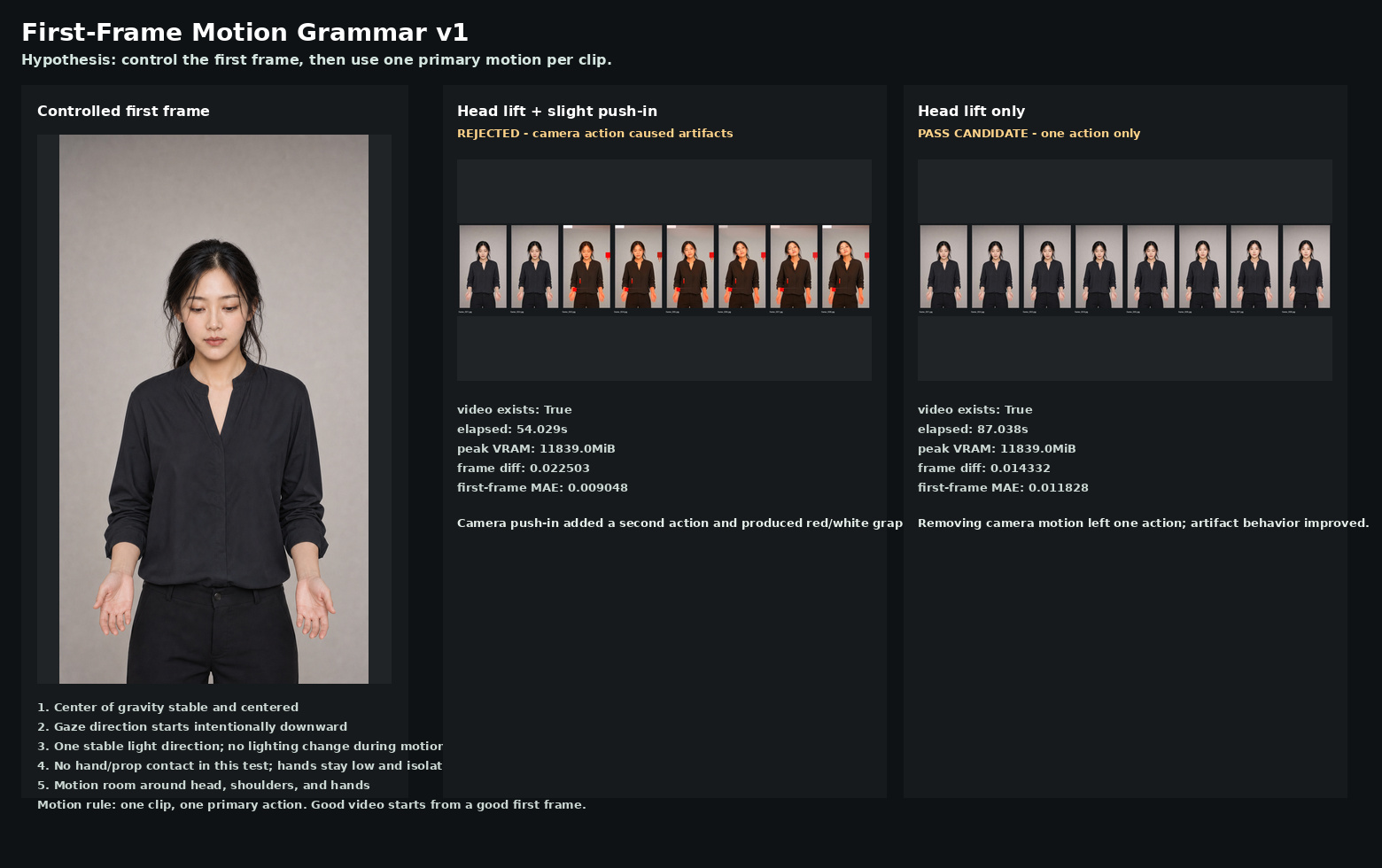
Good video starts from a controlled first frame and one motion
Checklist tested: center of gravity, gaze direction, one light direction, hand/prop contact, and motion room. FFM01 combined head lift and camera push-in and failed. FFM02 used head lift only and is the current pass candidate.
A - Grammar boardControlled first frame plus FFM01/FFM02 comparison. Current rule: one generated clip should have one primary action.
B - Controlled first frameCentered weight, downward gaze start, stable light, hands low, and motion room around body.
C - FFM02 head lift onlyPass candidate. Removing camera motion leaves one action and avoids the red/white graphic artifact seen in FFM01.
D - FFM01 rejected: head lift + push-inRejected. Camera push-in added a second action and produced red/white blocks plus color shift.
Rule confirmed
Use controlled first frames and one primary motion per generated clip.
Next
Promote FFM02 to 5-second head-lift-only validation, or add camera push later with post-crop/stabilization instead of in the generation prompt.
Rejected
Do not combine generated subject motion and generated camera push-in at this stage.
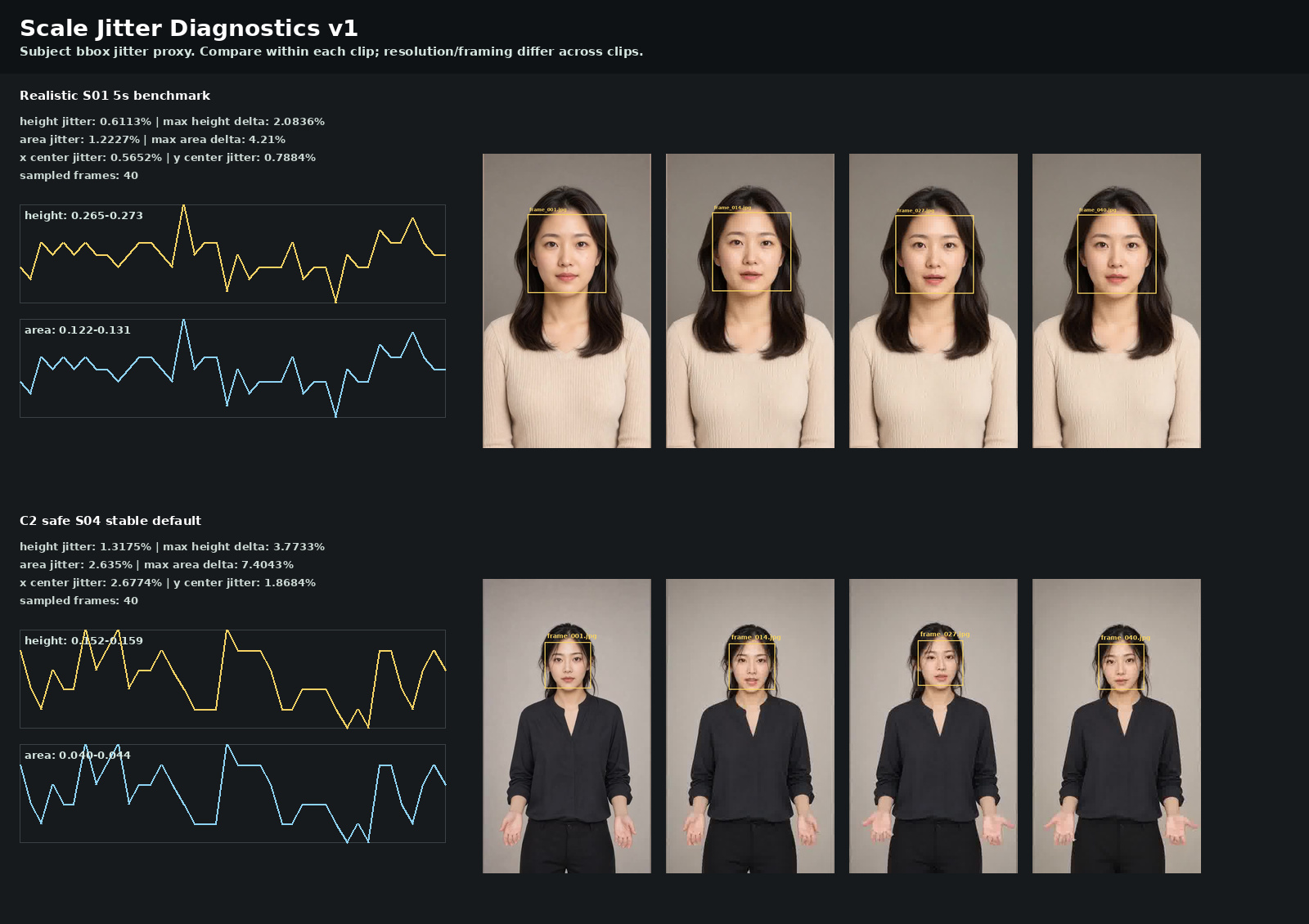
Observed S04 shake is subject scale/framing drift, not just camera shake
Face-box diagnostics confirm the user observation: S04 has materially higher height, area, and center jitter than Realistic S01. Do not promote S04 to 512x896 until scale-lock or post-crop stabilization is tested.
A - Scale jitter diagnostics boardFace bbox sampled at 8fps. Realistic S01: height jitter 0.61%, area 1.22%. S04: height jitter 1.32%, area 2.64%, x-center 2.68%.
B - Realistic S01 5s benchmarkReference with lower scale drift. Height jitter 0.61%, max height delta 2.08%.
C - S04 stable default candidateCurrent default candidate, but scale drift is visible. Height jitter 1.32%, max height delta 3.77%.
Issue confirmed
S04 shake is consistent with subject size/framing drift. This must be handled before template lock.
Next test
Run one scale-lock prompt test and one post-stabilized crop test at 384x672 before any 512x896 promotion.
LONGCAT VIDEO - RESEARCH CANDIDATE / PREFLIGHT ONLY
LongCat-Video review target: long story video and avatar lane
This is not a Wan replacement yet. Review it as a separate long-video/avatar candidate while C2 safe remains the active product path. The first decision is whether RTX 3060 12GB single-GPU preflight is realistic.
Why review
LongCat targets longer story videos, video continuation, and avatar-style generation. That matches our next concern after short 5s C2-safe clips: continuity across script-driven shots.
Primary risk
Do not install or promote before confirming single RTX 3060 12GB feasibility, INT8/low-step availability, license terms, and whether audio/image/avatar mode can run locally.
Current product path
Wan C2 safe S04 remains the current 5-second default candidate. LongCat is only a research candidate until it passes preflight.
Automation rule: do not force video-generation tools into loose-part rigging. Use full-frame storyboard/keyframe control for Wan/LTX/Seedance-like routes, and use validated rigpacks only for deterministic character systems.
Route A
Video-generation-native: full-frame anchor image, full-frame storyboard/keyframes, model-native I2V/keyframe/control, then visual and runtime gates.
Route B
Deterministic rig: validated rigpack, semantic anchors, motion primitives, then optional model polish.
Rejected route
Loose generated body parts cut from finished images and rotated without socket-authored joint metadata.
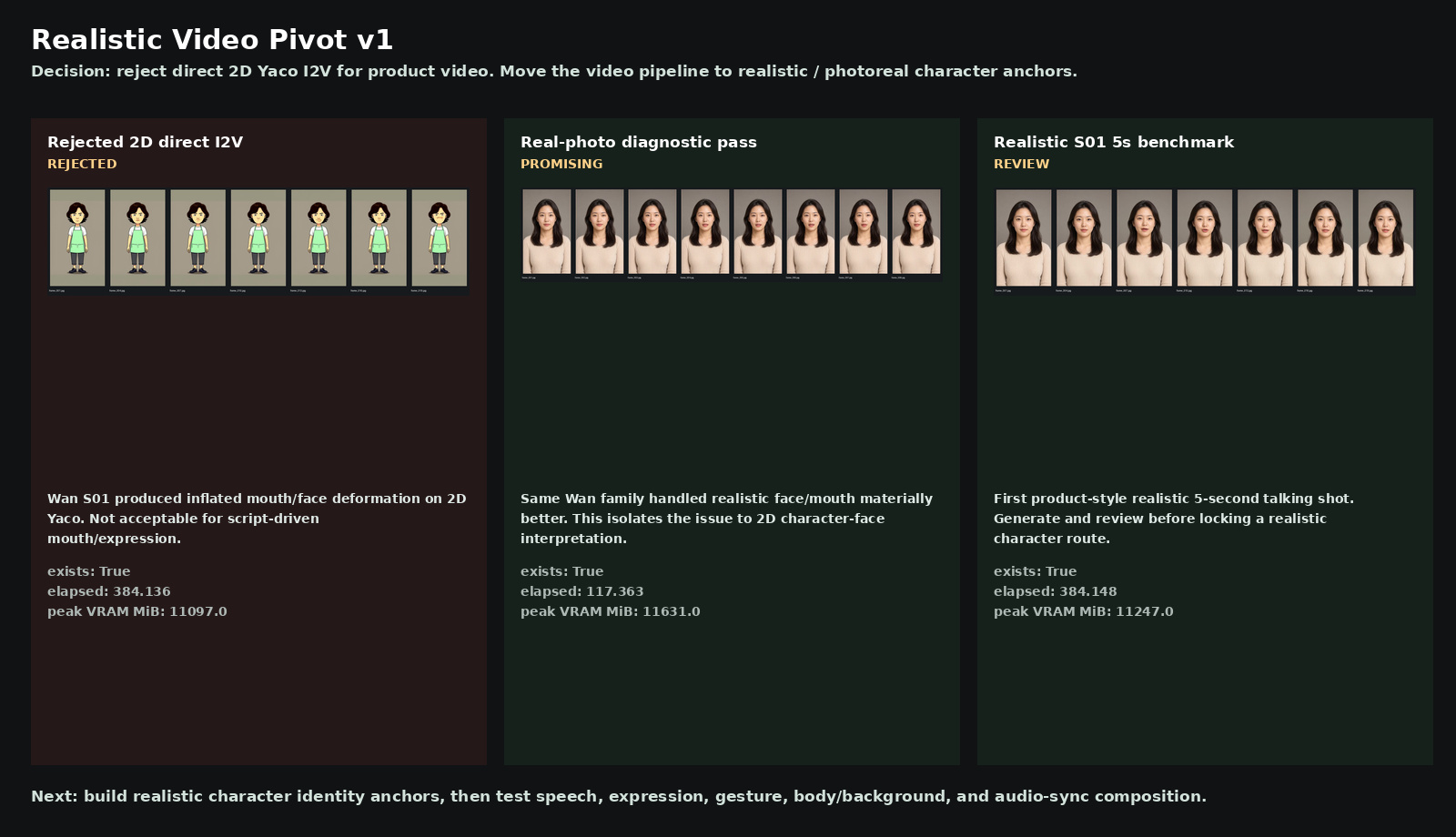
Realistic video route locked; direct 2D Yaco I2V rejected
Music/vocal remains locked. Video generation is now locked to realistic / photoreal character anchors because Wan mouth behavior is materially cleaner on real-photo input and Hunyuan full-quality runtime is rejected.
A - Pivot evidence boardRejected 2D Wan S01, real-photo diagnostic pass, and first realistic 5-second benchmark.
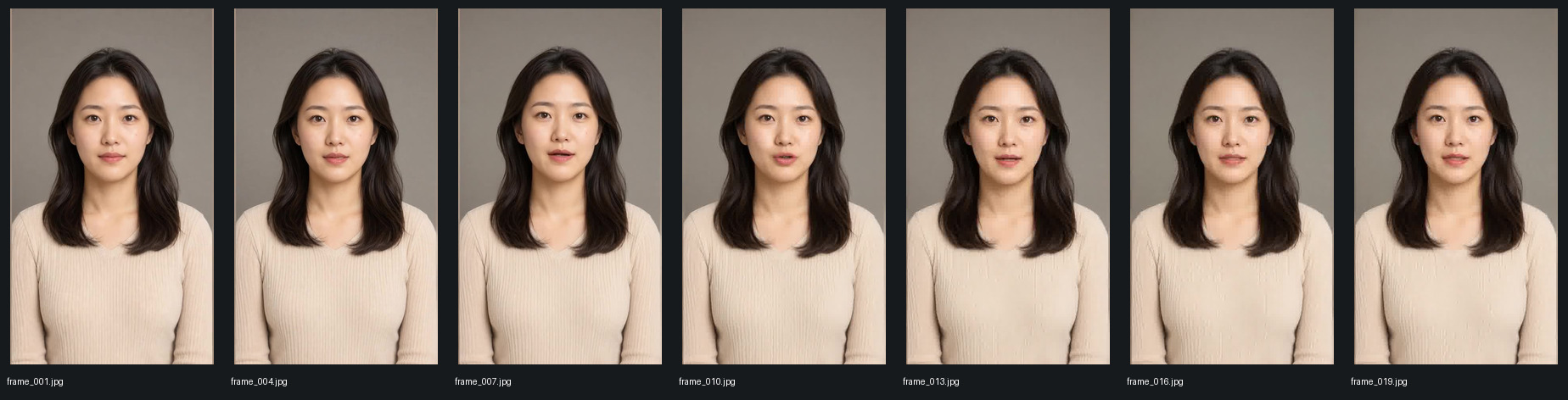
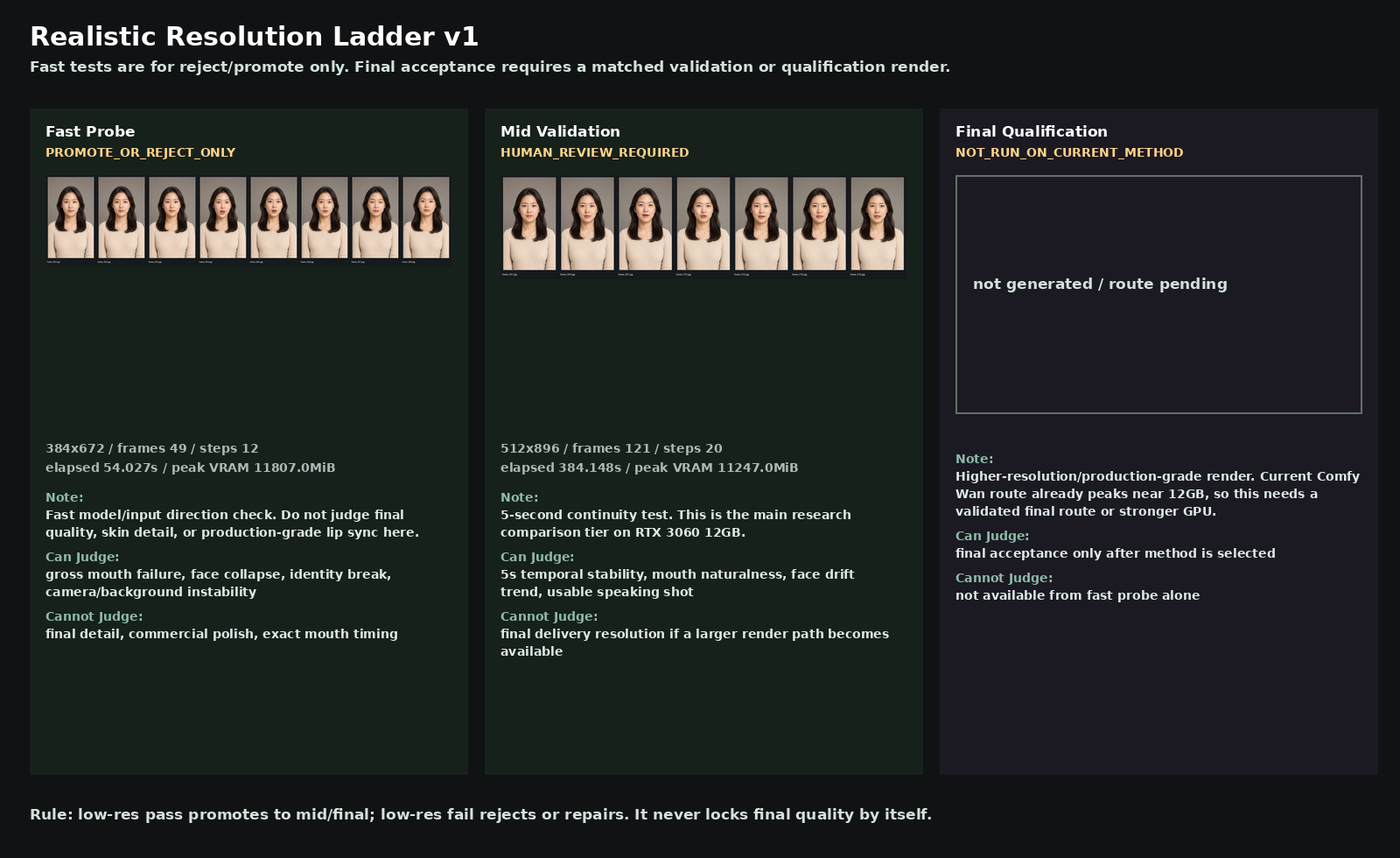
B - Realistic S01 5s benchmark5.04s / 121 frames / 512x896 / 384.148s / peak 11.25GB VRAM. Review mouth, face drift, identity, and speaking naturalness.
C - Realistic S01 contact sheetFirst visual check after the pivot. Better than 2D Yaco mouth, but still requires face-stability review.
Direction locked
실사/실사풍 캐릭터 영상을 기본 제품 경로로 고정. Direct 2D Yaco I2V is rejected.
Next
Generate realistic identity anchors, then test speaking, gesture, body/background, and audio-sync composition against the locked vocal.
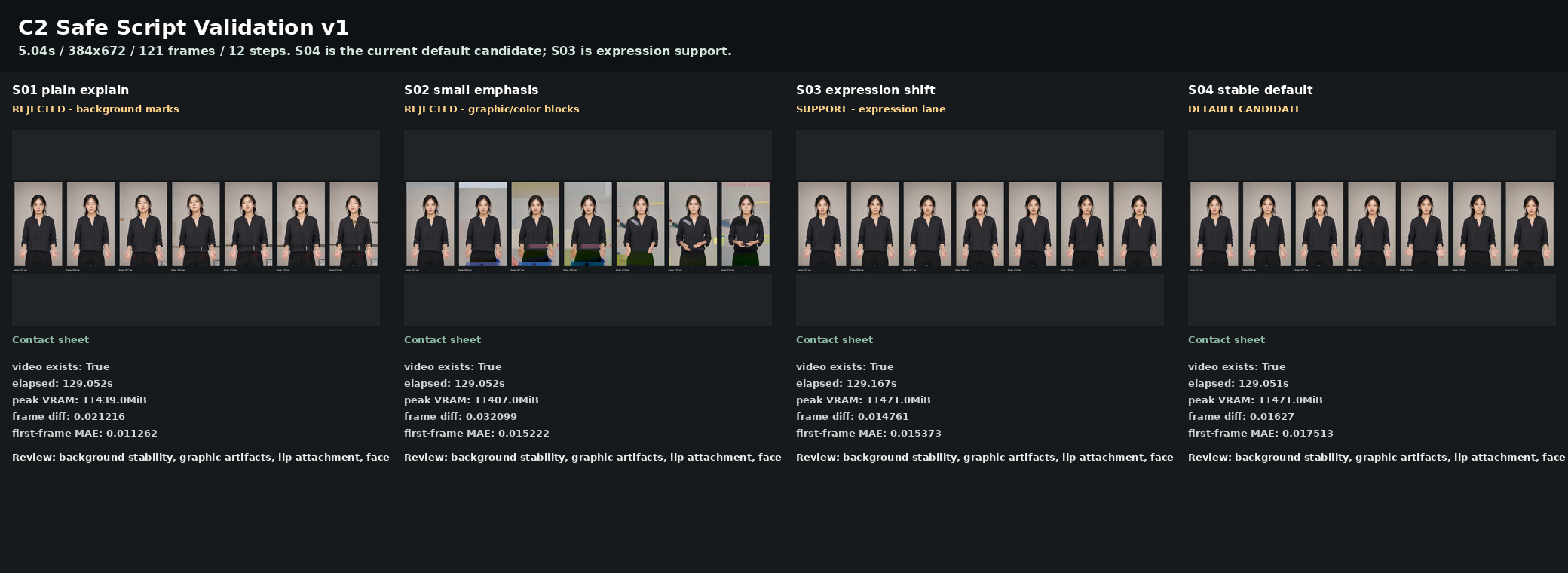
C2 safe promoted to real 5-second script validation
Four 5.04s C2-safe script shots were generated at 384x672. S04 is the current default candidate. S03 is an expression support lane. S01/S02 are kept as rejection evidence because 5-second hold introduced background or graphic artifacts.
A - Validation boardOne-board view of S01-S04 contact sheets, runtime, VRAM, and motion diagnostics.
B - S04 stable default candidate5.04s / 384x672 / 12 steps / 129.051s. Current default candidate for script-server speaking shots.
C - S03 expression support5.04s / 384x672 / 12 steps / 129.167s. Cleaner 5s expression lane; review face drift and mouth attachment.
D - S01 rejected evidenceBackground and lower-frame marks appear during 5s hold.
E - S02 rejected evidenceSmall emphasis prompt caused graphic/color blocks and background reinterpretation.
Default candidate
S04 is the current C2-safe default candidate for automated 5s speaking shots.
Next gate
If S04 passes human review, promote S04 to 512x896 5s mid validation before locking the script-server template.
Rejected
S01 and S02 show that 5-second holds can still create non-product artifacts depending on prompt/seed.
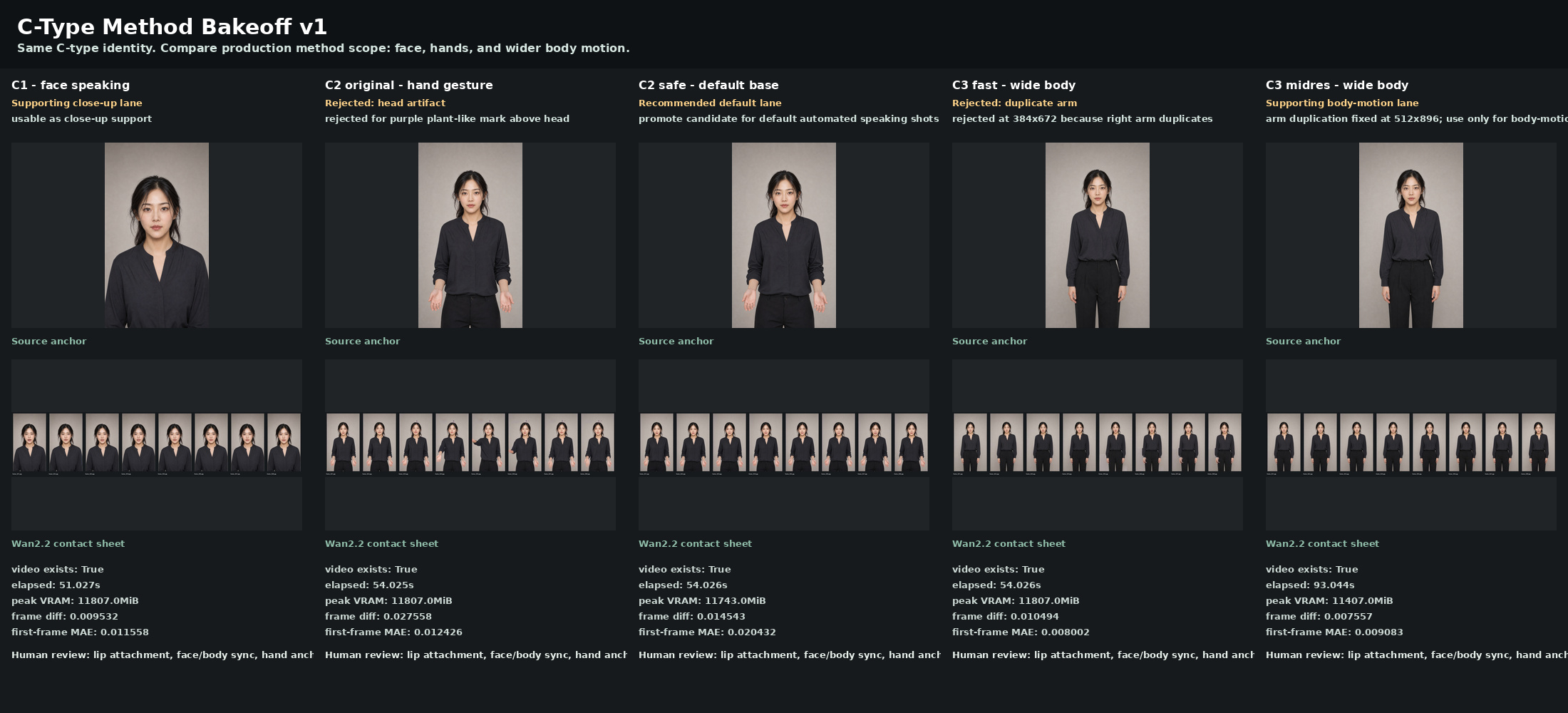
Candidate C baseline: C2 safe becomes the default method candidate
C2 original keeps the right method shape but has a plant-like head artifact. C2 safe removes the large gesture and is the current default candidate. C3 fast is rejected for duplicate arm; C3 midres fixes it and remains a supporting body-motion lane.
A - Method comparison boardReview source anchors, contact sheets, runtime, VRAM, frame motion, and first-frame drift in one board.
B - C1 face speaking2.04s / 384x672 / 12 steps / 51.027s. Check lip attachment, eye stability, and face drift.
C - C2 safe default candidate2.04s / 384x672 / 12 steps / 54.026s. Current default: upper body speaking with small low-hand movement and no visible head artifact in the sheet.
D - C2 original rejected evidence2.04s / 384x672 / 12 steps / 54.025s. Method shape is useful, but this version is rejected because a plant-like mark appears above the head.
E - C3 midres supporting lane2.04s / 512x896 / 12 steps / 93.044s. Right-arm duplication is fixed at mid resolution; use only when body motion is needed.
F - C3 fast rejected evidence2.04s / 384x672 / 12 steps / 54.026s. Rejected because the right arm duplicates at low-resolution full-body framing.
Default candidate
C2 safe is the current default method candidate for automated script-server speaking shots.
Supporting lane
C3 midres is usable for occasional body-motion shots, but not as the default because it costs 93s for 2s and needs higher resolution.
Rejected evidence
C2 original has a head artifact. C3 fast duplicates the right arm. C2 clean repair is discarded because it introduced colored graphic artifacts.
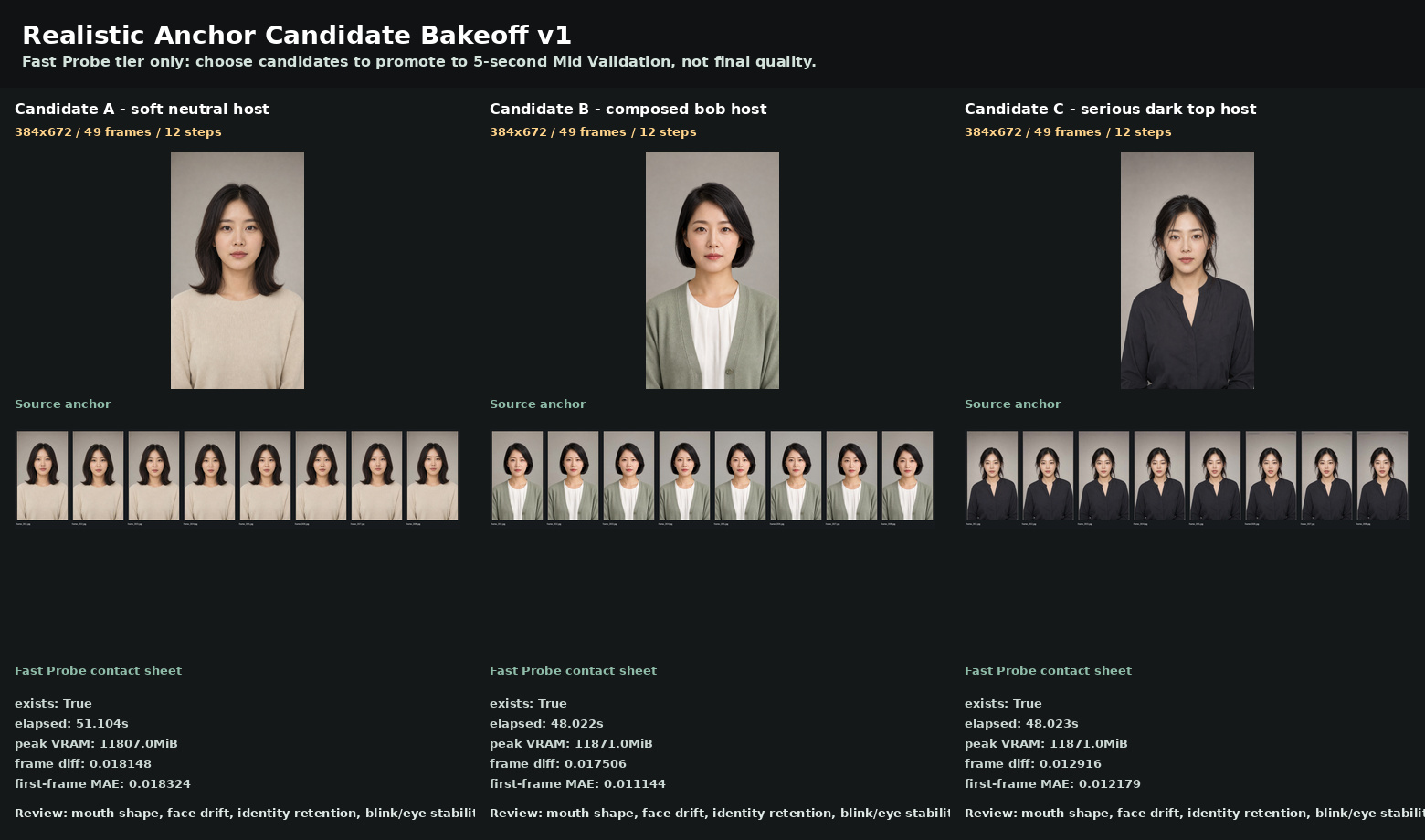
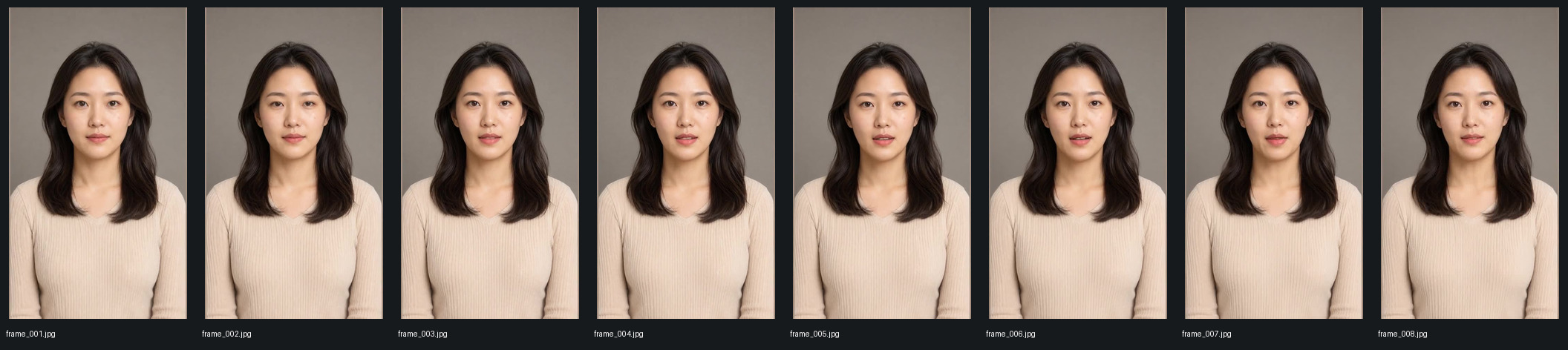
Three realistic anchor candidates were generated and tested with identical Wan2.2 Fast Probe settings. This is a promote/reject gate before 5-second Mid Validation.
A - Candidate comparison boardSource anchors plus Fast Probe contact sheets and runtime diagnostics.
B - Candidate A Fast ProbeSoft neutral host. 51.104s / peak 11.8GB.
C - Candidate B Fast ProbeComposed bob host. 48.022s / peak 11.9GB.
D - Candidate C Fast ProbeSerious dark top host. 48.023s / peak 11.9GB.
Review needed
Pick one or two candidates to promote to 5-second Mid Validation. Do not lock identity from this fast tier alone.
5-second script scenario test: mouth and expression
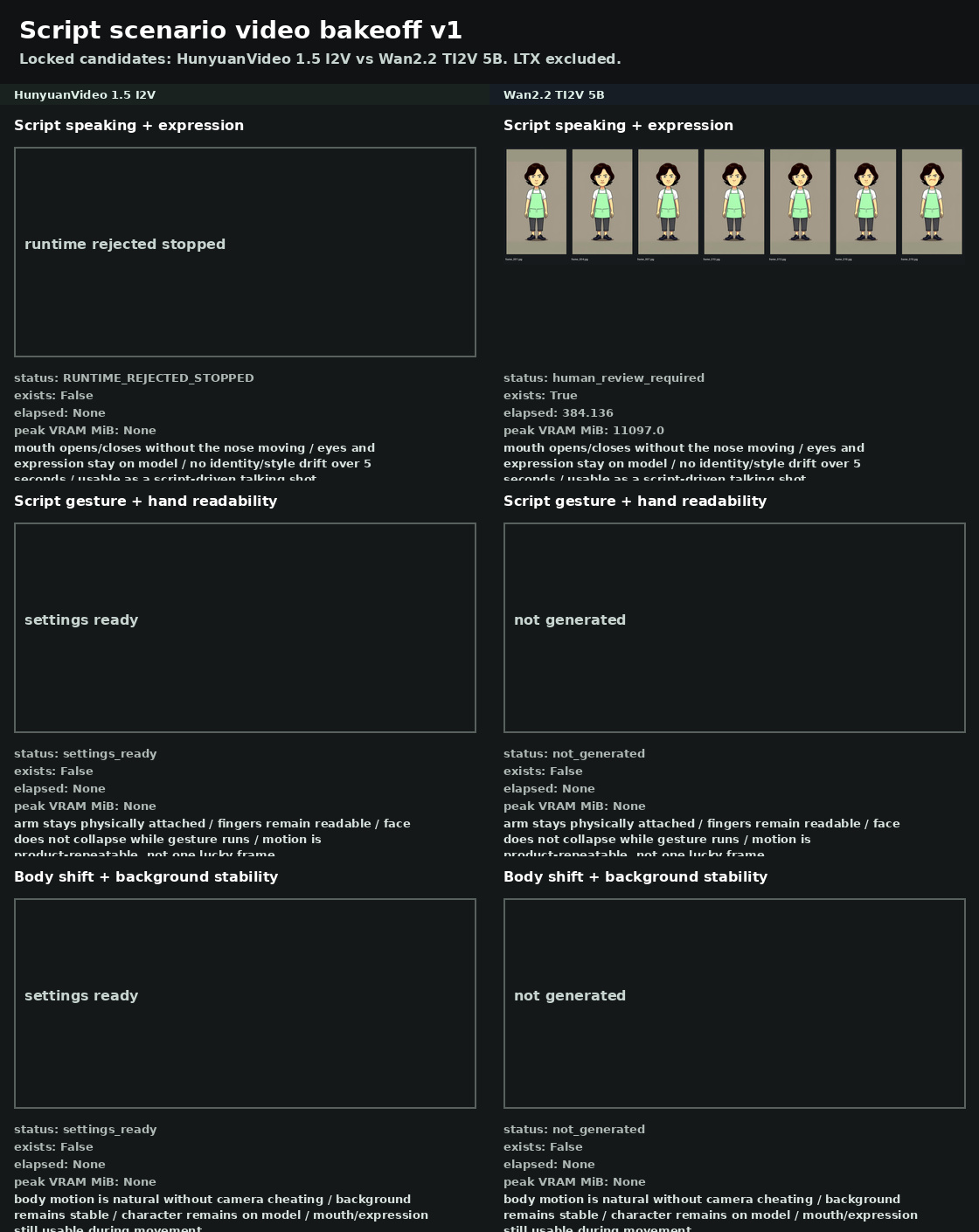
Candidate scope is now HunyuanVideo 1.5 I2V versus Wan2.2 TI2V 5B. This card shows what needs visual review; planning stays in the thread.
A - Scenario comparison sheetS01 mouth/expression is generated for Wan; Hunyuan full-quality S01 was stopped at 4/30 denoising because projected runtime is not product-compatible.
B - Wan2.2 TI2V 5B S015.04s / 121 frames / 512x896 / 384.136s / peak 11.1GB VRAM. Review mouth, nose stability, eyes, expression, and identity.
Generated
Wan S01 is ready for human review against the script-driven mouth/expression gate.
Hunyuan next decision
Only low-frame/low-step fast probes are allowed now; full-quality Hunyuan script scenarios are runtime-rejected for the product target.
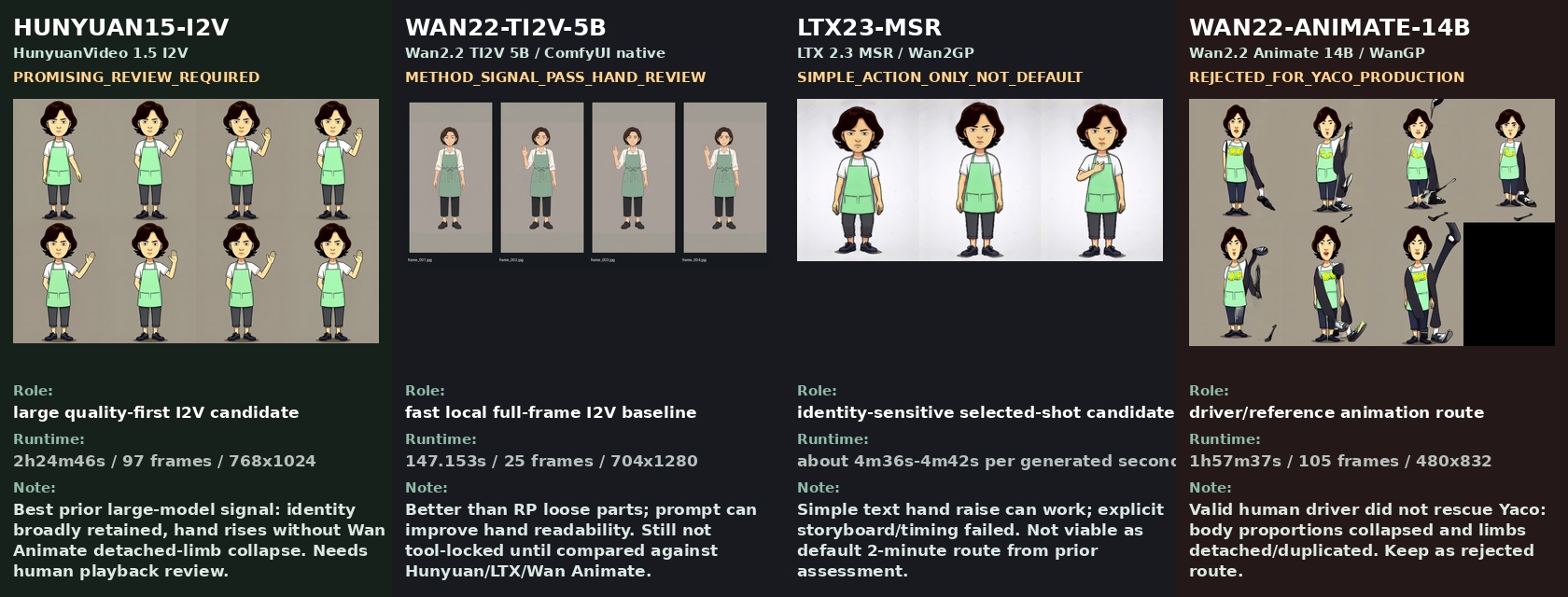
Video tool bakeoff comparison before deeper research
Same process as music/vocal: compare model families first, then freeze the best route. Current candidates: HunyuanVideo 1.5 I2V, Wan2.2 TI2V 5B, LTX 2.3 MSR, and Wan2.2 Animate 14B.
A - Comparison sheetVisual summary of current candidate evidence and runtime. This is not a final selection.
B - HunyuanVideo 1.5 I2VPrior best large-model signal; needs playback review before lock.
C - Wan2.2 TI2V 5BFast local full-frame baseline. Better than loose parts, but not locked.
D - LTX 2.3 MSRSelected-shot candidate; prior assessment says not default route.
Process corrected
No more locking Wan/VG from one promising sample. Tool-family bakeoff comes first.
Rejected already
Wan Animate 14B via current WanGP route is preserved as rejected for Yaco production.
Next
Review Hunyuan against Wan2.2 TI2V 5B and LTX. If Hunyuan passes, run torso translation and speaking close-up cases before locking.
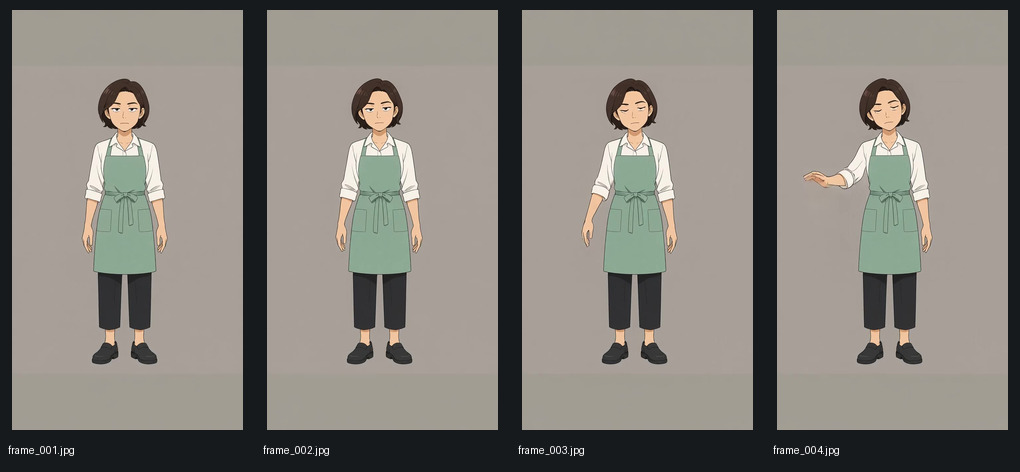
This tests the video-generation-native route: one full-frame character image goes into Wan2.2 TI2V, not loose arm parts. Runtime: 25 frames / 1.04s output / 150.079s elapsed / peak 11.9GB VRAM on RTX 3060.
A - Native full-frame videoReview whether the arm is generated as part of the full character frame rather than as detached pieces.
B - Contact sheetPositive method signal: integrated arm motion. Blockers: eye/face drift and limited storyboard control.
C - Source full-frame keyframeSingle full-body anchor image. No part extraction, no cutout rotation.
Method signal
Unlike RP-3, the arm does not read as a separate rotating object. This supports continuing video-generation-native tests.
Not approved
Face/expression drift appears and this run only used start-image I2V, not model-native storyboard/keyframe control.
Next
Run full-frame K0/B2/B3/K1 storyboard/keyframe control and compare adherence, identity drift, and runtime.
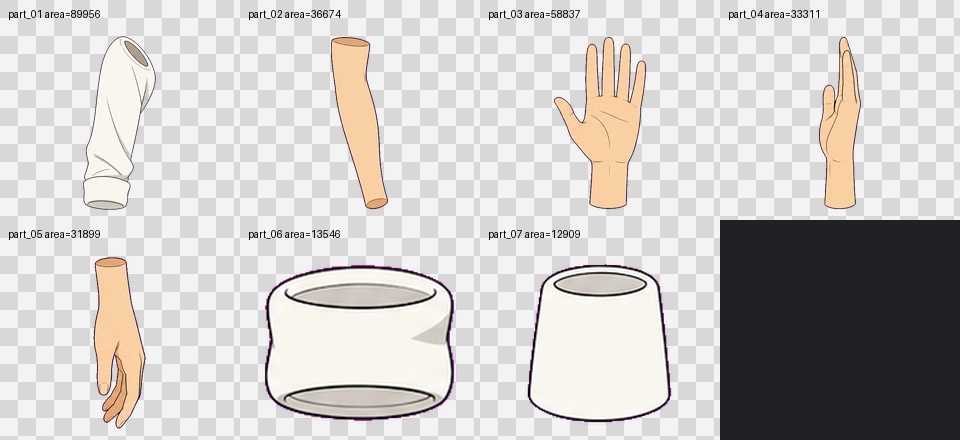
External/generated right-arm parts were extracted, mapped into the same rigpack contract, validated with file checks, and rendered through deterministic right_hand_raise_v1. Product fit is rejected: the arm behaves like loose pieces rotating separately from the character, so this route must not be used for automated shorts production.
A - Deterministic renderChecks whether actual character arm parts can be driven by the RP-2 rig primitive without video-model motion authority.
B - Contact sheetRejected review target. The failure is visible detached/floating part behavior, not only style mismatch.
C - Anchor debug sheetRed/yellow/cyan markers expose inferred shoulder, elbow, and wrist chain. This proves why inferred anchors are insufficient for production.
D - Extracted partsAutomatically separated parts from the generated chroma sheet. This is the asset source quality gate.
Passed
Chroma source ingestion, part extraction, rigpack file contract, validator --require-files, and deterministic render path are working.
Product rejected
The limb reads as separate moving pieces. This is not acceptable even though the rigpack schema and render path pass.
Next
Stop loose generated-part injection. Move to socket-authored rig assets, Live2D/Spine-style rigging, or a full-body keyframe route that preserves integrated limbs.
Benchmark character v1 input pack and transparent rig parts
Yaco/D-01 route abandoned. Music/vocal remains locked; video research now starts from this benchmark character pack.
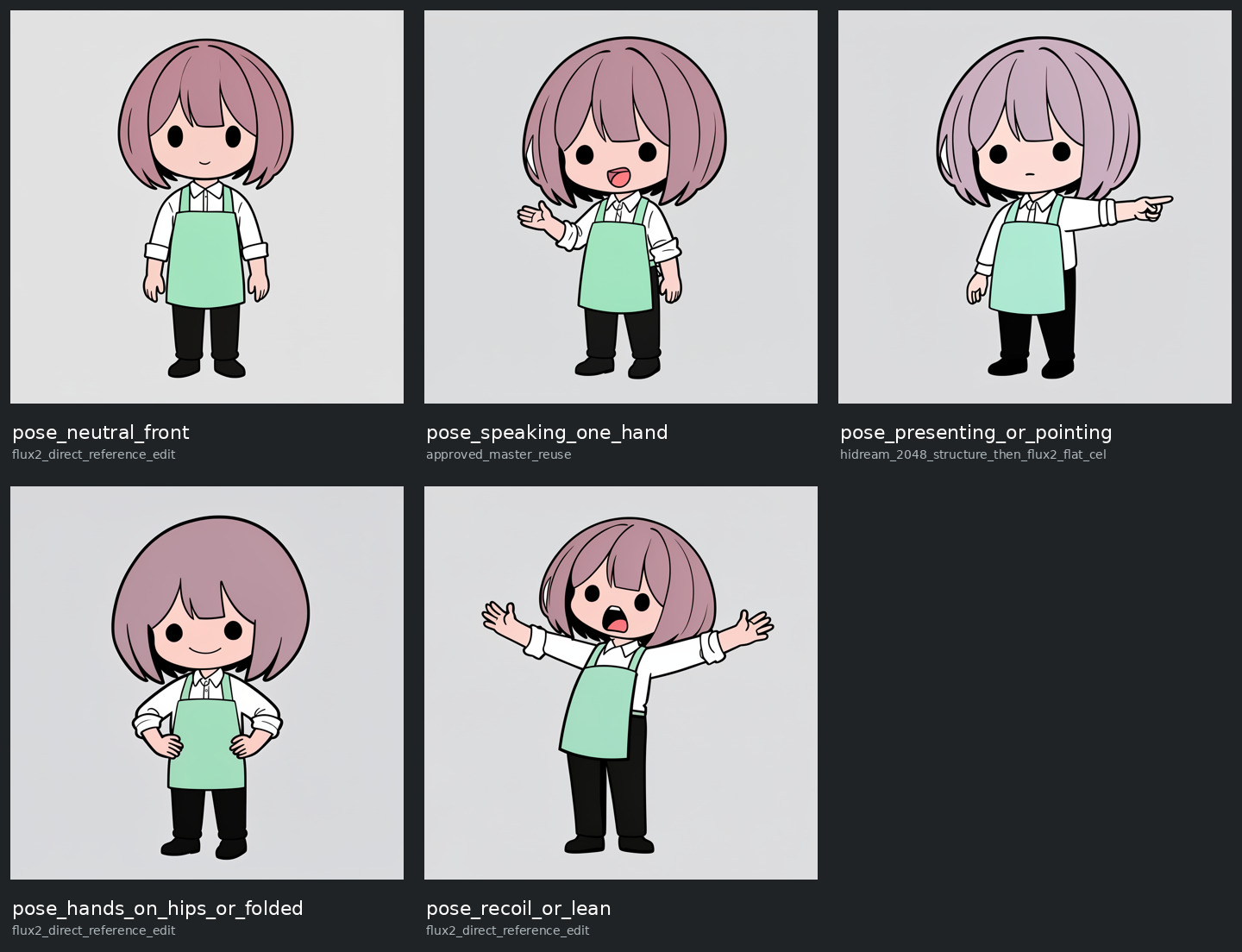
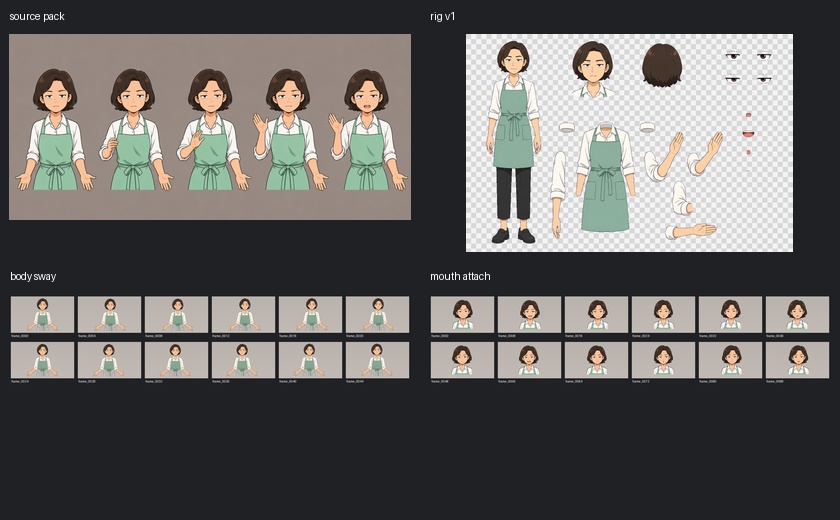
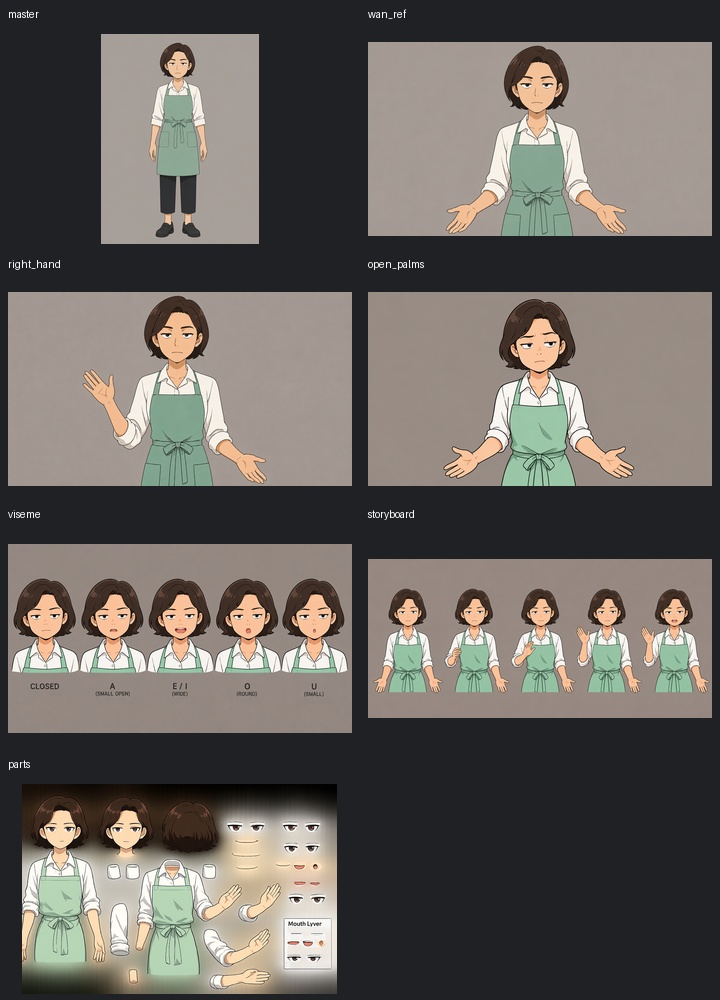
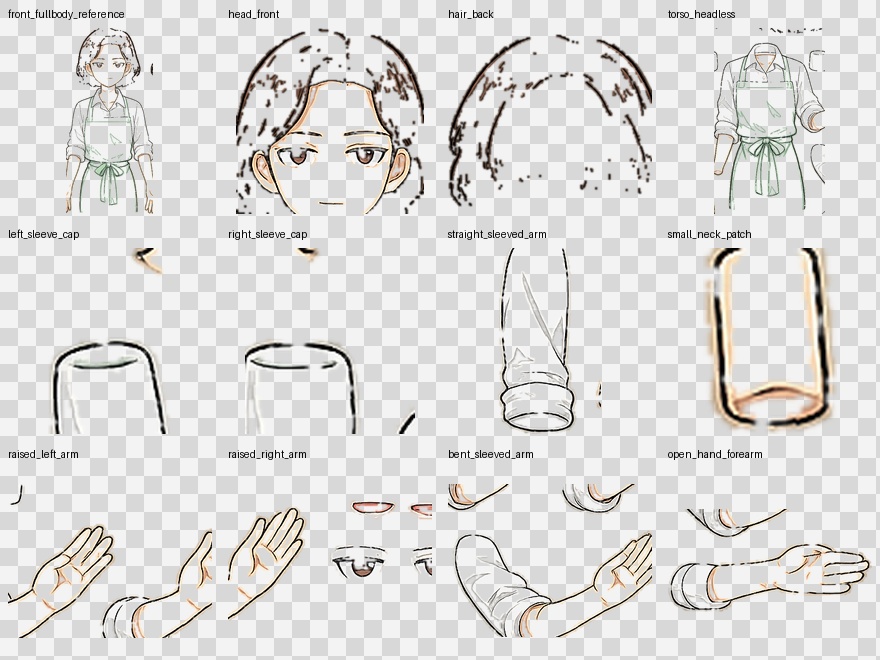
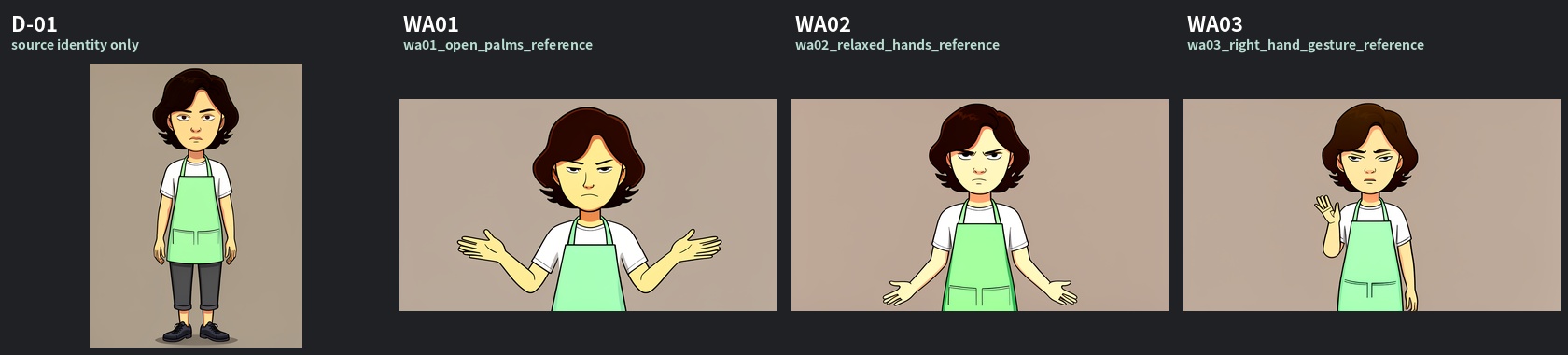
A - Source pack reviewUser-provided master, gesture keyframes, storyboard, viseme sheet, and rough parts sheet.
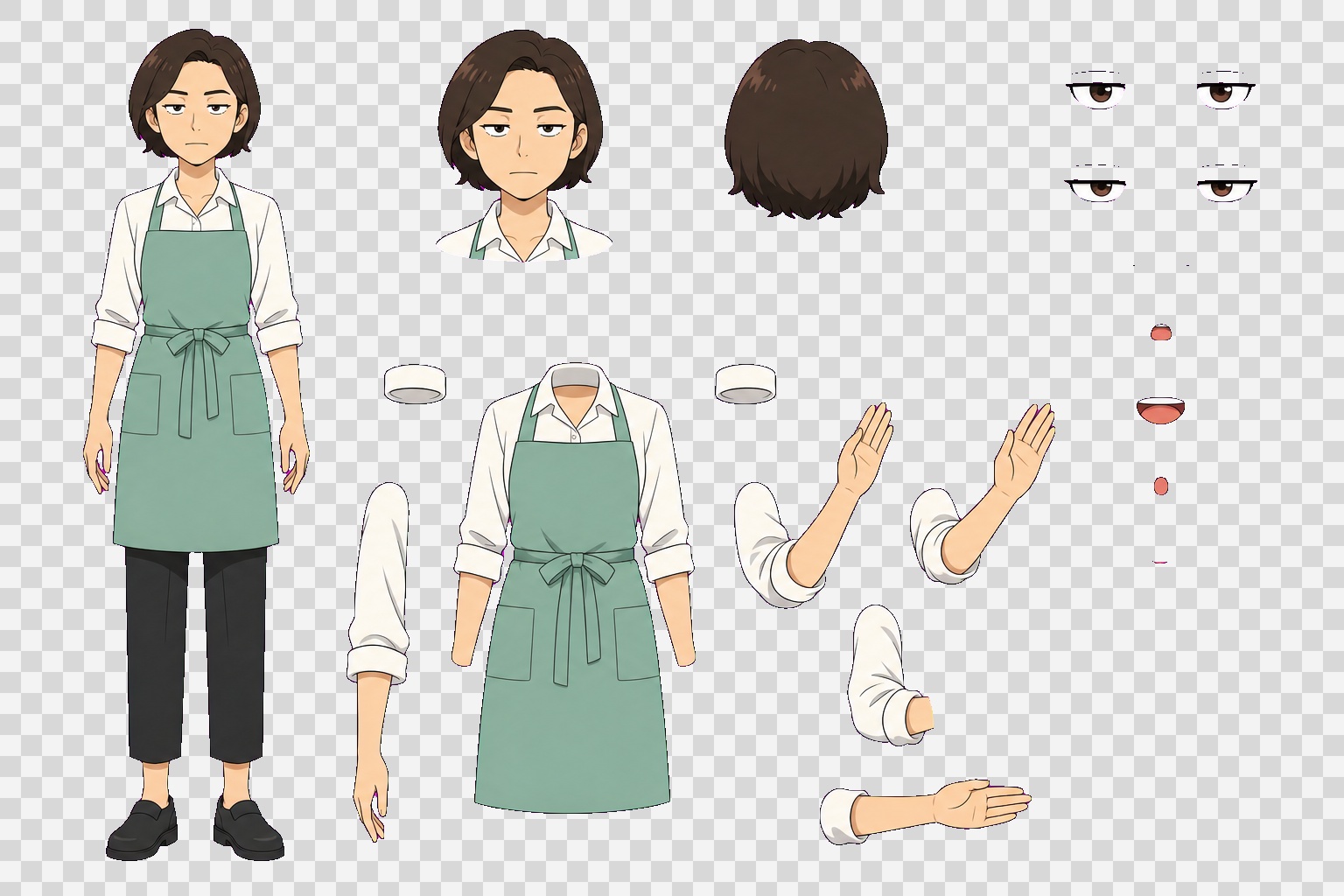
B - Clean rig sheet v1 over checkerRegenerated on chroma key, converted to RGBA. This is the current rig-parts source candidate.
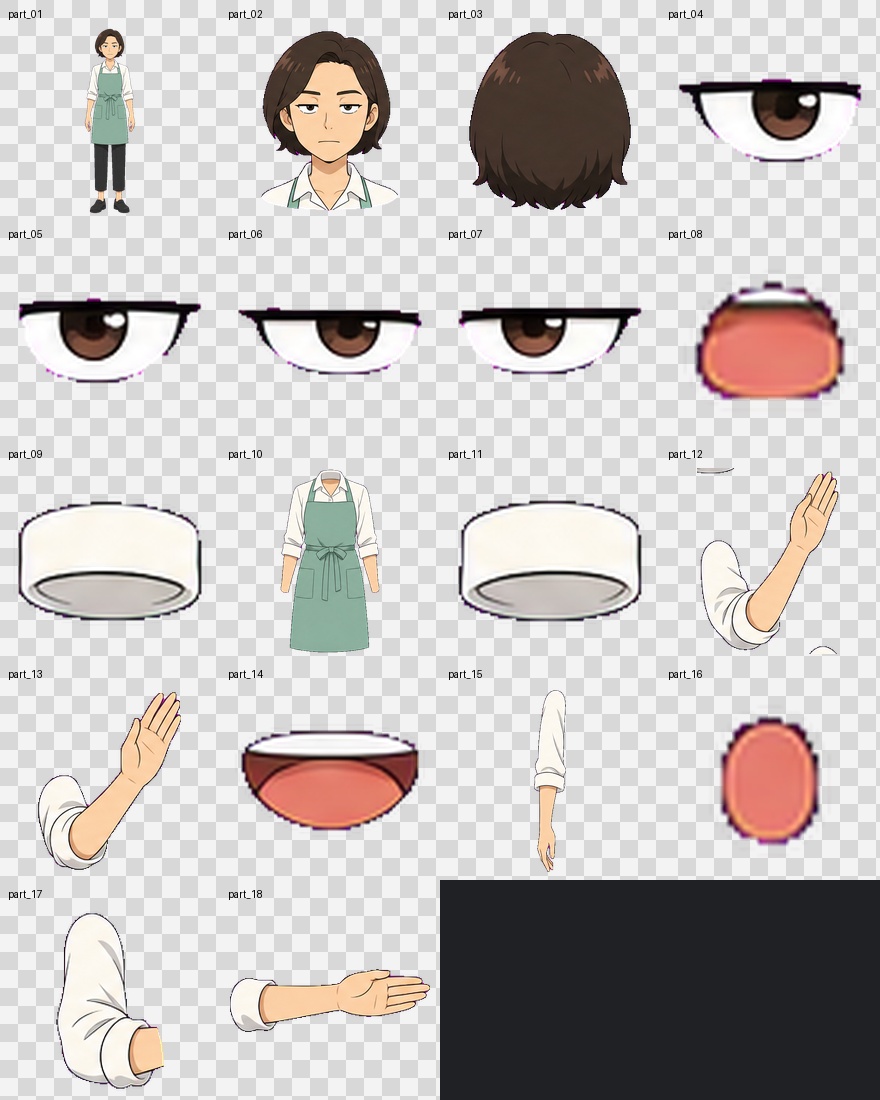
C - Auto split parts v118 connected components extracted for pre-rig review. Rename/group manually before production rigging.
Rejected v0 auto extractionKept only as failure evidence: face and hair interiors were cut out, and unrelated eye/mouth fragments leaked into arm parts.
Use for next preflight
Character identity, outfit, open-palm arms, viseme references, and storyboard inputs are now judgeable enough for Wan/LTX/Seedance-like route testing.
Next check
Run detector-friendly short preflight: static identity, arm gesture, body sway, mouth/face attachment, then reject or keep by visual review.
Known risk
Thin chroma-key residue remains around some small eye/mouth parts; final rigging needs edge cleanup before production.
Status: SIMPLE_TEXT_MOTION_ONLY_STORYBEAT_REJECTED_NOT_DEFAULT_PRODUCTION. MSR cannot use direct VG Control Video. Simple text motion is possible; storyboard timing prompt is rejected.
BG + subject refsKI route. Strong identity, but white-background shift and lower-right dot artifact.
Subject refs onlyI route. Better artifact profile and stable Yaco hold, but motion is near-static.
Subject refs + text motionI route. Right hand raises to chest; identity mostly holds, but runtime is 4m36s for 1s.
Storybeat timing prompt - rejectedI route. Prompted torso turn and hand-to-chest timing; output misses final pose and adds background artifacts.
Read before next test
MSR remains useful only for simple selected-shot identity motion. Storyboard-level timing control is not reliable in this route, direct video-driver conditioning is unavailable, and runtime is too high.
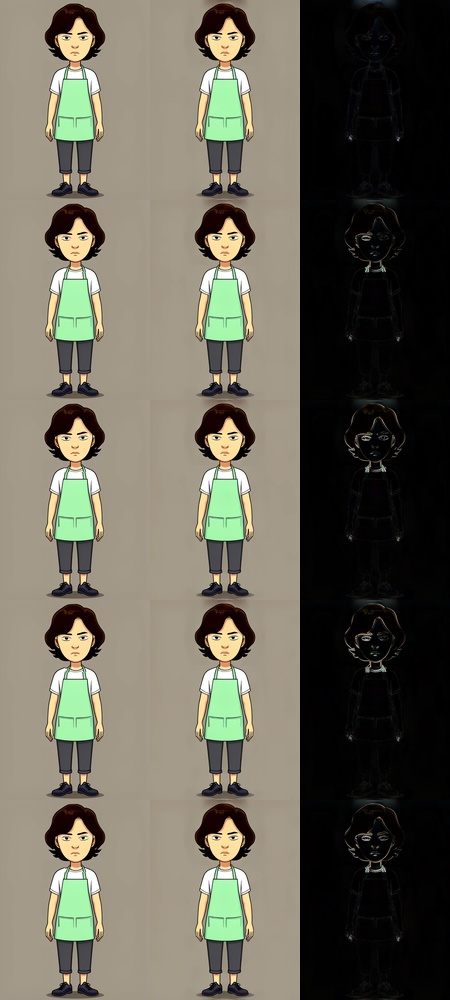
Status: NO_OBJECTIVE_UPGRADE_DETECTED. Raw VG is stable, but does not prove quality improvement over the deterministic guide.
Raw 1.00 diffRows are guide / raw / auto-contrast diff.
Raw 0.85 diffRows are guide / raw / auto-contrast diff.
Raw 0.65 diffRows are guide / raw / auto-contrast diff.
Metric read
SSIM stays around 0.962 and mean absolute difference is only about 3.6, so outputs are close copies. Temporal and edge changes are lower than the guide, indicating reduced motion/edge activity rather than a clear line-quality upgrade.
Same neutral guide and seed 2026072802. Tests whether Raw VG is useful beyond stable guide-copying.
A · neutral guideTarget guide: subtle head motion only, mouth fixed.
B · Raw 1.00Strongest guide adherence. Most copy-like.
C · Raw 0.85Previous best local LTX2 sample.
D · Raw 0.65More generation allowance. Check if polish improves or identity drifts.
Current read
Raw VG remains the most stable LTX2 Q4 route, but strength changes are visually small. It behaves like stable controlled copy/cleanup, not a clear generative quality upgrade.
Neutral deterministic guide · compare guide vs Canny EVG vs Raw VG. Raw is best so far, not final approval.
A · neutral guideInput control video: subtle head motion only, no mouth motion.
B · Canny EVGFollows outline, but check repeated eye-closing artifact.
C · Raw VGBest LTX2 result so far: face/mouth more stable, but copy-like.
Current read
Raw control is the strongest local LTX2 route so far. It reduces face drift compared with First/Last and Injected Frames. Next: Raw control strength sweep, then LTX-2.3 MSR/reference sheet if needed.
Same seed 2026072802 · video_prompt_type=KFI · compare K1 injected at L vs 13+L.
A · K1 injected at LCheck final-frame anchoring, face drift, eye artifacts, and hand interpolation.
B · K1 injected at 13 and LCheck whether extra anchor reduces drift or only forces earlier arm arrival.
Current read
Injected frames are valid in WanGP CLI and speed passes. They do not materially improve Yaco face identity control. Next validation should use control video or pose/depth/canny, then MSR/reference sheet if identity drift remains.
A · strength 1.00Strongest frame anchor. Check face drift and hand interpolation.
B · strength 0.85Previous baseline sample. Arm motion appears, face drift remains.
C · strength 0.65More motion allowance. Check whether motion improves or identity gets worse.
Current read
Speed passes and arm motion is present. Strength alone does not materially fix face/eye/nose drift. Next LTX validation should move to injected frames, then control video or MSR/reference sheet.
CURRENT REVIEW · LTX2 first/last frame · not final approval
LTX2 K0 to K1 control test
WanGP · LTX2 Q4 · image_prompt_type=SE · 25 frames · 24fps · 1m45s. This is the first fair usage-pattern check, not a final route decision.
A · video outputCheck whether the right arm reaches K1 while face and mouth stay stable.
B · all-frame sheet25-frame sequence review: arm interpolation, face drift, eye/nose/mouth drift.
Frame 01
Frame 13
Frame 25
Current read
Movement control is materially better than the smoke test. Arm motion appears, but face/eye/nose style drift remains visible. Next validation should compare lower/higher input strength and injected-frame positioning before judging LTX.
현재 작업 · Seedance 2.0 = 100 · 로컬 I2V 엔진 자격 시험정체성, 동작·물리, 지시 이행, 얼굴·표정, 다인 상호작용, 카메라·구도, 배경 안정성, 결함 없음의 여덟 항목으로 비교합니다.
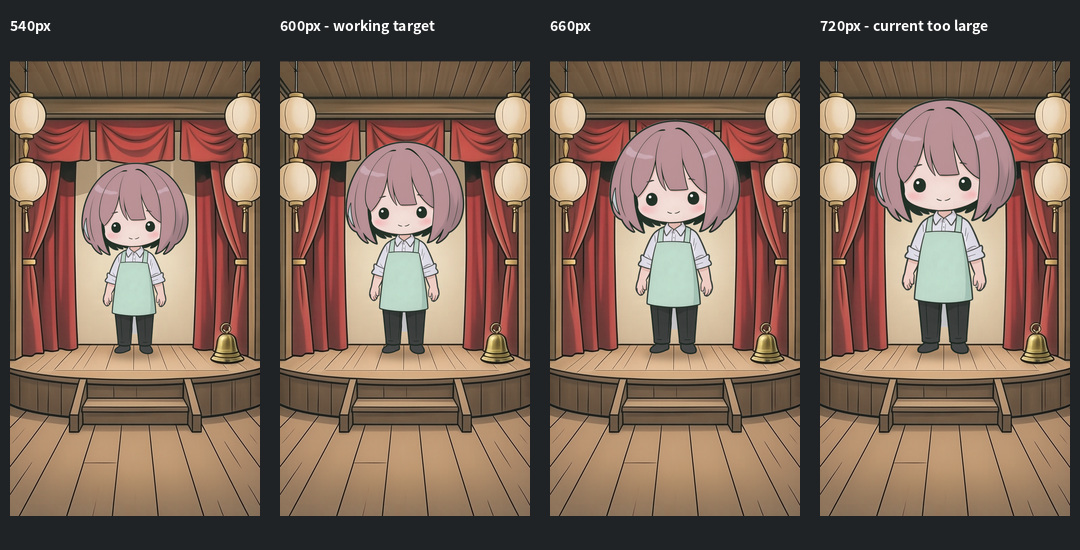
크기 재검수 · 540 / 600 / 660 / 기존 720px기존 720px는 배경 대비 과대 · 다음 복합 후보는 600px 작업 기준 · 발 위치 825px 고정
이전 720px 키프레임 · 크기 폐기캐릭터와 배경 원화 승인은 유지하지만 이 배치 크기는 다음 후보에서 재사용하지 않습니다.
Seedance 2.0 · 기준 100공식 복합 동작 기준본 · 비교 전용
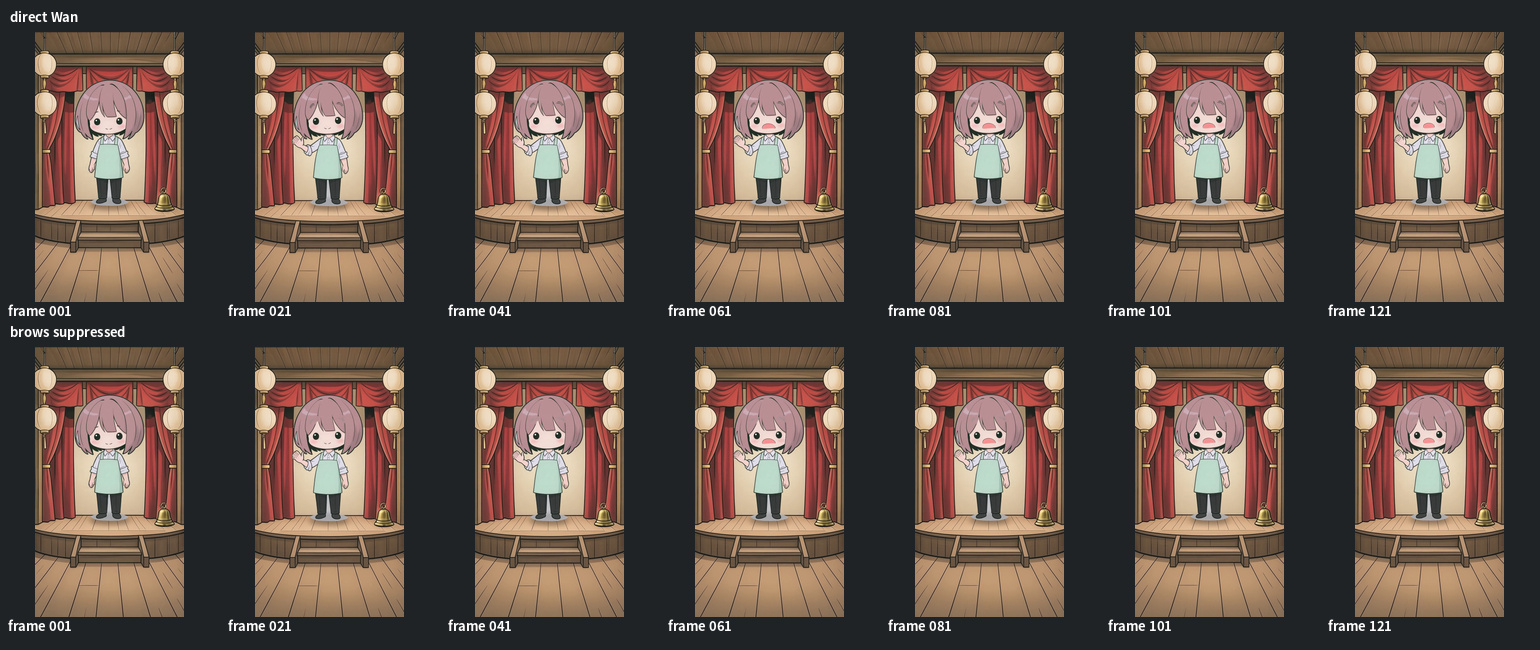
직접 Wan 7차 · 600px · 눈썹 국소 복원 · 사람 검수121프레임 직접 생성 유지 · 역재생·홀드·표정 오버레이 없음 · 점수 보류
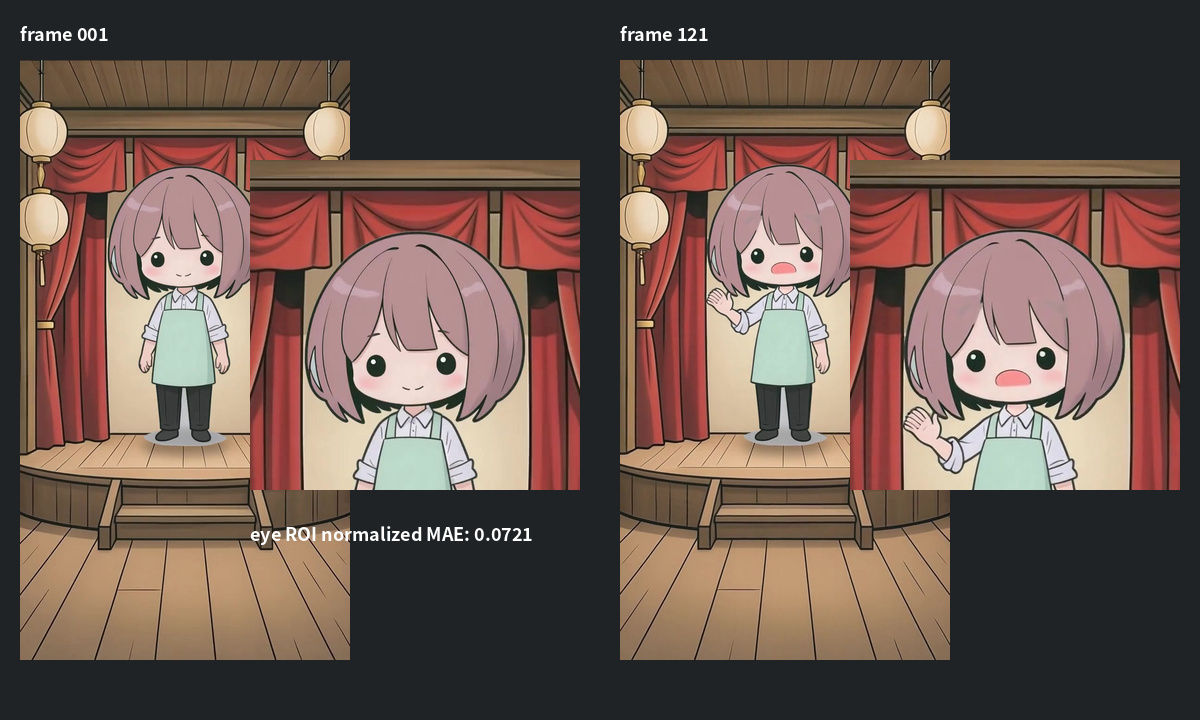
직접 Wan 6차 원본 · 부드러움 회복 · 눈썹 실패시간 동작은 자연스러우나 놀람 표정에서 숨겨진 눈썹을 새로 생성
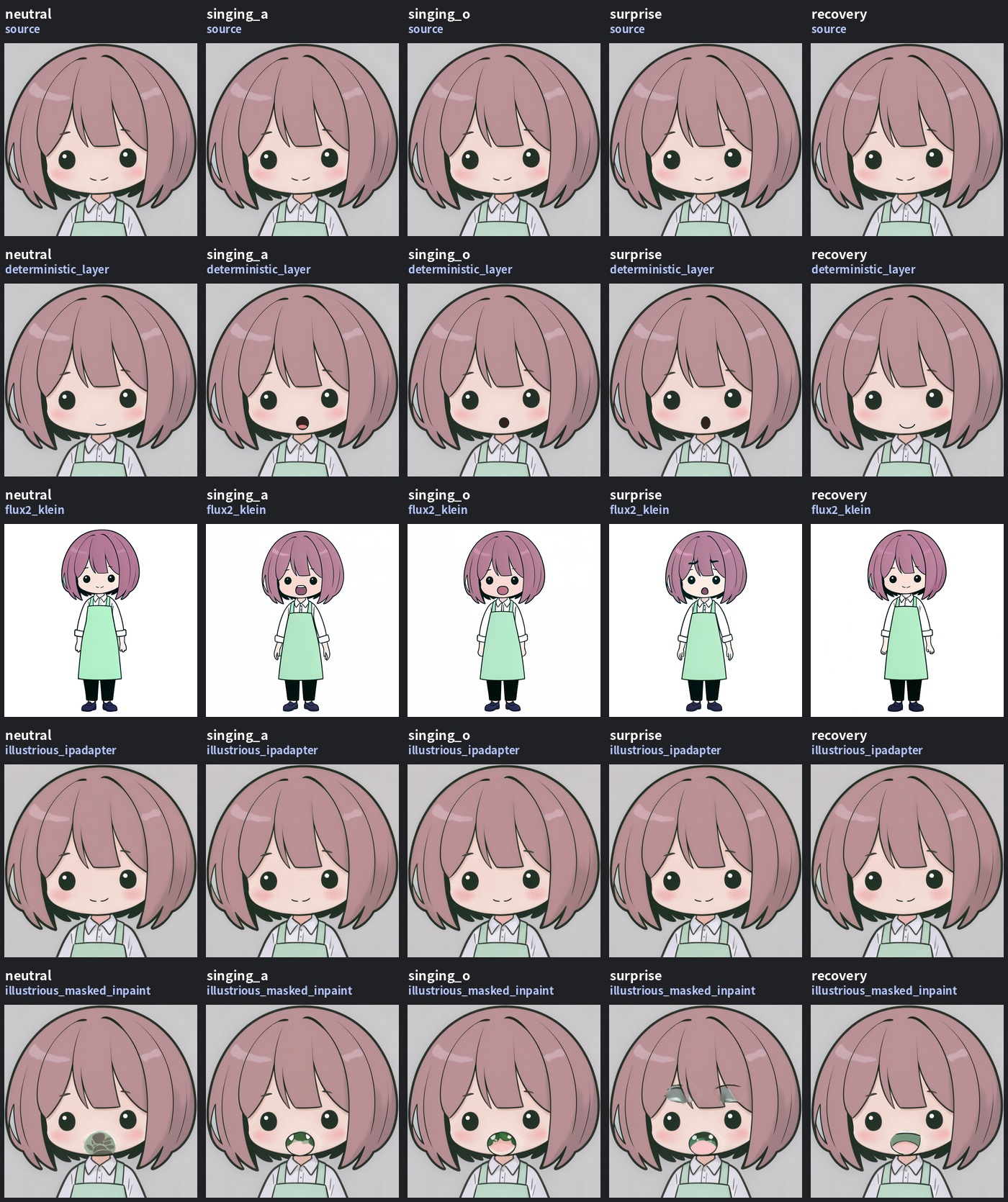
레이어 잠금 5차 · 시간 자연스러움 탈락정지 68.3% · 역재생 팔 복귀 · 갑작스러운 O입·눈썹 오버레이
복합 4차 · 600px · 복잡도 하드게이트 실패표정·동작은 증가했으나 머리색·눈·입·오른손 정체성 붕괴 · 점수 없음
분리형 3차 · 안정성 94.1 · 자격 점수 아님표정 1개·팔 동작 1개로 복잡도 미충족 · 분리 합성 방식만 검증
Wan2.2 TI2V 5B · 결함 통제 2차왼팔 고정 · 오른팔만 제시 · 양눈 유지 · 손가락 변형 억제
Wan2.2 TI2V 5B · 승인 키프레임 1차 · 내부 81.3오른손 지시 중 왼팔 동반 상승·손가락 변형 확인
이전 이력 · Wan2.2 연구 캘리브레이션내부 72.7 · 미승인 회색 패딩 키프레임으로 승격 불가
직접 Wan 7차 · 부드러움 복구, 국소 정체성 복원 검수600px 승인 장면에서 121프레임을 직접 생성했습니다. 정지 비율은 5차 68.3%에서 8.3%로 감소했고, 새로 생긴 눈썹만 국소 복원했습니다. 머리 패치 흔적·손 모양·중립 복귀 누락을 사람이 확인하기 전에는 점수를 계산하지 않습니다.
정체성 유지N/A비중 20
동작·물리N/A비중 20
지시 이행N/A비중 15
얼굴·표정N/A비중 15
다인 상호작용N/A비중 10
카메라·구도N/A비중 10
배경 안정성N/A비중 5
결함 없음N/A비중 5
기준본 고정 · Seedance 2.0 공식 샘플
공식 복합 동작 샘플을 100점으로 고정했습니다. Seedance API는 호출하지 않고 로컬 결과의 비교 기준으로만 사용합니다.
로컬 엔진 설치 · Wan2.2 TI2V 5B
FP16 모델, UMT5 FP8, Wan VAE를 native ComfyUI offloading으로 구성했습니다. 4-step 속도 LoRA는 사용하지 않습니다.
현재 판정
직접 Wan 7차 눈썹 국소 복원 완료 · 시간축 유지 · 사람 검수 전 점수 보류
승격 조건
승인 키프레임 4종에서 장면당 네 후보를 만들고 총점 90 이상, 항목별 80 이상, 하드 실패 0건을 사람 검수로 통과해야 합니다.
본편 생성 잠금 · 대본 동결 완료media_req_c5d01502179c · 62초 · 47개 세그먼트 · 뮤지컬 28.333~55초 · 다음 관문 visual_background_plates
1. Local Korean musical research baseline승인 · 후보 5개 · 최소 90점 + 사람 승인
a reproducible 75-to-90-second one-pass Korean comic song baseline with human-marked pronunciation defects and optional per-job localized repair; this approval freezes the current research method and does not claim Suno parity
2. Local premium clean background plates대기 · 후보 16개 · 최소 90점 + 사람 승인
four approved 768x1344 local HiDream or FLUX.2 clean background candidates for each qualification scene, scoring at least 90 without characters or text
3. Local premium reference-edited character states대기 · 후보 24개 · 최소 90점 + 사람 승인
approved direct HiDream 4MP full-body states scoring at least 90 relative to the user-selected HiDream reference while preserving its premium face finish, identity, and round two-to-three-head comedy proportions
4. Deterministic full-scene composite keyframes대기 · 후보 16개 · 최소 90점 + 사람 승인
four human-approved deterministic composites per qualification scene using only approved background and character layers
5. Active: Seedance-relative local motion suite대기 · 후보 4개 · 최소 90점 + 사람 승인
four independent 4-to-6-second vertical image-to-video shots that score at least 90 against Seedance 2.0 normalized to 100
6. Ten-second audio-video integration scene대기 · 후보 3개 · 최소 90점 + 사람 승인
a final-pipeline ten-second scene using only approved music, voices, character references, motion shots, captions, effects, and mastering
대본 방향 승인
대사·가사·순서·운세 내용은 다시 쓰지 않고 승인 체크섬으로 동결했습니다.
현재 본편 렌더 차단
음악 연구 기준선은 승인됐지만 제작 키프레임, Seedance급 모션, 10초 통합 시험이 남아 본편은 아직 생성하지 않습니다.
다음 실행
4종 전체 장면 키프레임을 장면당 네 후보로 만들고 캐릭터 정체성, 표정, 구도, 배경 완성도를 먼저 승인합니다.
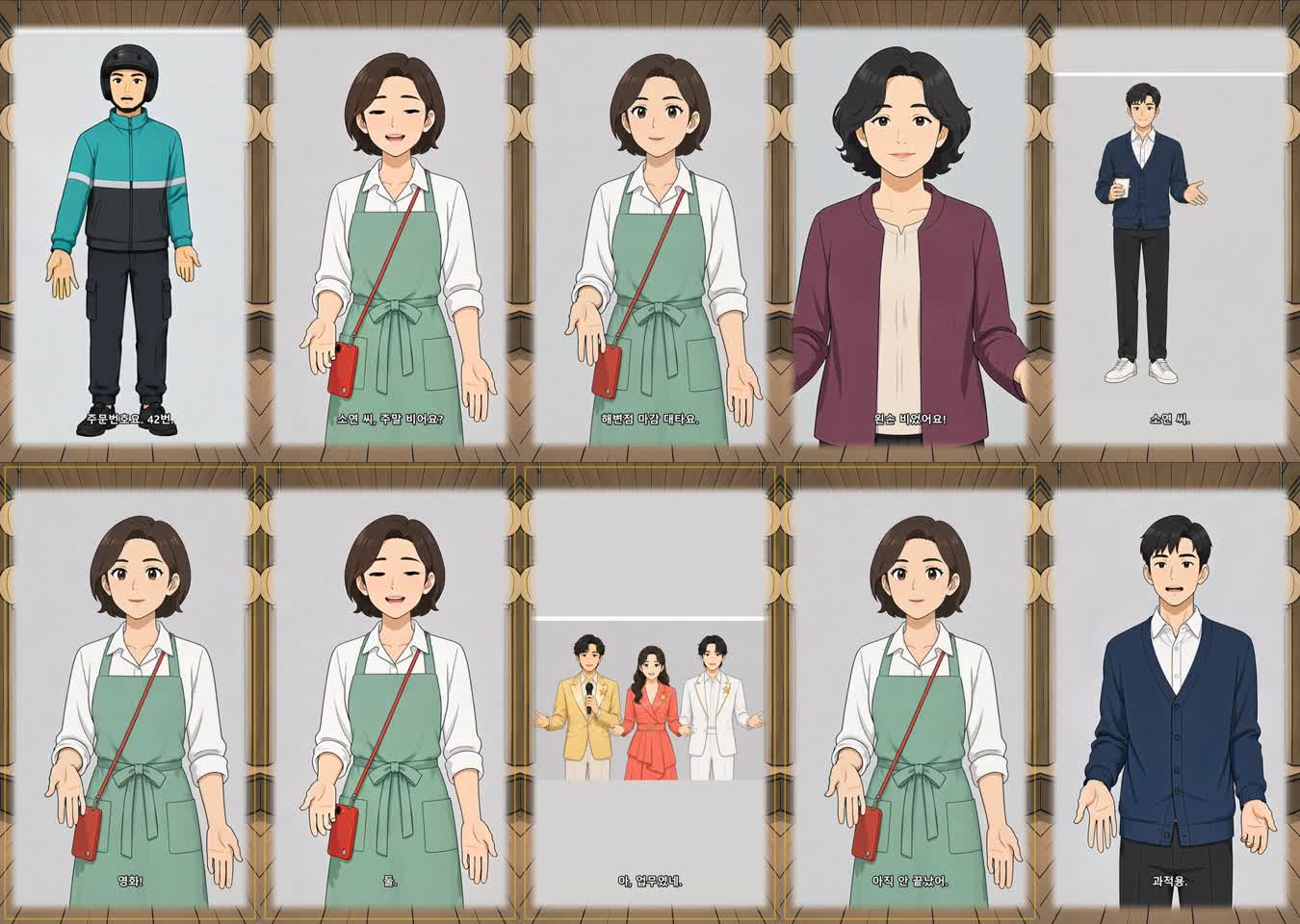
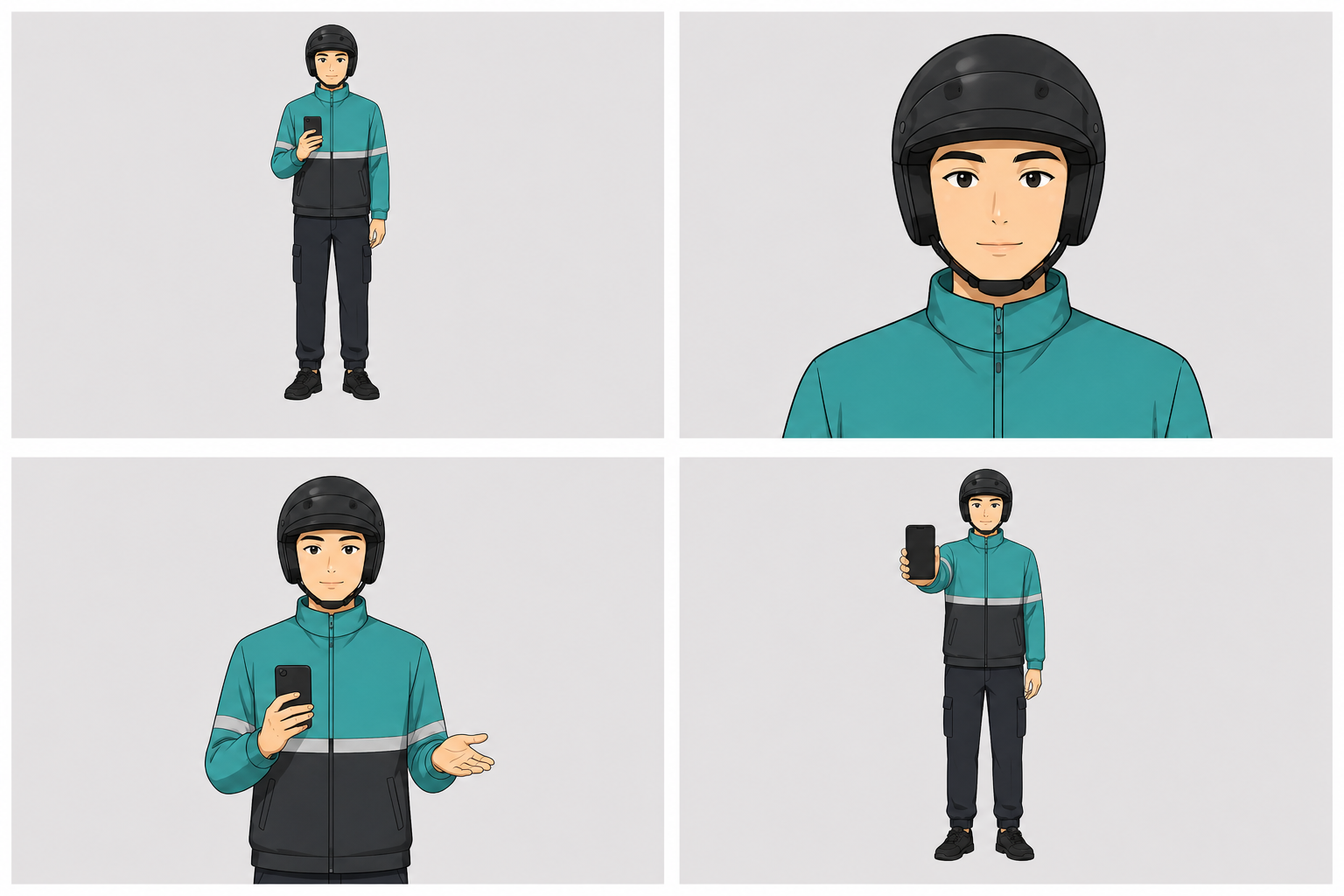
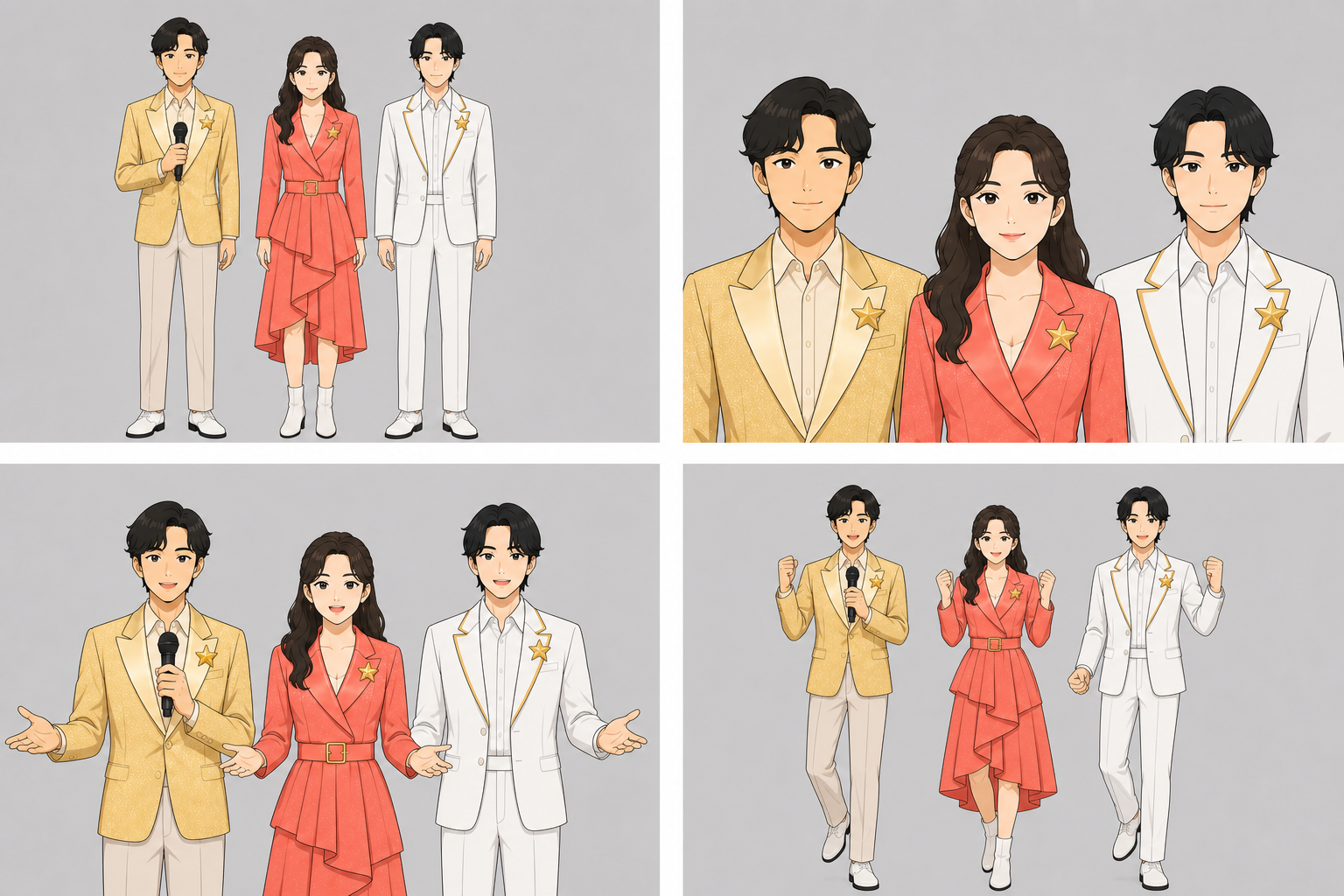
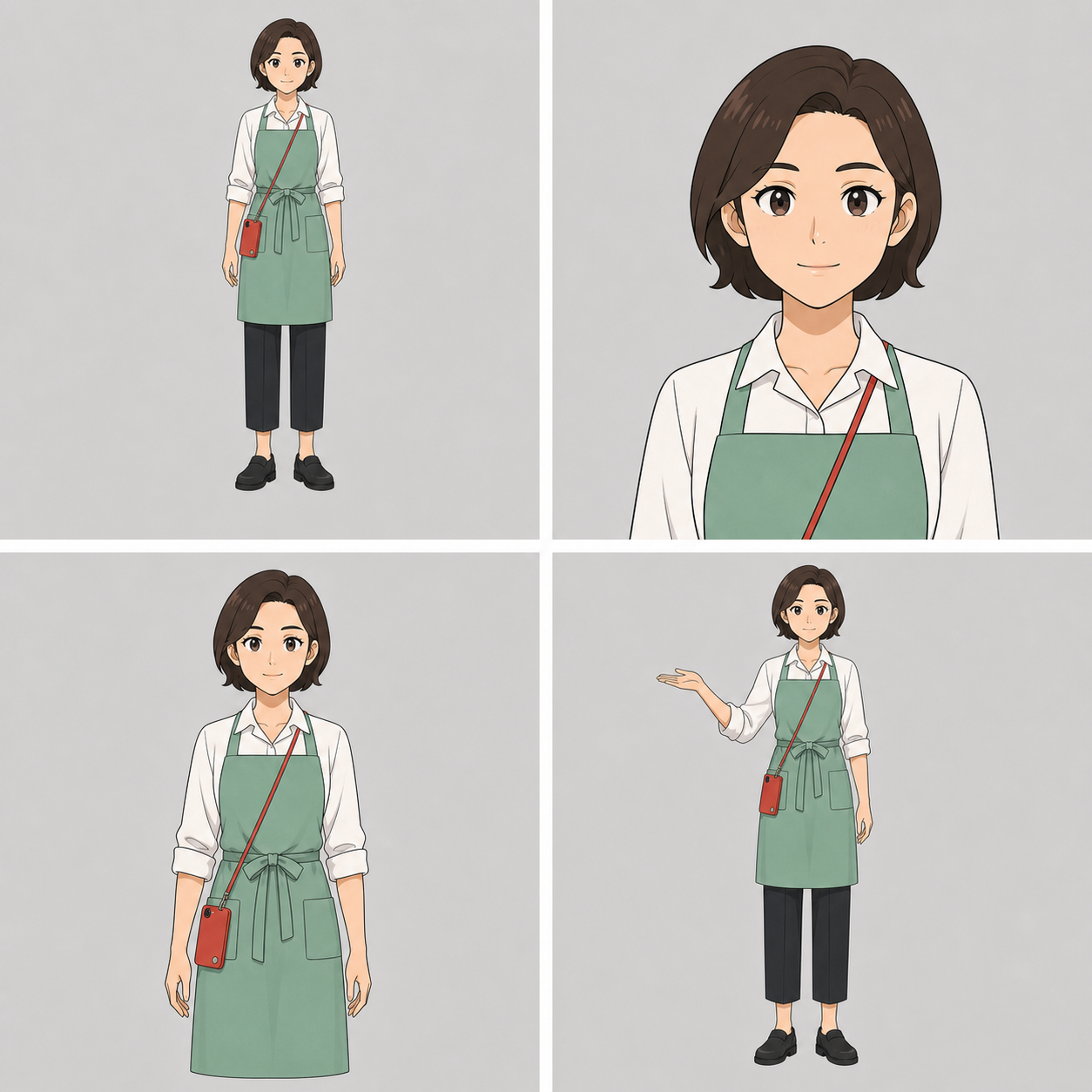
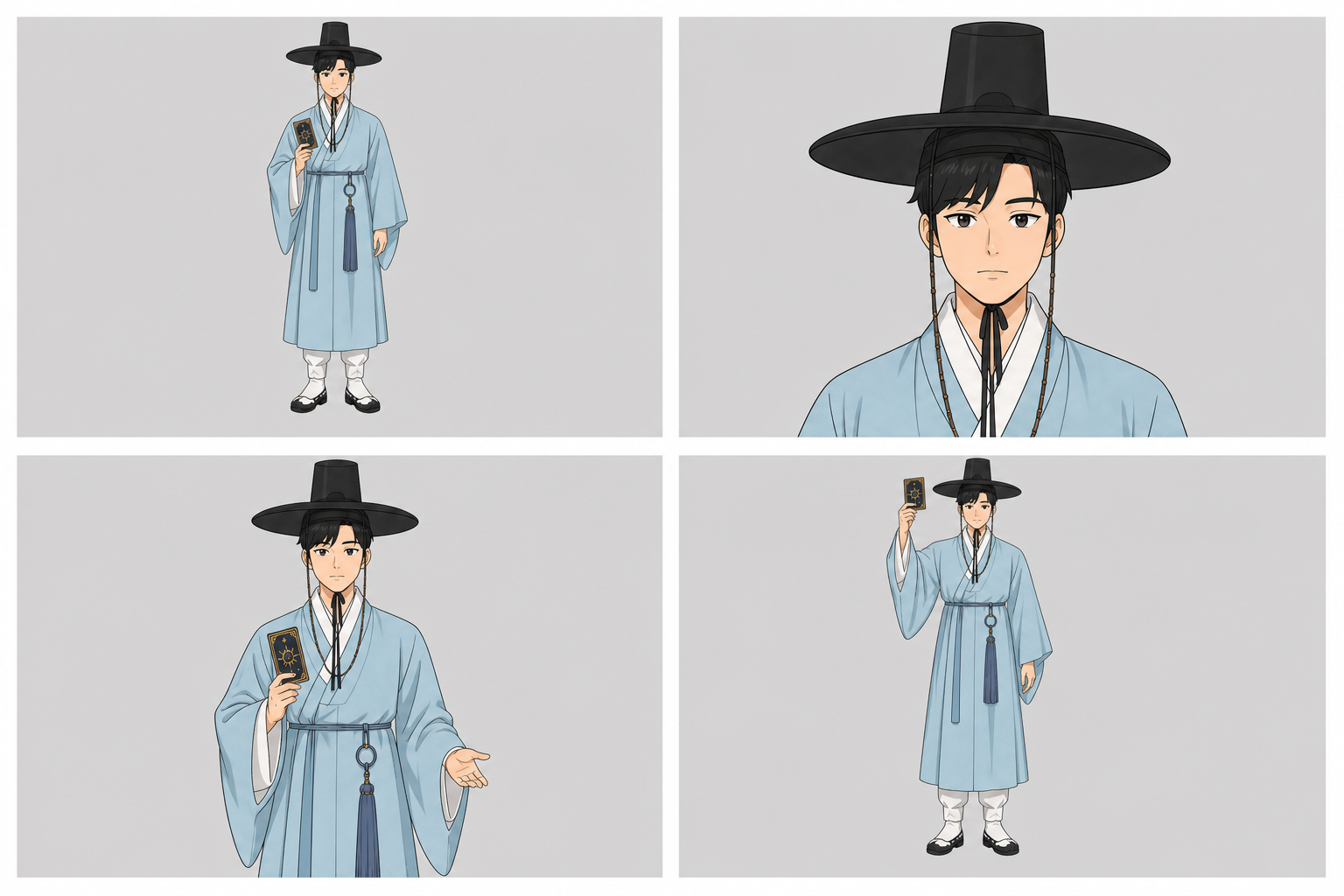
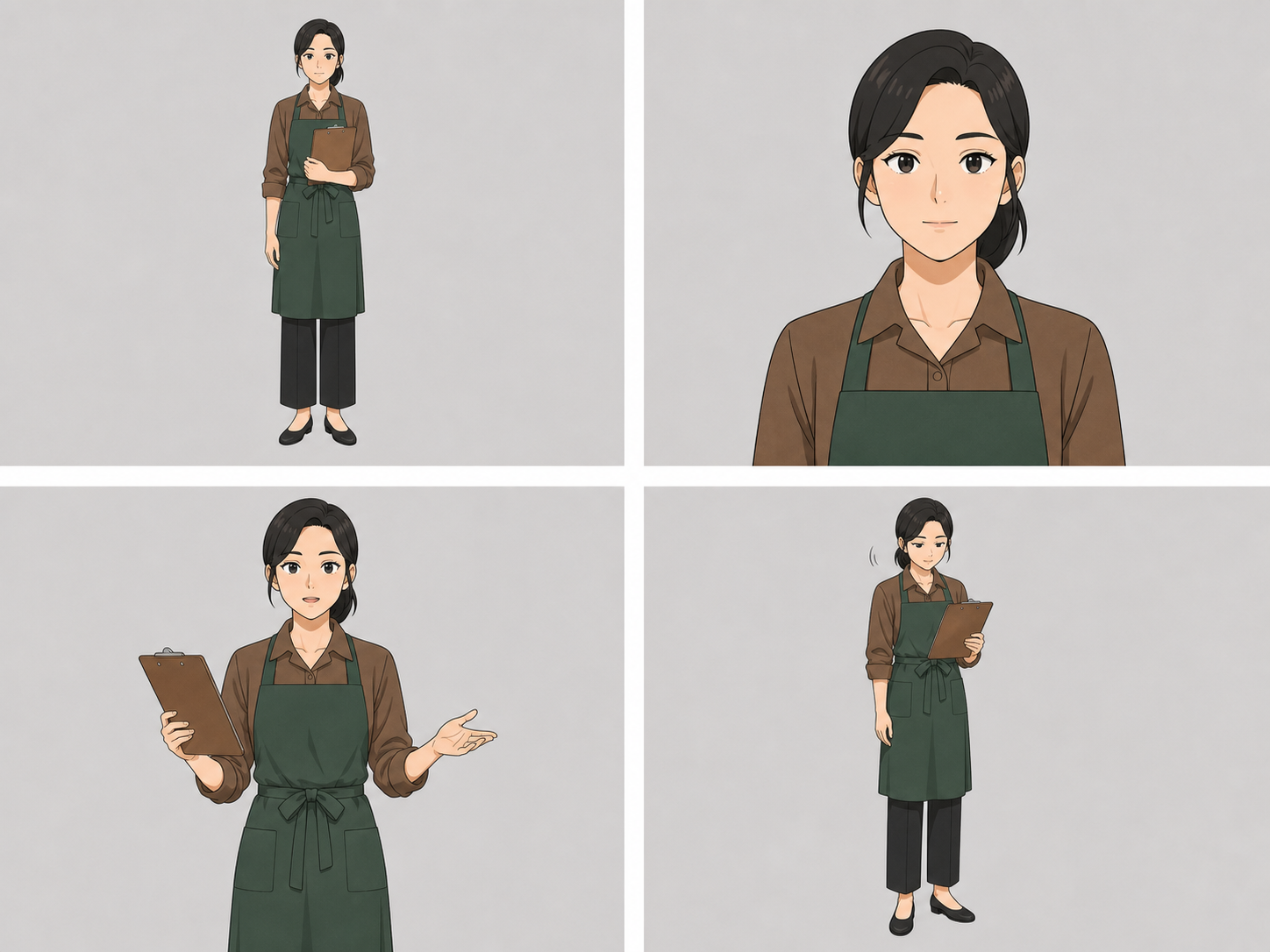
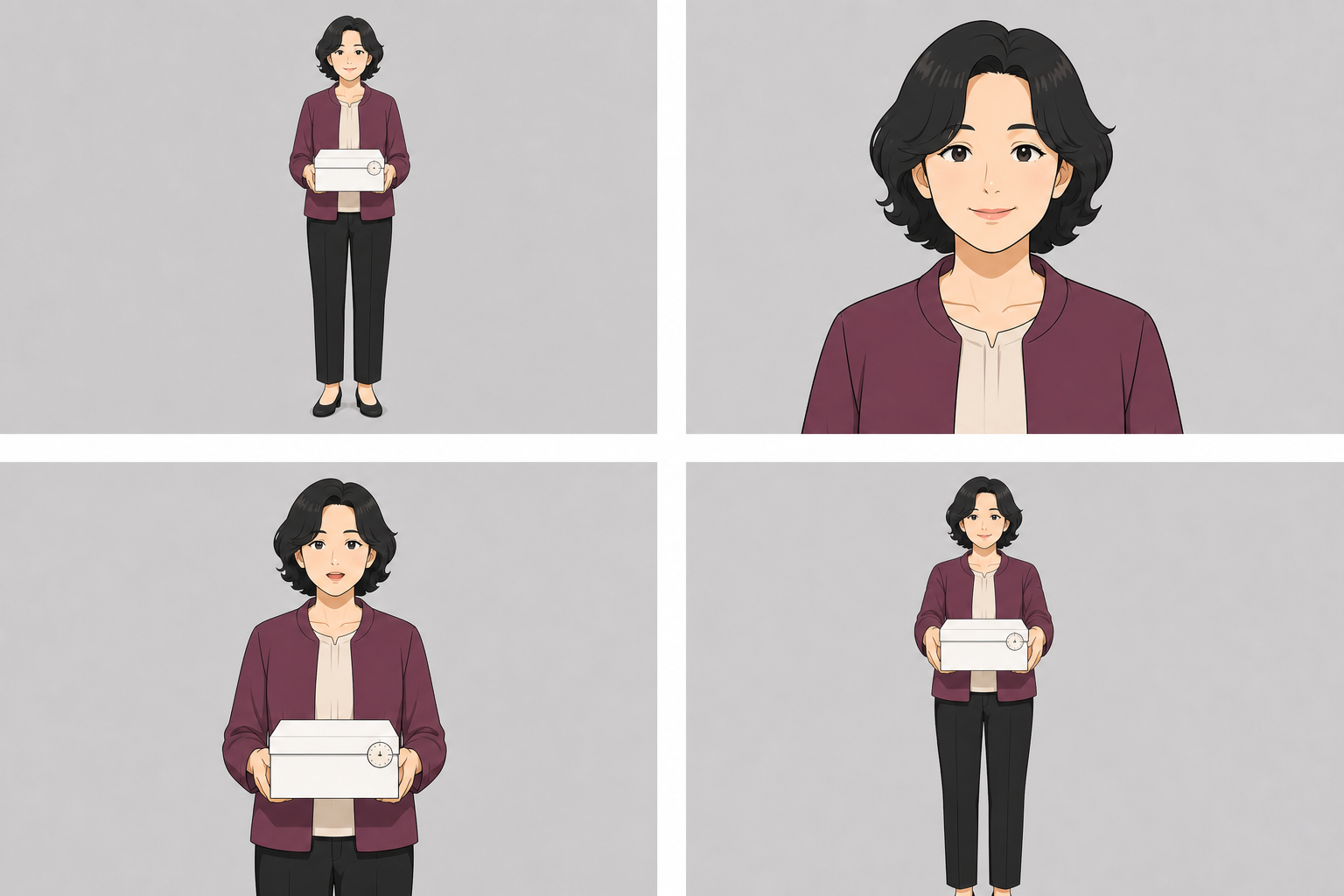
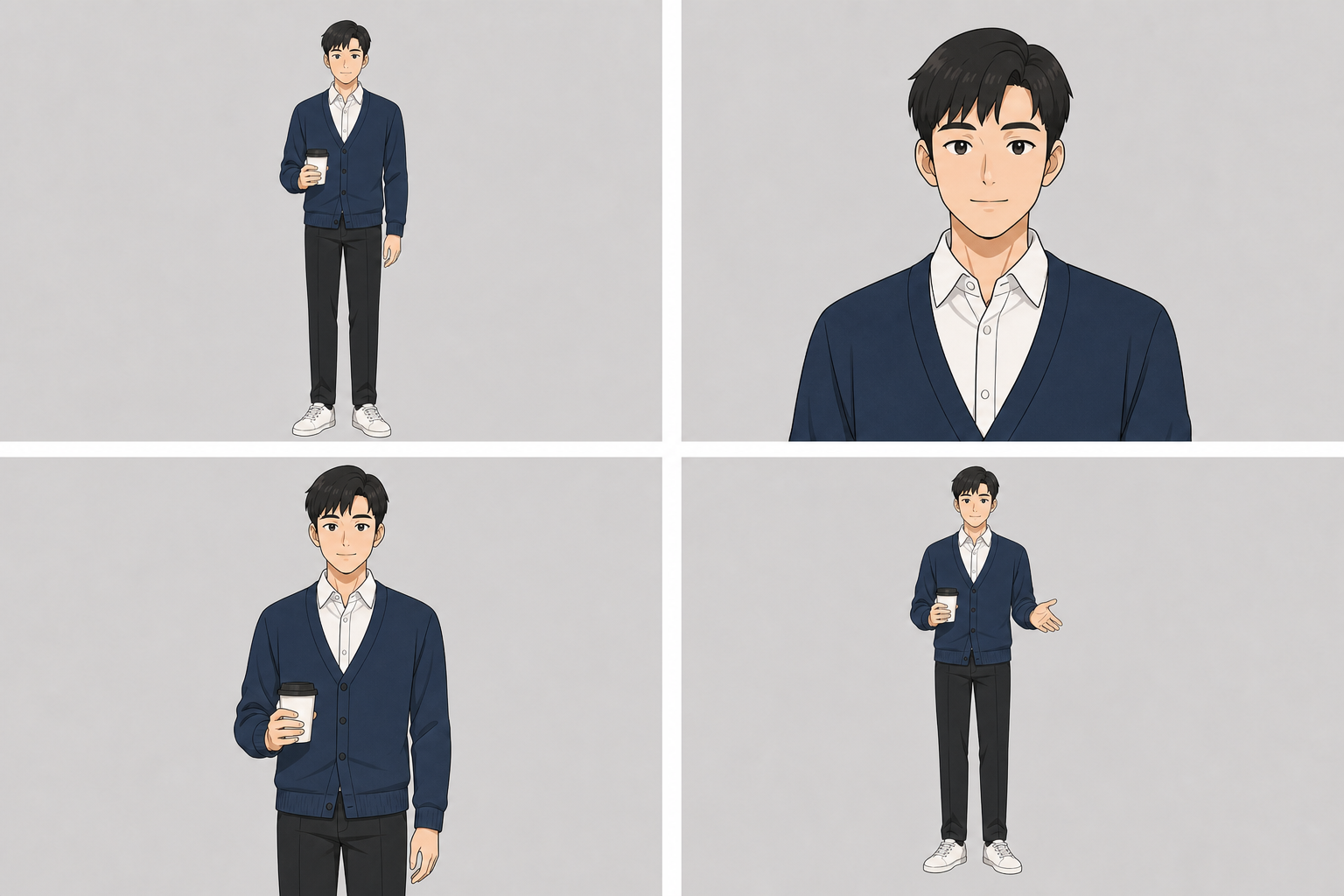
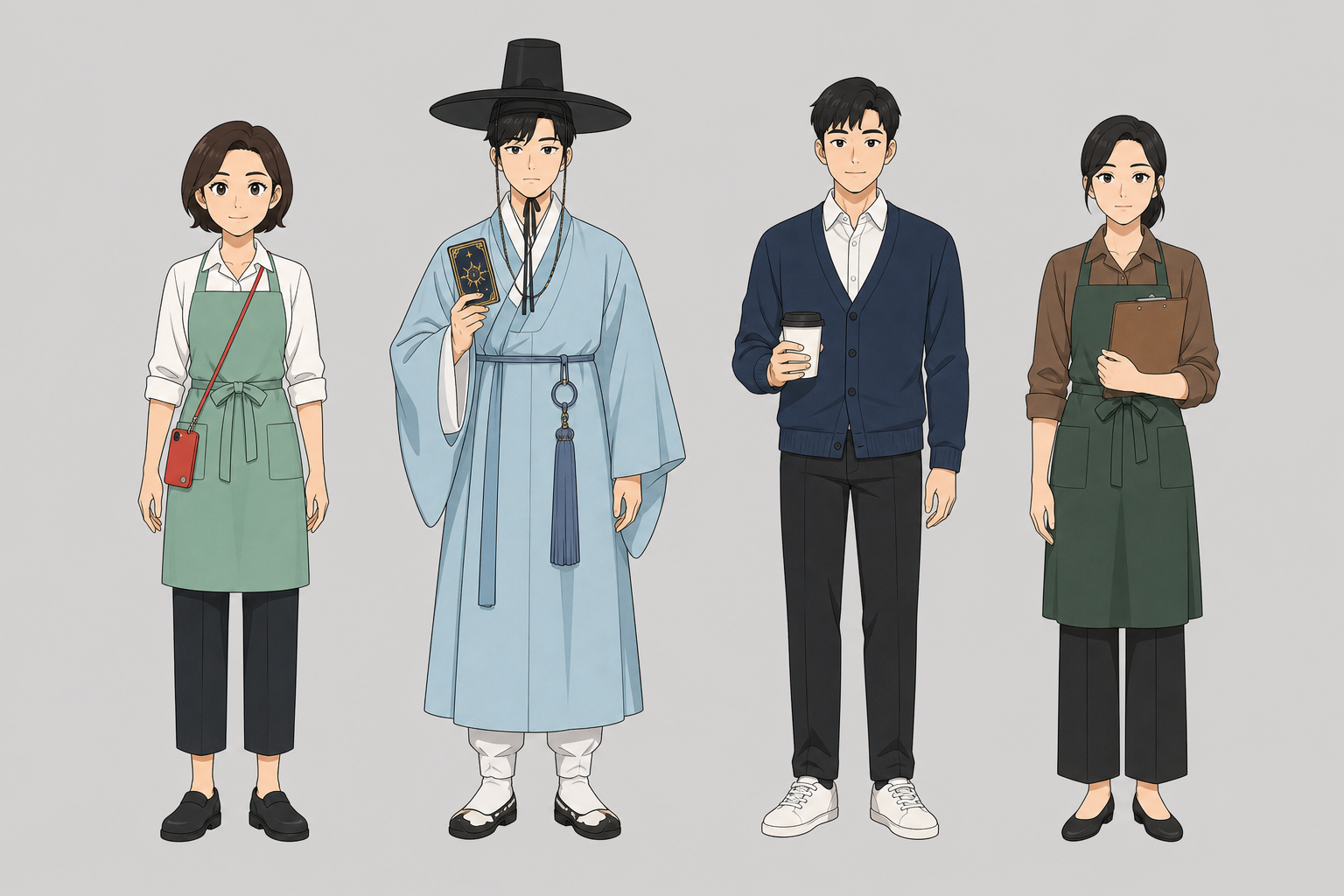
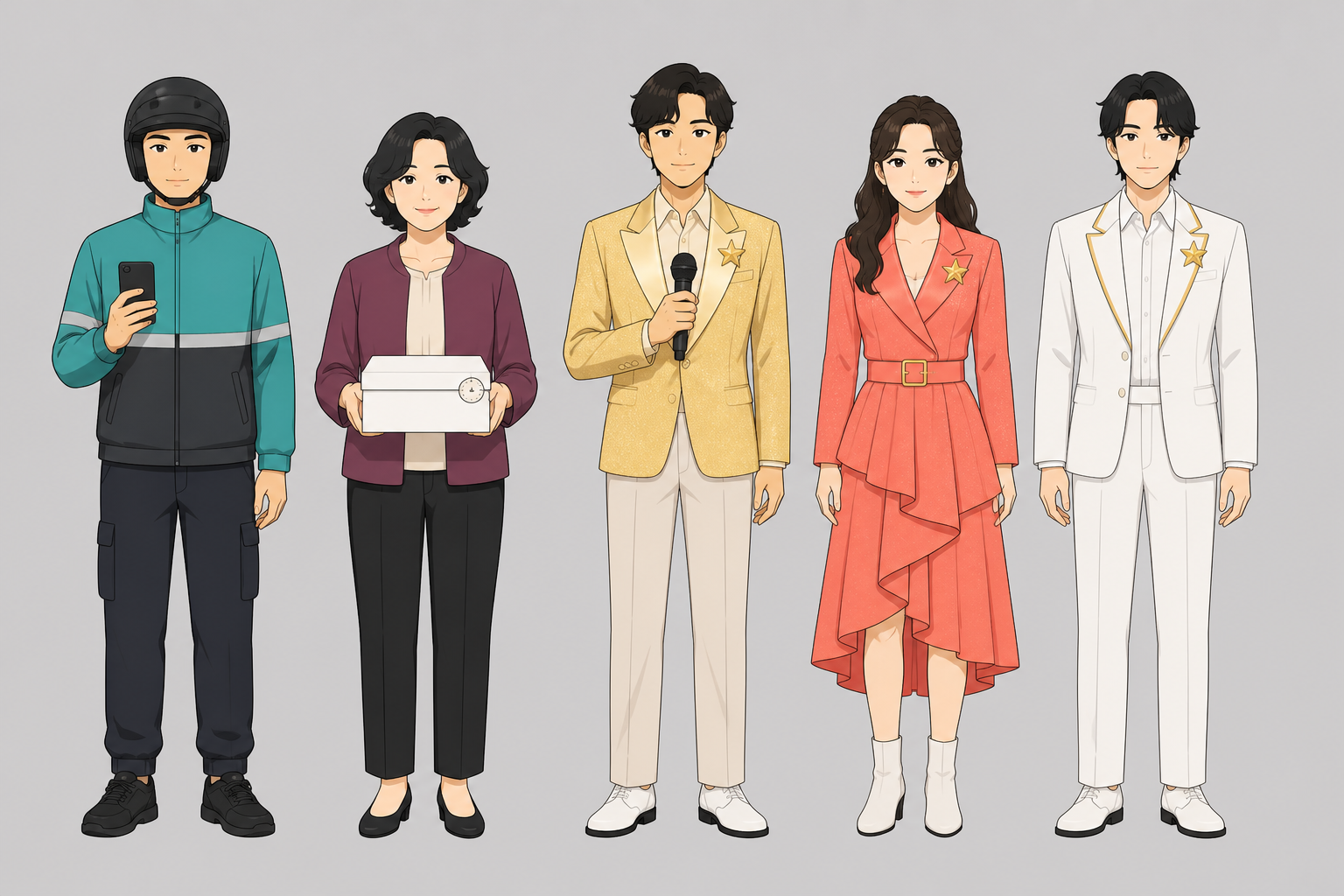

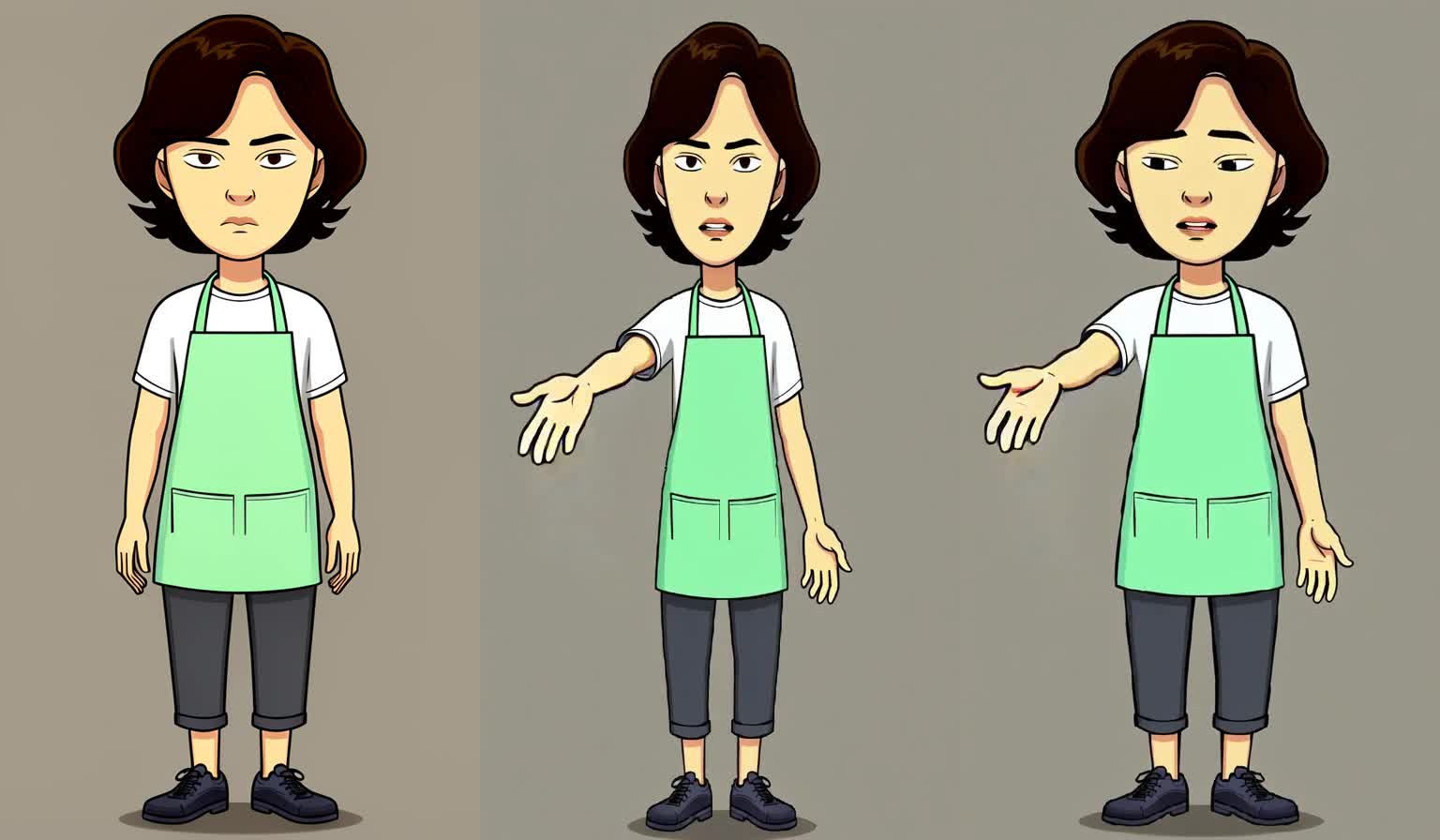
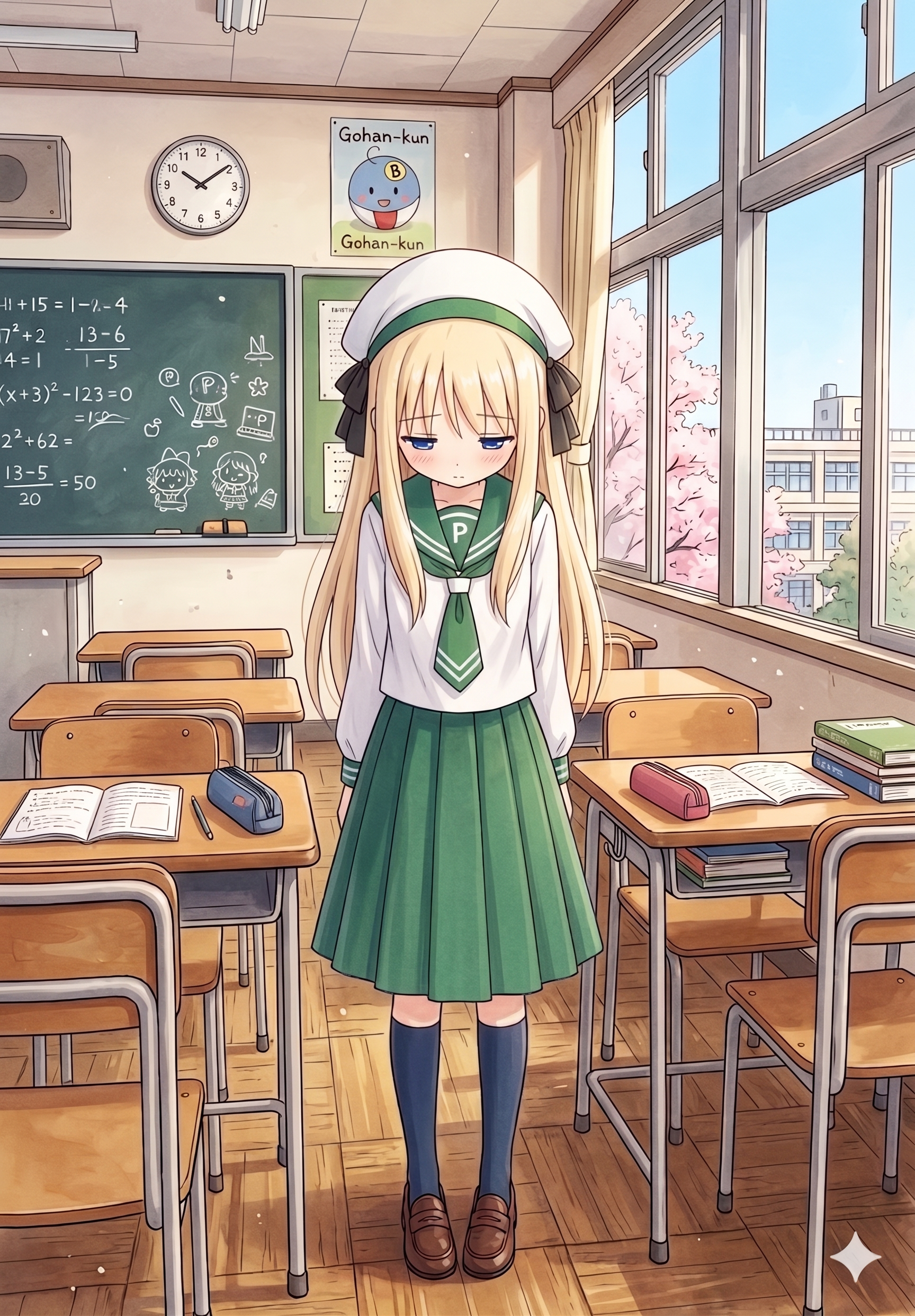
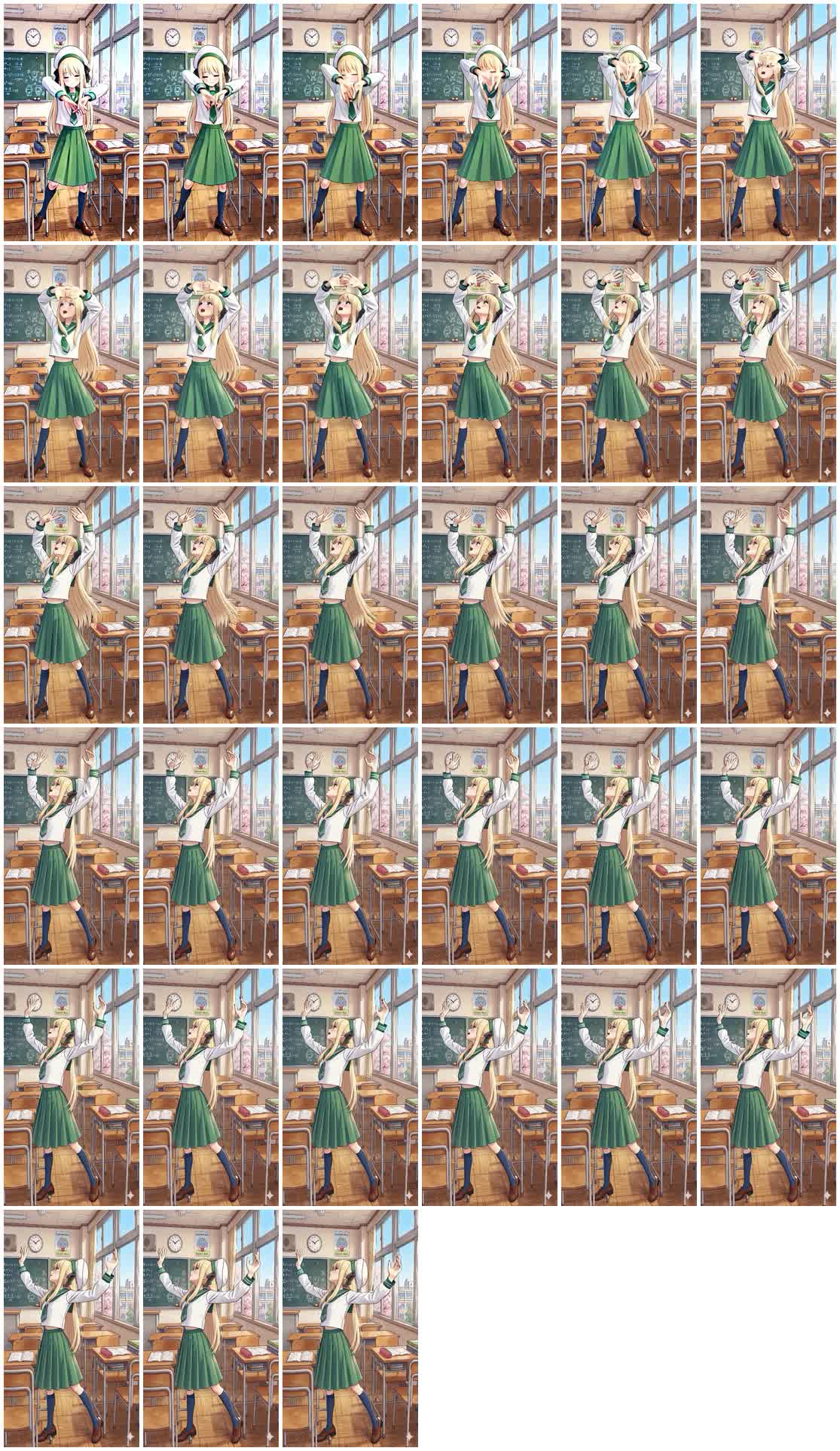
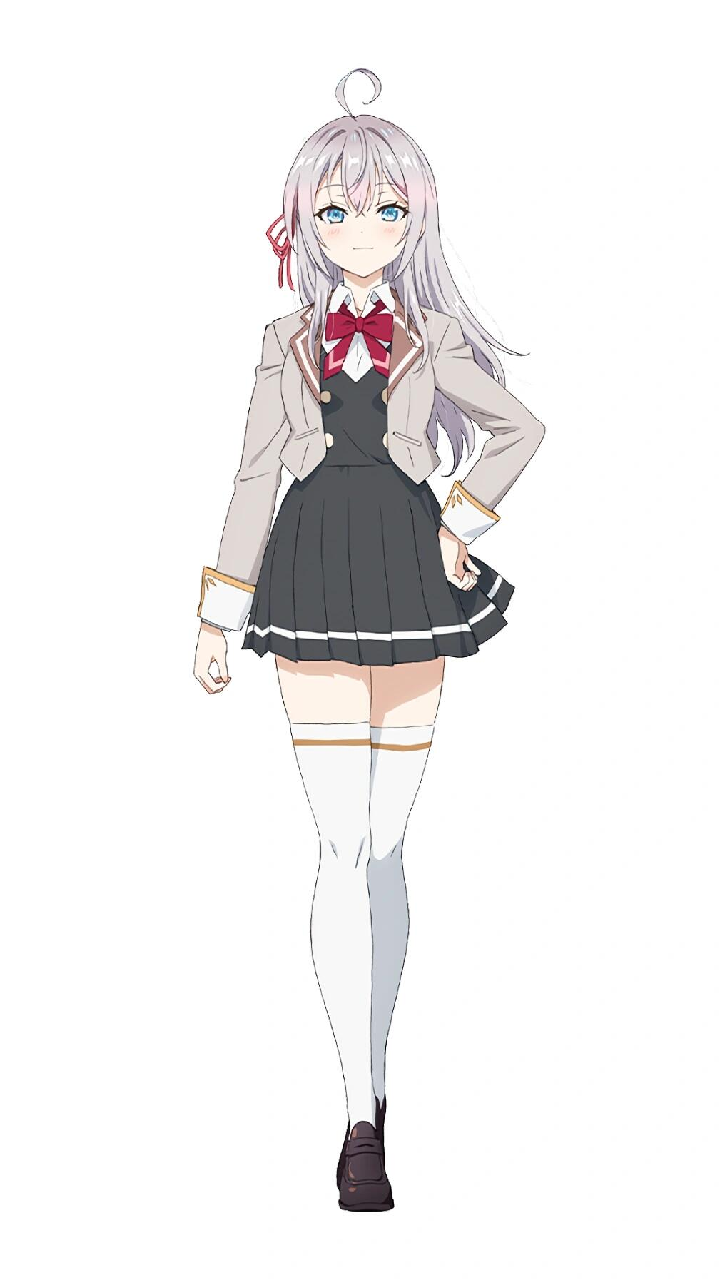











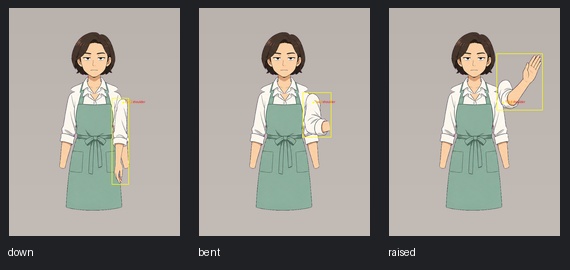

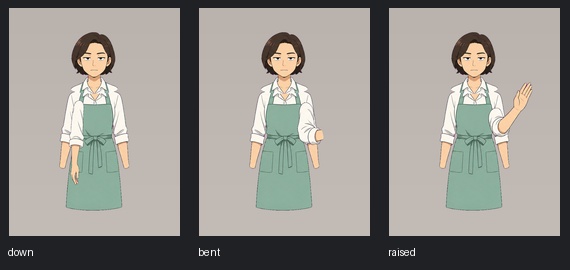



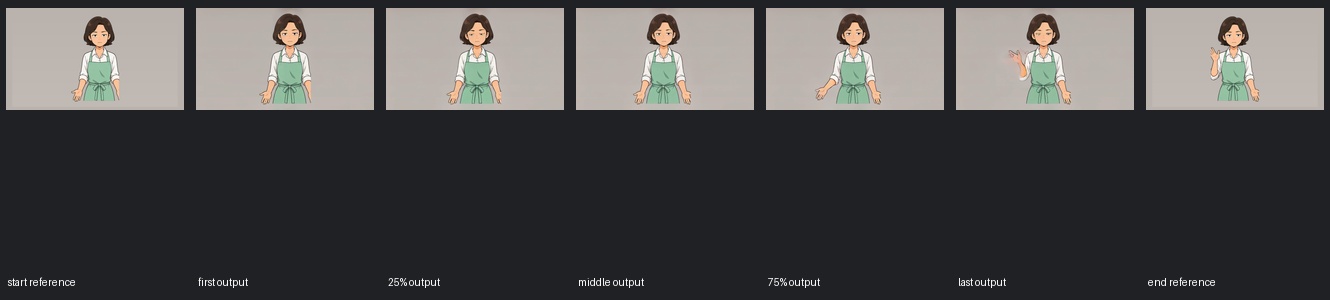

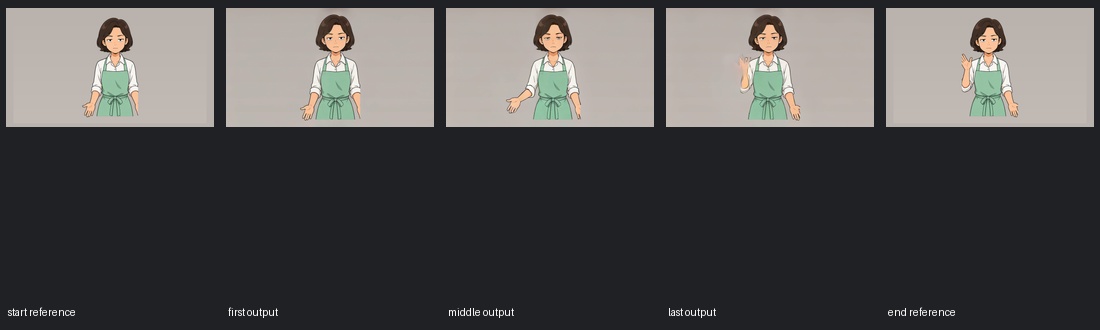
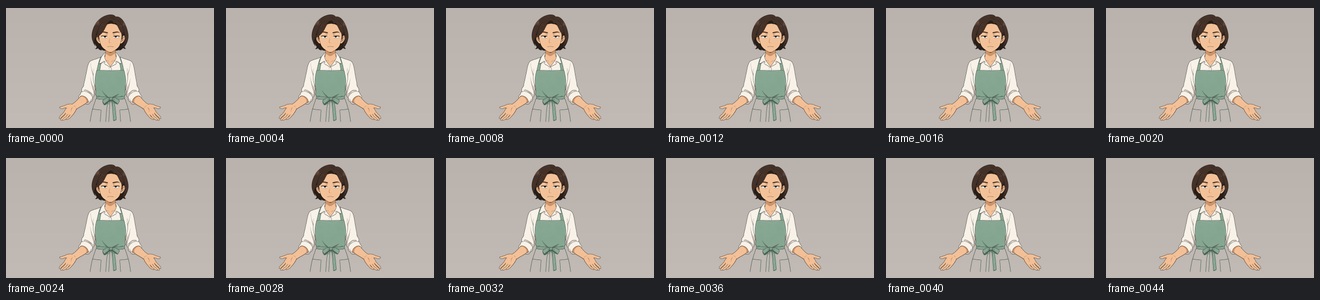
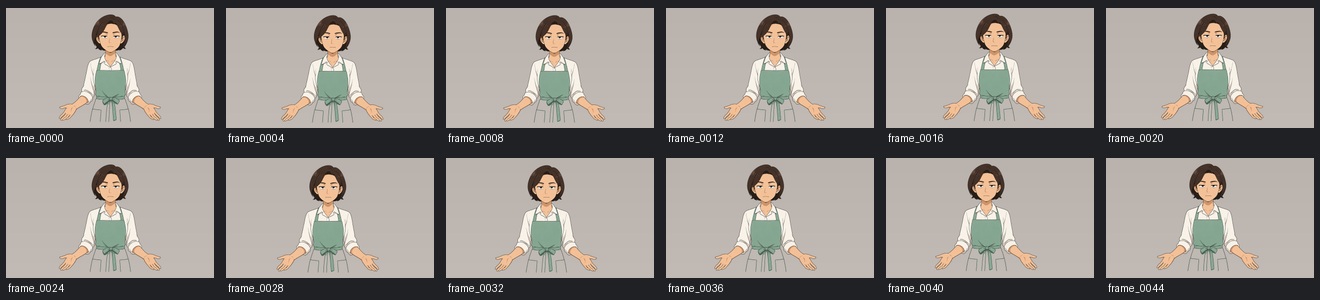
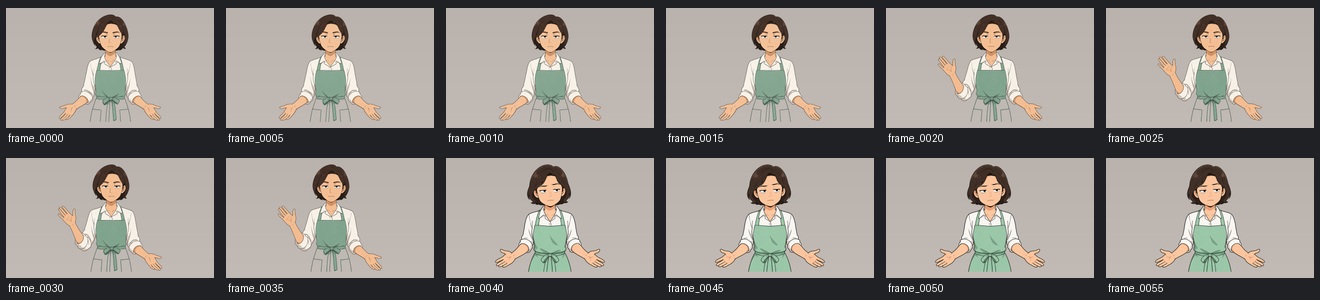
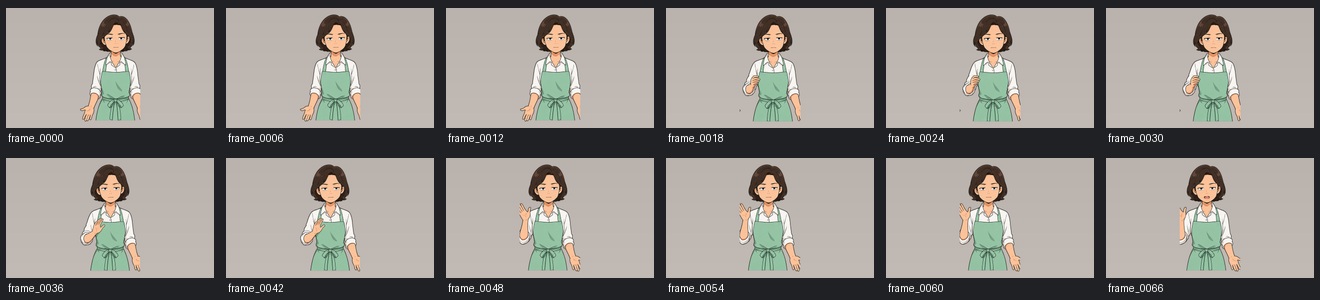
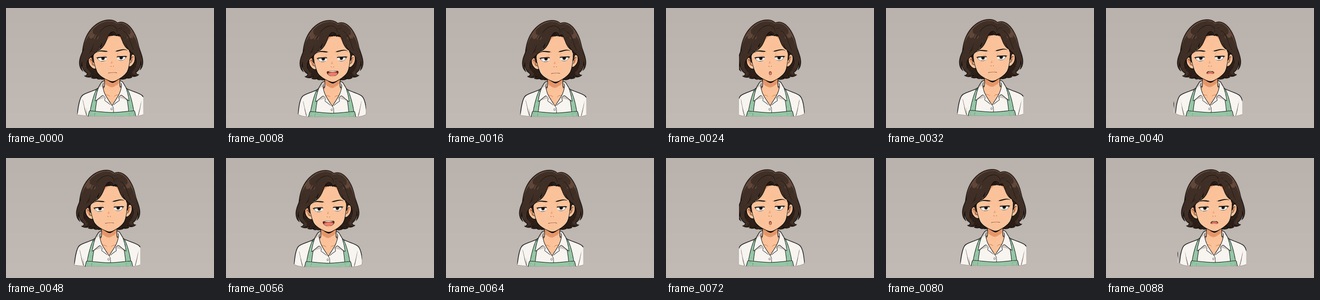

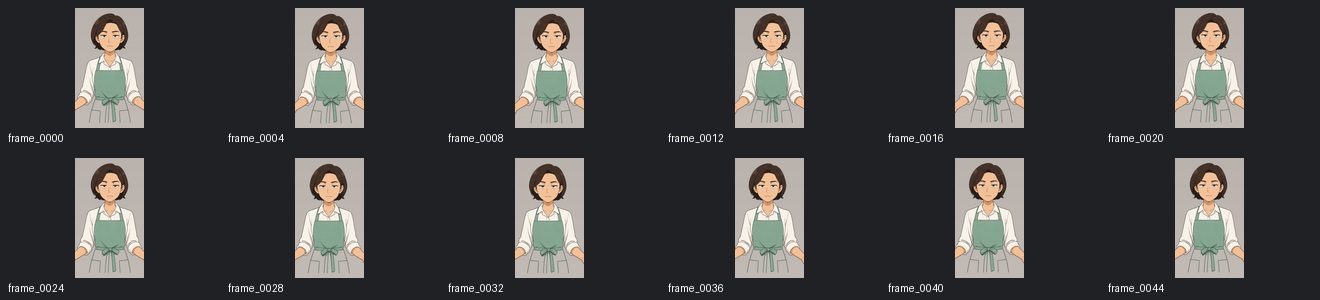
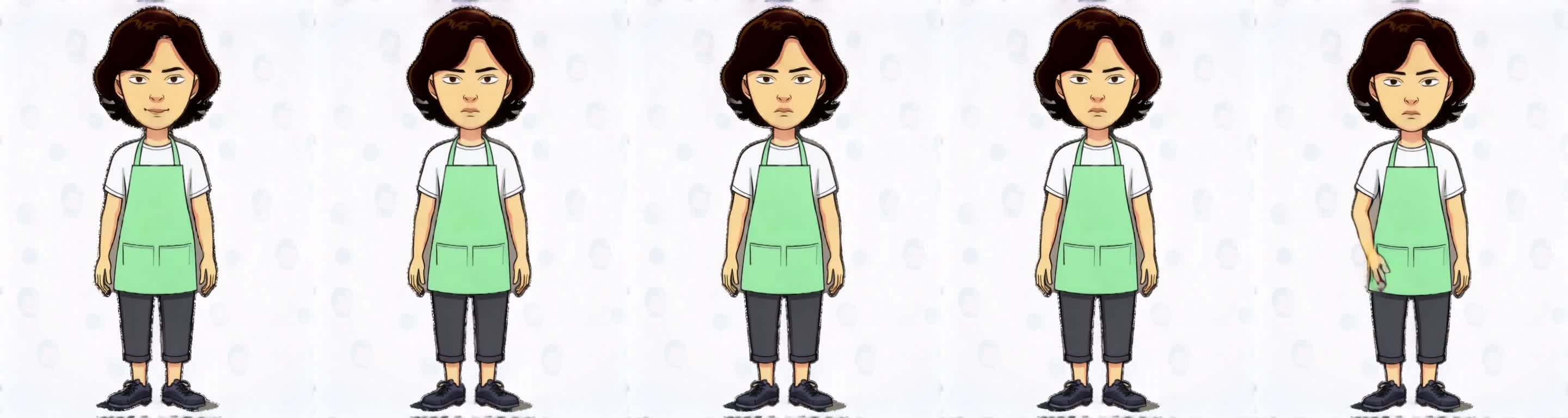
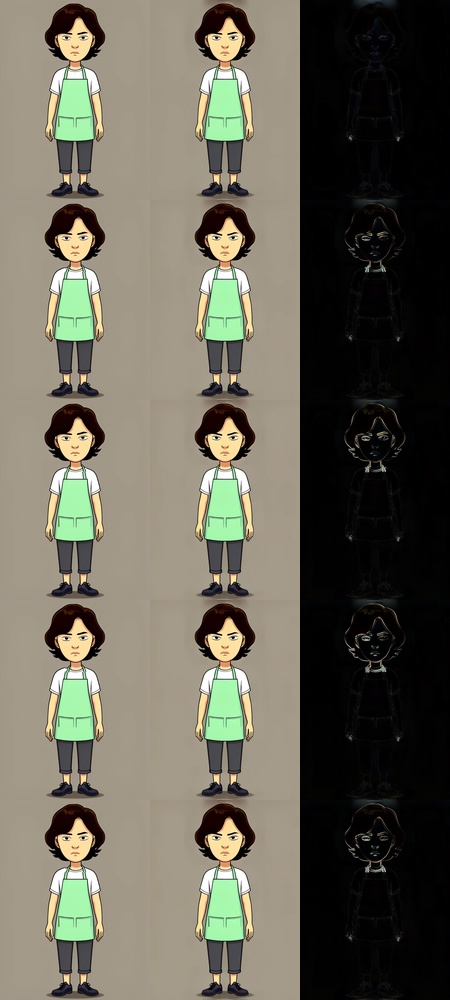
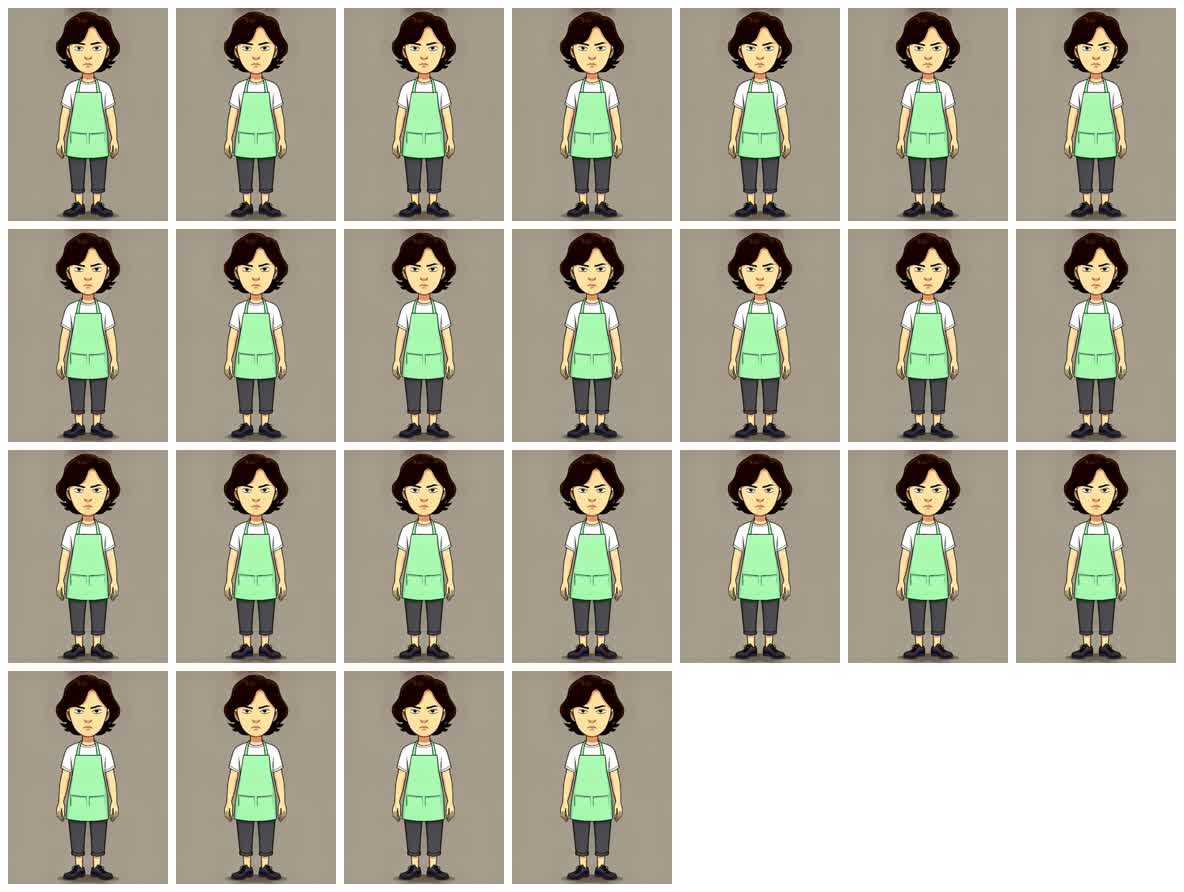
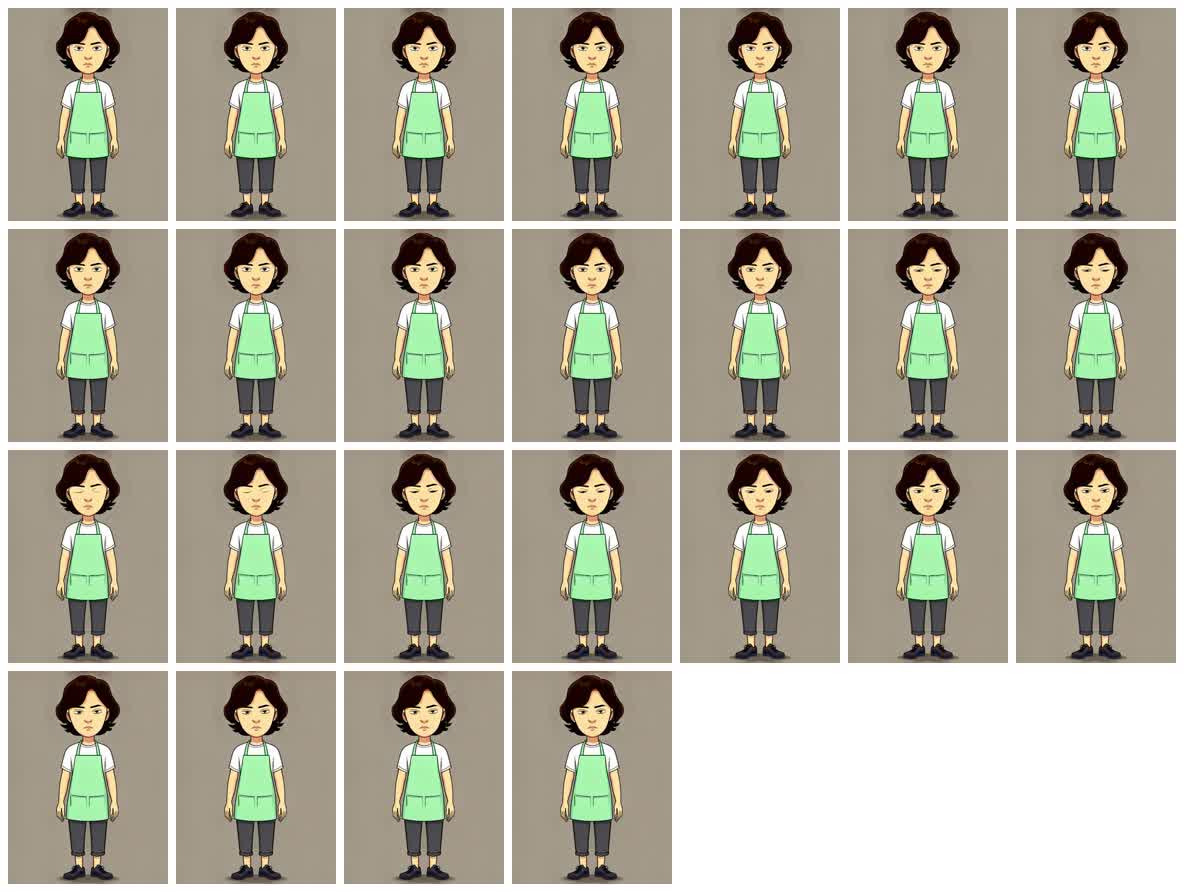
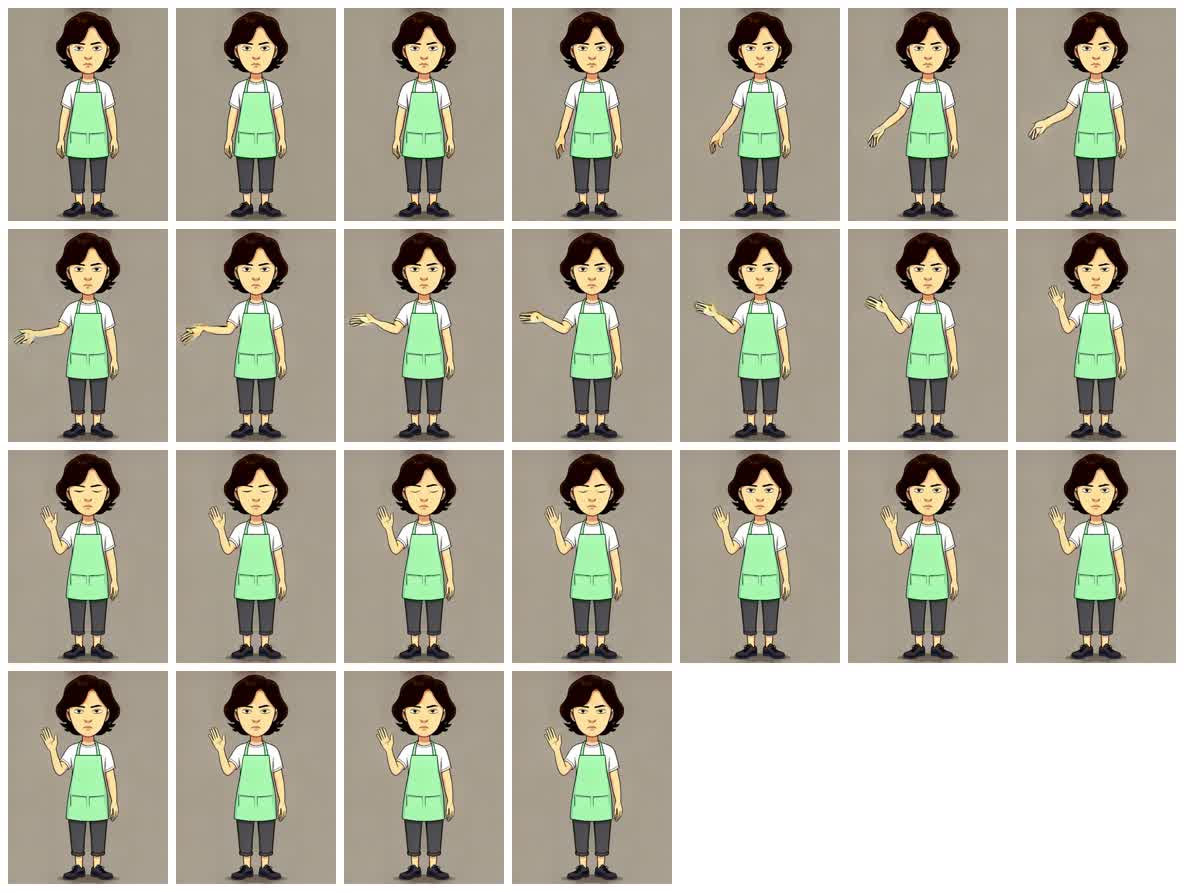
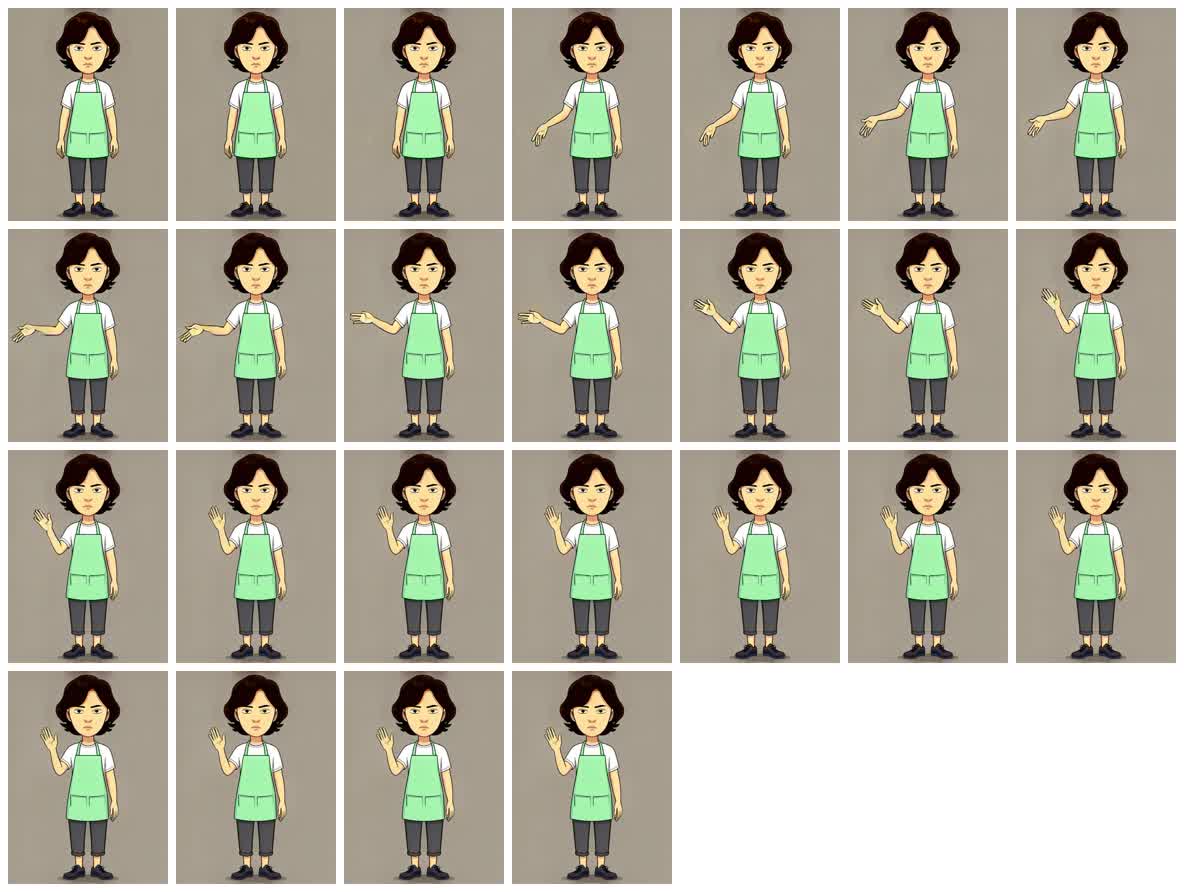


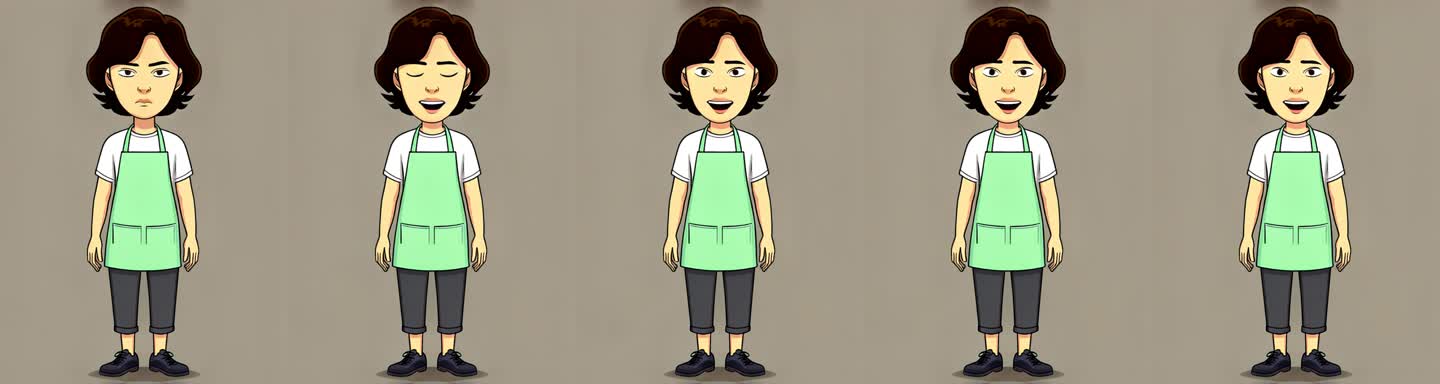

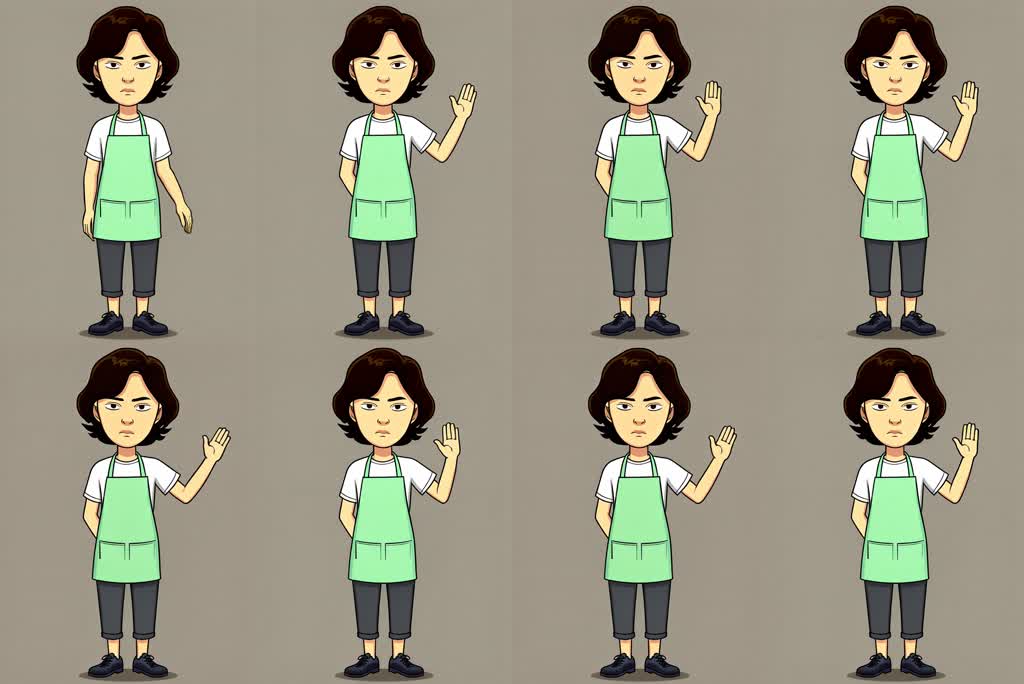


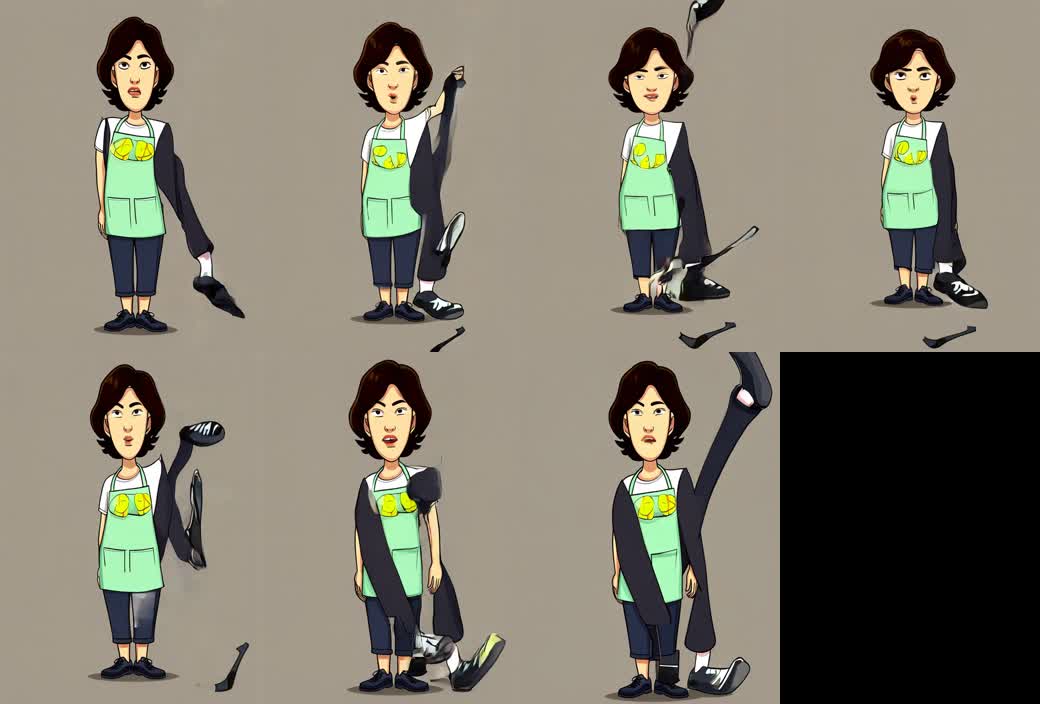
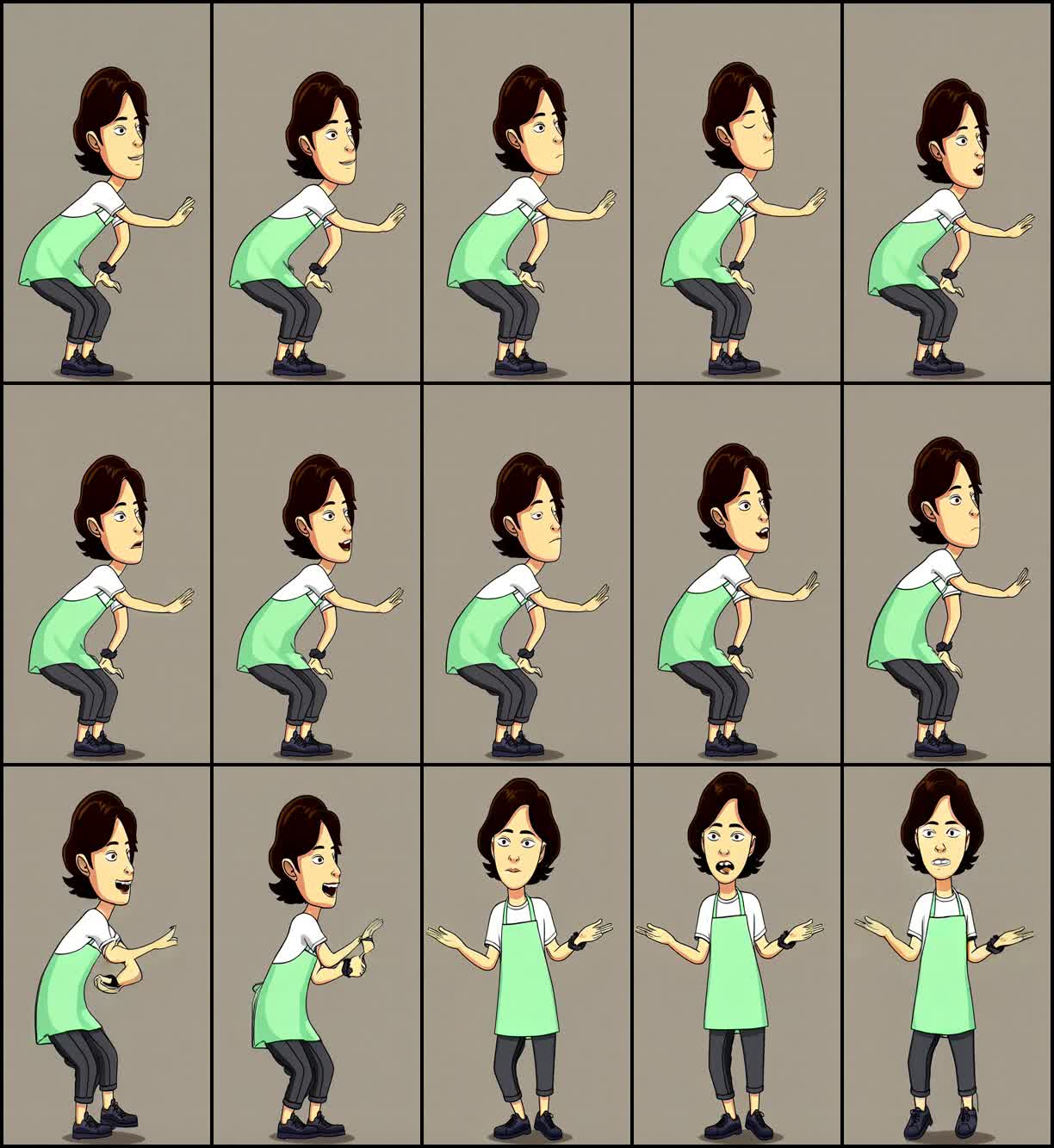
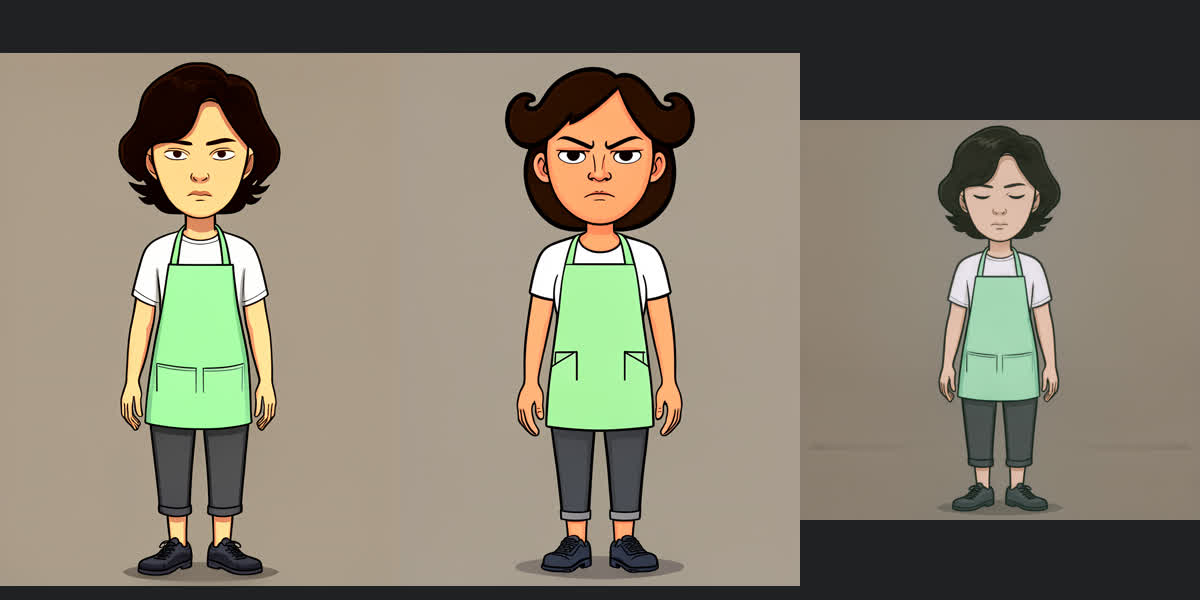
 D-01 · 영상 시험 리젝
 D-04 · 방향 이탈 리젝
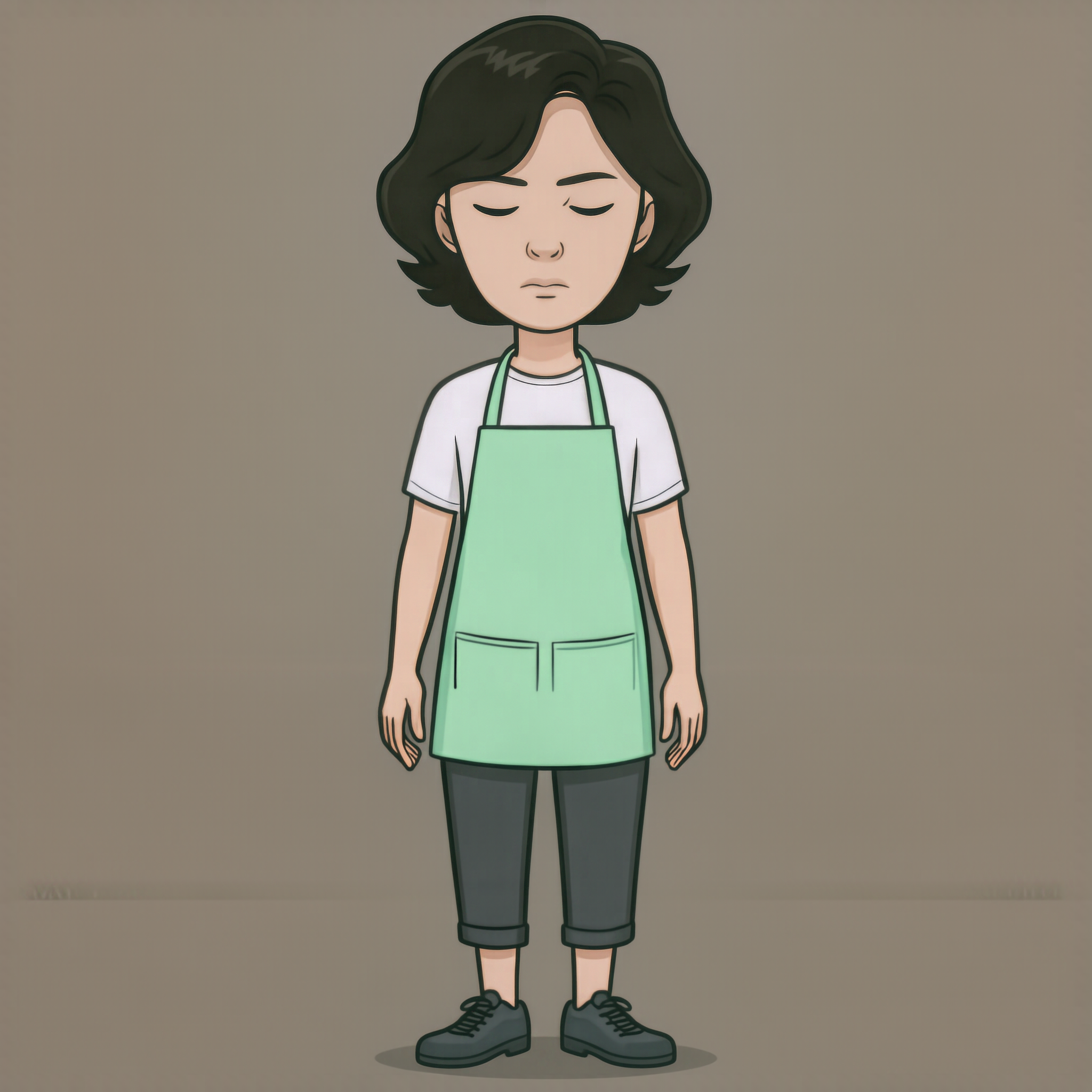 D-05 · 참조 보존 실패